
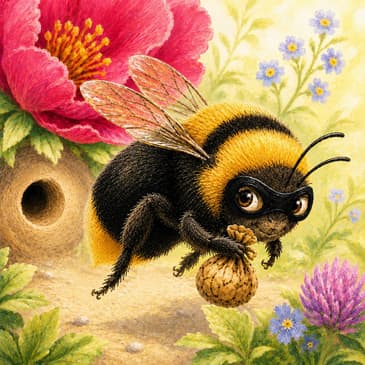
For 40 million years, a small group of bees has been pulling off one of the most elegant heists in the insect world. They build no nests. They raise no workers. They never collect a single grain of pollen. Instead, they walk into the colonies of other bumblebee species and quietly take them over. They are the cuckoo bumblebees — and in this episode of Secret Pollinators, we meet all six species living across the United States.
From the Suckley cuckoo bumblebee (Bombus suckleyi) of the Mountain West to the lemon cuckoo bumblebee (Bombus citrinus) of the eastern deciduous forests, this episode tours every cuckoo bumblebee in North America: Bombus suckleyi, Bombus insularis, Bombus flavidus, Bombus bohemicus, Bombus citrinus, and the vanishing Bombus variabilis.
We explore the chemistry of infiltration — how cuticular hydrocarbons let a cuckoo bumblebee queen smell her way into a host colony undetected. We unpack the violent takeover: the queen-on-queen combat, the reinforced exoskeletons and oversized stingers, and the pheromonal reproductive suppression that follows. And we end with the story of the variable cuckoo bumblebee, a southern species that may already be functionally extinct across much of its former American range — a ghost that lived by erasing other bees, and has now been erased itself.
A wonder-first science podcast about native bees, wild bees, bumblebees, and lesser-known pollinators.
KEY SOURCES & DOIs
(Verify all DOIs and current citations before publication — these are starting points, not final.)
Cuckoo bumblebee biology, evolution, and ecology
- Lhomme, P. & Hines, H. M. (2019). Ecology and evolution of cuckoo bumble bees. Annals of the Entomological Society of America, 112(3), 122–140. — the recent definitive review of the group; cite heavily for chemistry, weapons, and host-suppression material.
Cuticular hydrocarbon mimicry in social parasites
- Foundational work by Lockey on cuticular hydrocarbons; more recent work by Dronnet, Lhomme, and colleagues on cuckoo-specific chemical mimicry. (Search: "cuticular hydrocarbons Psithyrus" or "cuckoo bumblebee chemical mimicry.")
North American bumblebee decline (including B. variabilis and host species)
- Cameron, S. A., Lozier, J. D., Strange, J. P., Koch, J. B., Cordes, N., Solter, L. F., & Griswold, T. L. (2011). Patterns of widespread decline in North American bumble bees. PNAS, 108(2), 662–667.
- Follow-up work by Cameron and colleagues on B. pensylvanicus and associated cuckoo species.
Conservation status of individual species
- IUCN Red List entries for Bombus suckleyi, Bombus bohemicus, Bombus variabilis.
- COSEWIC reports (Canadian) for B. bohemicus and B. suckleyi.
#CuckooBumblebee #CuckooBee #BeeHeist #BeeTheft #SecretPollinators #NativeBees #WildBees #Bumblebees #Bombus #ParasiticBees #BroodParasite #BombusSuckleyi #BombusCitrinus #BombusVariabilis #AmericanBumblebee #BeeScience #PollinatorPodcast #InsectScience #NatureScience #BeeFacts #PollinatorConservation #SocialParasite #CuticularHydrocarbons #BeeBiology #SciencePodcast #IndiePodcast #Bees
About Secret Pollinators
A wonder-first science podcast about native bees, bumblebees, wild bees, and the lesser-known pollinators most of us walk right past every day.
Visit secretpollinators.com
[00:00:03] Welcome back to Secret Pollinators. I'm your host, Kelly Parks, and today the show is about the bumblebees you've never heard of. The ones humming under your feet, hiding in your hedgerows, and in today's case, quietly committing one of the most elegant heists in the entire insect world. Today's episode is about cuckoo bumblebees. They're the pollinators that don't pollinate.
[00:00:29] There's six species in six regions of the United States. And a chemistry of infiltration that reads more like a spy novel than a nature documentary, so let's dive in. The Pollinator That Doesn't Pollinate If you've been listening for a while, you know that I love a bee that breaks the rules. And I also love bumblebees.
[00:00:56] The mason bee that builds with mud, the bumblebee that builds with body heat, and the bee that nests in hollow grass stems. Well, cuckoo bumblebees break a different rule. They break the rule that says a bee is a creature of work. Because a cuckoo bumblebee queen does not build her own nest, she does not gather pollen, and she doesn't raise her own first generation of workers.
[00:01:24] In fact, she doesn't have any workers at all. Cuckoo skipped the entire worker cast. Just queens, just males, reproduction only. So what does she actually do? Well, here's the interesting part. She finds an established colony of another bumblebee species. A colony that's been doing all the right
[00:01:50] things like building wax cells and raising a brood, foraging from dawn to dusk. And then she just walks right in. Sometimes she'll fight the resident queen. Sometimes she'll kill her. Sometimes she just takes over. And from that moment on, the colony belongs totally to her. The workers she didn't raise will raise her young. It's one of the most efficient survival strategies in the bumblebee world.
[00:02:19] It's also one of the most fragile. And we'll come back to why, in a few minutes. Six Species, One Country Let's take a quick tour. Because North America is home to six cuckoo bumblebee species. In the western mountains, the suckly cuckoo. It parasitizes the western bumblebees. And both species have become
[00:02:45] exceedingly rare. Across the broader west and into the boreal north, there's the indiscriminate cuckoo. Indiscriminate because it doesn't commit to a single host. It's not picky at all. In the boreal forests across the top of the continent, there's the fernald cuckoo, which is yellow-marked, widespread, and rarely common.
[00:03:12] In the northeast and upper midwest, the ashton cuckoo, which is also listed as endangered in Canada. In its primary host is the yellow-banded bumblebee, but that's crashed in recent decades, and the cuckoo crashed with it. In the eastern deciduous forests, there's the lemon cuckoo, which is bright yellow, as you can imagine. It parasitizes the common eastern bumblebee, which is the workhorse species
[00:03:40] that pollinates most of our country's commercial blueberry and greenhouse tomato crops. And in the southern and central states, the prairies, the southeast, the lower midwest, they're supposed to be the variable cuckoo. And I say supposed to because almost nobody has seen one in twenty years. But we'll come back to that one. That is the ghost in this story.
[00:04:07] The Chemistry of Infiltration So how does a queen walk into another colony and not get torn apart? Bumblebees, well, they don't have eyes for faces, they have noses for chemistry. And every bumblebee colony has its own scent, which is a cocktail of waxy molecules sitting on each bee's body. They're called cuticular hydrocarbons, I hope I said that right. And to a worker bumblebee,
[00:04:37] these molecules are her colony's password. If a bee smells right, she's family. If she smells wrong, she's an intruder. And the workers will sting her to death. Well, the cuckoo queen's first weapon is not her stinger. It's her smell. Some cuckoo species enter a host nest and they hide for a few
[00:05:01] days, doing very little, while their own cuticle slowly absorbs the colony's chemical signature. Other appears to actively produce compounds that mimic the host's scent profile. But either way, by the time the workers notice, she smells like one of them. Think about that for a moment. A bee
[00:05:28] walking through a doorway, gradually becoming chemically indistinguishable from the family inside. No disguise, no costume, just the slow, patient acquisition of an identity that does not belong to her. I think that gives me a whole new perspective on having your identity stolen.
[00:05:53] And, well, this is not a metaphor. It's real molecular biology. Long alkane chains sit on the surface of an exoskeleton. The vocabulary of belonging. It's rewritten one molecule at a time.
[00:06:14] The takeover. So, smell gets her in, and force keeps her there. If you ever look at a cuckoo bumblebee queen under magnification, you'll notice a couple of things. Her exoskeleton is thicker than a host queens. Her stinger is longer, and her venom stock is larger, and her mandibles are reinforced. She is,
[00:06:40] by every anatomical measure, built for combat, a little warrior. Most cuckoo queens do meet the queen host at some point. Sometimes the host submits, and sometimes she dies. And there are documented cases of cuckoo queens decapitating host queens, and then lying motionless beneath the bodies of the workers for
[00:07:03] days while the colony reorganizes around her. And once she's installed, the cuckoo queen does something even stranger. She begins to release chemical signals that suppress egg-laying in the host workers. Worker bumblebees can normally lay unfertilized eggs that develop in the males. Under a cuckoo queen,
[00:07:26] though, in many host species, they do not. Her pheromones tell their ovaries to stay quiet. So she's not just occupying the colony. She's actually rewriting it. The workers' bodies, and their behavior, and even their reproduction, all of it, now turned to serve her offspring instead of theirs.
[00:07:53] And a few episodes ago, we talked about a bumblebee colony as a living thermostat, a nursery held at 33 or around 30 degrees Celsius by shivering dozens of bodies. In the last episode, we talked about underground architecture, the chambers and corridors carved into hillsides and abandoned rodent burrows. Well, the cuckoo bumblebees, they don't build any of that. They walk into it. And by
[00:08:21] summer's end, every adult bee leaving that nest will be a cuckoo. The host workers, the ones who built the wax and gathered the pollen and raised the brood and heated the chambers with their own bodies, they'll be dead. The colony will dissolve, and next spring, somewhere in that meadow, a new cuckoo queen
[00:08:43] will go looking for her own house to take over—the ghost. So now we're coming back to the variable cuckoo, the one that almost nobody sees anymore. In the 1990s, the American bumblebee began to decline sharply across its entire range. And when that happened,
[00:09:08] the cuckoo declined faster. Because that's pretty much the cost of the strategy. A cuckoo bumblebee, she can't survive without her host. Can't adapt, can't switch crops or change calendar or buy new flowers to land on. She's locked in. And the last variable cuckoo bumblebee sighting is,
[00:09:32] I think, really decades old. And survey after survey seems to turn up nothing. So there are still occasional reports, but they're so rare that enough researchers considered the species functionally extinct across the majority of the United States. So think about what that means.
[00:09:50] A bee that lived by erasing other bees has been erased itself. So let's try and answer the question that I've been thinking about, and maybe you've been thinking about after listening to this episode, what do cuckoo bumblebees actually do? And I would say the truest answer is that cuckoo bumblebees don't
[00:10:14] really exist to benefit anything. I mean, they exist because brood parasitism is an evolutionary strategy that's worked for 40 million years. But what's it actually for? And what are cuckoo bees actually for? What do they do? That's more of a human-shaped question that we ask of nature, but nature doesn't always have a satisfying answer, and particularly in this case. So the cuckoo
[00:10:42] bumblebee isn't useful. It's just real. And it's been real for a very long time. And I wouldn't say that cuckoo bumblebees are villains or victims. They're just one of the more elegant evolutionary experiments in the bee world, and maybe one of the most fragile. And they're definitely an indicator of bumblebee species health, because when they decline,
[00:11:06] you know the bumblebees have declined. So thank you so much for listening. I really appreciate it. And until next time, remember to watch the bumblebees and all of the bees and flies that look like bees because they're probably watching you back.