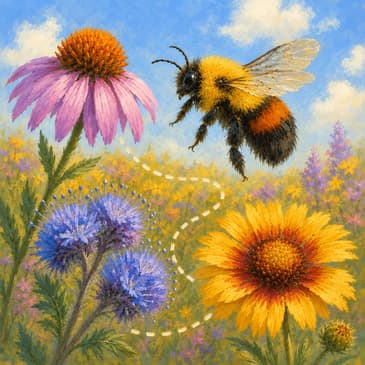
A bumblebee leaves her nest with no map, no GPS, and no instructions. By the end of the week, she'll have figured out the most efficient route between every flower patch in her territory — reducing her total flight distance by eighty percent. That's not a metaphor. Researchers tracked it with radar. In this episode of Secret Pollinators, Kelly digs into the hidden navigation science of wild bees: traplines, floral constancy, the multi-scale memory that makes it all work, and why the technology to track solitary native bees is only now catching up to the questions scientists most want to answer. Plus: what the flowers have to do with all of it.
No honey bees. All wild. All wonder.
Key Sources:
Bumblebee traplines and route optimization
- Lihoreau, M., Chittka, L., & Raine, N.E. (2010). Travel optimization by foraging bumblebees through readjustments of traplines after discovery of new feeding locations. The American Naturalist, 176(6), 744–757. https://doi.org/10.1086/657042
- Woodgate, J.L., Makinson, J.C., Lim, K.S., Reynolds, A.M., & Chittka, L. (2017). Continuous radar tracking illustrates the development of multi-destination routes of bumblebees. Scientific Reports, 7, 17323. https://doi.org/10.1038/s41598-017-17553-1
Floral constancy in native and solitary bees
- Shrotri, S., Kaur, S., Nawge, V., Sandhya, S., Dandavate, R., & Gowda, V. (2024). Revisiting Aristotle's observation on bees: High floral constancy is common among bees but it is shaped by the locally abundant flowering species. bioRxiv. https://doi.org/10.1101/2024.10.28.614270
- Lanza, J., Smith, G.C., Sack, S., & Cash, A. (2019). Honey bee and native solitary bee foraging behavior in a crop with dimorphic parental lines. PLOS ONE, 14(10), e0223865. https://doi.org/10.1371/journal.pone.0223865
Memory and foraging ecology
- Worden, B.D., & Papaj, D.R. (2005). Flower choice copying in bumblebees. Biology Letters, 1(4), 504–507.
- Ecology dictates the value of memory for foraging bees. (2022). Current Biology, 32(18). https://doi.org/10.1016/j.cub.2022.07.068
Bee tracking technology — solitary and wild bees
- Kratschmer, S., Milchram, M., Landler, L., et al. (2025). Tracking large bees in open landscapes with active radio tags — advantages and challenges using stationary receivers. Journal of Animal Ecology. https://doi.org/10.1111/1365-2656.70061
#SecretPollinators #NativeBees #WildBees #BeeNavigation #BumbleBee #FloralConstancy #Trapline #PollinatorWeek #PollinatorWeek2026 #BeeScience #WildPollinator #NativePollinators #BeeResearch #PollinatorSteward #PollinatorPartnership #BeeMemory #Pollinator #BeeFlight #NaturePodcast #SciencePodcast #BeeFlightPath #Bumblebees #travelingsalesmanproblem #solvedbyabee #trapline #beeroutes #beepaths #QueenMaryUniversity
About Secret Pollinators
A wonder-first science podcast about native bees, bumblebees, wild bees, and the lesser-known pollinators most of us walk right past every day.
Visit secretpollinators.com