Happy Pollinator Week! Tell someone you love native wild bees and they'll start talking about honey every time. But the honey bee is a European import — it's not even one of the four thousand native wild bee species that live in the United States. This is a short, joyful one: a celebration of the bees most people never notice, the ones in every parking lot and sidewalk crack, the ones already under your feet. They are docile and some of the best pollinators in the world. Four thousand shapes, four thousand quiet lives. Once you see them, you can't stop.
KEY SOURCES
Species counts
- U.S. Geological Survey — "How many species of native bees are in the United States?" (4,000+ US native species; world's smallest bee ~2 mm). usgs.gov
- Xerces Society — "Bee Species Diversity in the US" (3,600+ species US & Canada — conservative regional figure). xerces.org
Honey bee as non-native; solitary / ground-nesting life
- Scientific American — "There Are 4,000 Species of Native Bees in the U.S." (no native bees make honey or hives; most solitary). scientificamerican.com, Apr 2026
- National Geographic — "Why America's 4,000 native bees deserve more attention" (~4,000 wild species; ~70% ground-nesting; size range). nationalgeographic.com
Deep-time / "ancient" framing
- Bossert et al. / WSU — "The Evolutionary History of Bees in Time and Space" (bee lineage dates back 120+ million years; origin in Western Gondwana, later dispersal to northern continents). news.wsu.edu; ScienceDirect
- Museum of the Earth — "Evolution and Fossil Record of Bees" (bees evolved from predatory wasps ~120 mya). museumoftheearth.org
Pollinator Week & community science
- Pollinator Partnership — "Pollinator Week" (June 22–28, 2026; initiated and managed by Pollinator Partnership). pollinator.org/pollinator-week
- Pollinator Partnership — "Pollinator Week Activities" (Pollinator Week Bioblitz hosted on iNaturalist; community science collecting native pollinator distribution data across US, Canada, Mexico). pollinator.org/pollinator-week/activities
- iNaturalist — free observation app feeding research-grade biodiversity records. inaturalist.org
#SecretPollinators #NativeBees #WildBees #BumbleBees #PollinatorWeek #iNaturalist #PollinatorPartnership #NativePollinators #BeesOfNorthAmerica #SolitaryBees #CommunityScience #PollinatorScience #BeeDiversity #NatureWonder #SciencePodcast #iNaturalist #PollinatorPartnership #gardening
About Secret Pollinators
A wonder-first science podcast about native bees, bumblebees, wild bees, and the lesser-known pollinators most of us walk right past every day.
Visit secretpollinators.com
[00:00:03] Welcome back to Secret Pollinators, and Happy Pollinator Week, everyone! Today, one number, 4,000. That's how many kinds of Native Wild Bees live in the United States. Not four, not 40, but 4,000. And almost none of them are the bee you're picturing in your head right now.
[00:00:27] And here's something that happens to me constantly. I tell someone I make a podcast about Native Wild Bees, and before I've even finished this sentence, they're talking about honey, the high, their cousin who keeps bees, or their friend, every time. And every time I get to say, well, that one's not from here. The honeybee was brought over from Europe a few centuries ago.
[00:00:53] It's an import. It's not what I mean by Native Wild Bee, and it's not one of the 4,000. It kind of gets a little frustrating, but mostly it's exciting, because it's exactly why I started this podcast. That conversation is my way in. My chance to introduce someone to 4,000 bees. Bees that mostly nest in the ground, and that they probably walk past their whole lives.
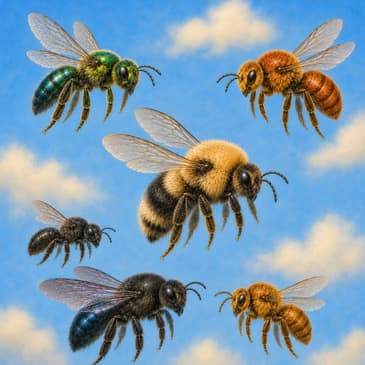
[00:01:21] 4,000 shapes. So sit with that number for a second. 4,000. Bees the size of a crayon tip. Bees as big as the tip of your thumb. Bees that are metallic green, electric blue. Bees that shine like oil in the sun.
[00:01:51] Bees that shine like oil in the sun. bees are solitary. One female, one nest, quietly getting on with their day. The swarm, the comb,
[00:02:19] the honey, that's the imported bee story. The 4,000 were always doing something quieter and so much older. Bees go back more than 100 million years, and these ancient little lives carrying on the way they always have since long before anyone shipped a hive across the ocean. They're everywhere I go, and here's what I love most, and quite frankly, it's a little bit of a
[00:02:47] problem. I photograph them pretty much everywhere. Bumblebees, wild bees, I can't help it. It doesn't matter what state I'm in or if I'm at a drive-thru, and if there's a flower strip in the parking lot, I'm leaning out the window with my phone. Gas stations, sidewalk cracks, the sad little
[00:03:11] planer outside the waiting room. I take pictures everywhere, and they're always there every time. You don't have to go anywhere special, and that's the secret. You walk by them today. You'll walk by them tomorrow, and once you start looking, you genuinely can't stop seeing them. They're everywhere, and here's the timing of all of this. It's Pollinator Week. A whole week, every June,
[00:03:38] set aside to celebrate exactly these little ancient creatures, and it's run by the Pollinator Partnership, the folks who started it, and it's only one week a year, so we all throw a little party for the pollinators, and you don't have to do anything fancy to join. Remember, I take pictures everywhere, and you can do that and make it count, and there's a project on iNaturalist. It's a free
[00:04:05] app where you can snap a photo of any bee you find and log it where it was when you saw it. That's the whole job, and it helps tremendously. And here's why it's more than a hobby. Every one of those photos is data. Researchers use these observations to map where our native bees actually are, and which kinds live where. Who's thriving? Who's turning up somewhere new? Your parking lot bee? Your sidewalk
[00:04:34] bee? The one on the flowers outside the grocery store? Once it's logged, it becomes a real dot on a map, and you on your lunch break are doing science. So this week, and actually, honestly, every week of the year, you can get in on it. You can plant something. You can take a walk, snap a picture of a bee, and log it. Tell somebody about the 4,000. The party's already started, and there is lots of
[00:05:04] room for everybody. Why I never get tired of this, and that's kind of the part that still gets me. It's not that native wild bees are rare. They're just here. They're everywhere, and they've always been here, beneath us, beside us, all over. And most wild native bees are docile. They're not aggressive.
[00:05:27] They're not looking to sting you. They just want to collect pollen. And the other thing that I find really incredible is that they're some of the very best pollinators on the planet. And if you listen to some of my previous episodes, you can learn about their effectiveness on just numerous types of
[00:05:50] crops and how we all benefit from native wild bees. So I want to thank you for listening. I really appreciate it. Happy Pollinator Week. And remember, the next time you're taking a walk, slow down a little bit and check out the wild native bees because they're down there, and they know you're passing by. So until next time, keep watching them because they're probably watching you back.