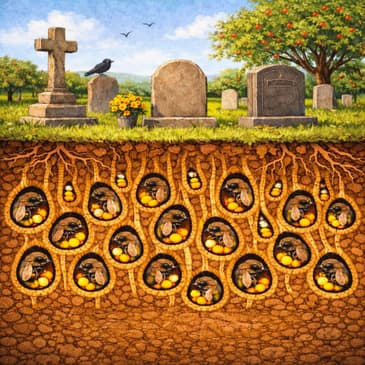
In 2021, researchers noticed something unusual about the northeast corner of a cemetery in Ithaca, New York. The ground was full of tiny holes. A Cornell University team set up emergence traps and counted what came out. The answer: 5.6 million solitary bees, emerging from beneath the headstones every spring, quietly pollinating a university apple orchard 600 meters away. Then the same team found 651,440 more bees in a suburban lawn — collecting grass pollen nobody knew they wanted. These populations are hiding everywhere in plain sight, in the patches of ground we've never thought to study. And the safest place a wild bee can nest might just be the one piece of land nobody ever builds on.
#SecretPollinators #5MillionBees #CemeteryBees #AndreaBees #AndenaRegularis #NativeBees #GroundNestingBees #SolitaryBees #BeeDiscovery #HiddenBees #EastLawnCemetery #CornellUniversity #PollinatorScience #WildBees #BeeConservation #ApplePollination #MelissodesBimaculatus #TwoSpottedLonghornBee #GrassPollen #BeeResearch #NativeBeeResearch #PollinatorConservation #SaveTheBees #BeeNerd #BeeFacts #InsectScience #SciencePodcast #NaturePodcast #NatureLovers #EntomologyNerd #Entomology #DidYouKnow #MindBlown #ScienceIsAmazing #HiddenNature #UnexpectedNature #BeesOfInstagram #PollinatorHabitat #SacredGround #TheDeadAreKeepingBees #NewEpisode #Ghosts #Dead #Cemetery #headstones #wildbees
About Secret Pollinators
A wonder-first science podcast about native bees, bumblebees, wild bees, and the lesser-known pollinators most of us walk right past every day.
Visit secretpollinators.com
Speaker A:
Welcome back to Secret Pollinators.
I'm Kelly Parks, your host,
and I need to ask you something right off the top.
Are the dead or our dead relatives protecting native bees for us?
I know how that sounds.
I mean,
that's way out there. But just stay with me because a team of scientists from Cornell University just published a paper that might be possibly, well, I don't know completely the most extraordinary bee discovery I've ever read.
And the answer to that question turns out to be yes.
Actually,
yes.
There's 5.6 million bees living under a cemetery in Ithaca, New York.
Not near a cemetery, not visiting a cemetery.
Literally under one. In the soil beneath the headstones and the mowed lawn and the pine trees,
living there quietly season after season for what scientists now believe may be nearly 90 years,
possibly longer,
and nobody knew.
And then in 2021,
someone finally looked down what they found.
Okay, so it's the East Lawn Cemetery in Ithaca, New York,
and it's been there since 1878.
It was originally a farm.
About 10 hectares of land had stones, maple trees, and a regularly mowed lawn.
Completely ordinary to anyone driving past.
And I've driven past it lots because my daughter is at Cornell University.
In 2021, researchers noticed that the northeast corner had an unusual number of small holes in the ground.
Little mounds of excavated soil,
tiny openings the size of a pencil eraser scattered everywhere across the grass.
Bees nest thousands upon thousands of of bees nests.
And a team from Cornell University set up 10 emergence traps across the nesting area.
And like an emergence trap, is essentially a tent staked firmly over the ground. And any bee that hatches and crawls up out of the soil walks right into the trap.
And you check it every day and you count everything and you do the math.
Well, they ran the traps for 41 days in the spring of 2023,
from 10 small traps,
each covering,
I don't know, just about 0.36 square meters of ground,
they collected 3,251 individual insects.
And the dominant species by a massive margin was Andrena regularis, a solitary ground nesting bee. They pulled 3,070 of them out of those tiny patches of soil.
Mean bee density across the traps,
852 bees per square meter. The total nesting area, about 6,500 square meters.
So multiply it out.
5.56 million Andrena regularis bees, native wild bees emerging from that cemetery in a single spring.
And I mean, it could be possibly up to 8 million on the high end,
based on collection records of the species and this exact location going back to 1935.
Well, guess what? This population has been there for at least 90 years.
The Bee and her secret job.
So who is this little mining bee? Because she's worth knowing by name.
She's a solitary bee. She overwinters underground, alone.
No colony, no queen, no workers, no honey.
And when spring temperatures climb, she pushes out of the soil and immediately gets to work.
They're very efficient. She digs a tunnel,
stocking it with pollen, laying her eggs, sealing it up.
Her offspring won't emerge until the following spring.
She special specializes in early spring blossoms like apples, cherry, plum, serviceberry and hawthorn.
And she carries nearly pure apple pollen when she forages.
And she makes contact with the reproductive parts of the flower at a remarkably high rate.
And she is, according to Cornell researchers who've been serving the New York apple orchard since 2008,
the single most abundant bee pollinator in those orchards.
More common than managed honeybees, if you can believe that.
And here's the interesting part. The Cornell apple orchard is 600 meters away from East Lawn Cemetery.
The researchers have spent years documenting that little native mining bee and how it dominated their apple orchard.
But they just had no idea where she was coming from.
And the discovery of the cemetery aggregation pretty much answered a question that had been sitting quietly in their daughter for over a decade.
Yeah, a decade.
The bees under the cemetery had been pollinating the apple orchard the whole time for possibly 90 years and probably longer,
without anyone knowing they were there.
It's happening in suburban lawns, too.
So here's where this story gets even better.
I mean, if that's possible.
Because the same Cornell team published another paper in 2024 about a completely different large bee aggregation,
a large native bee aggregation,
also in upstate New York,
and also hiding in plain sight.
And this one was the two spotted longhorn bee. And she wasn't in a cemetery.
She was in a suburban lawn.
Are you sitting down 651,440 bees in someone's yard?
That's, like,
fantastic.
So I think this might be becoming a pattern. Enormous, ancient, completely overlooked populations of solitary native wild bees living in ordinary looking patches of ground that nobody thought to study.
A cemetery,
a lawn,
hiding in the most mundane landscapes imaginable.
And here is something the two spotted longhorned bee study found that I find completely and absolutely fascinating.
They documented what is called the selfish herd hypothesis playing out in real time.
And what that is is basically the idea behind it is that bees may actually choose to nest in dense aggregations shoulder to shoulder.
With thousands of other bees,
specifically because it dilutes individual parasite risk.
The more neighbors you have, the less likely any single nest gets targeted.
It's safety in numbers, underground,
in the dark.
And they're not just nesting together because the soil happens to be good in that one spot.
They may be nesting together on purpose because together is actually safer.
The grass thing.
So the two spotted longhorn bee study found something else that genuinely surprised me.
It showed a strong preference that these little wild native bees have for grass pollen.
A family that includes basically every grass in your lawn. And I honestly never thought about that before,
Although I have seen bees on the grass and I've always wondered,
and this has never been documented before, this species.
And I know what you might be thinking because I was thinking it too.
Like, wait, does grass even have pollen?
I mean,
I've been wondering why little bees are on my blades of grass or the little,
I don't know, seeds of grass or,
I don't know, grass,
flowers or something. I mean, I don't even know.
But grasses have pollen and it,
it's actually the reason that people get hay fever every spring and they're wind pollinated, so they produce enormous quantities of lightweight airborne pollen that gets into everything.
I never thought about that before. And it just doesn't occur to most of us that a bee might be deliberately collecting it because grasses don't have flowers the way we think of flowers.
No petals,
no bright color, and no perfume.
And that's something I just learned and that I've been wondering about for a very long time.
But the little two spotted longhorn bee, well, it found the pollen anyway.
So she's flying low over the suburban lawn and she's working.
She found a food source that most other bees are completely ignoring.
Which means the next time you see a bee hovering close to the ground over a patch of grass like I have,
well,
she might not be passing through on her way to somewhere else. She might actually be doing the exact job she came to do.
And that to me,
completely blows my mind,
the cemetery effect.
So let's go or circle back to that question. Are the dead protecting our native wild bees for us,
the soil at East Lawn cemetery in Ithaca, New York is primary sandy loam,
66% sand.
It's easy to excavate and, well, draining and then. And the lawn gets mowed, but never tilled,
never paved,
never poisoned, and never developed.
So the ground's been fundamentally undisturbed since 1878.
And because you cannot build on a cemetery,
cemeteries are turning out to be some of the most significant biodiversity sanctuaries in the developed world.
A single urban cemetery in Berlin was documented harboring over 600 species.
Bees, beetles, bats, birds, and rare plants,
nearly 8% of which were of conservation concern.
Studies from England,
Hungary and Iran show the same pattern again and again.
Sacred ground left alone becomes a refuge.
One researcher describes cemeteries as sentinels of biodiversity, where the dead protect the living.
And I've been thinking about that phrase since I first read,
has had a lot of impact on the way I think about things.
I mean, the bees found the safe ground,
they moved in,
they stayed for 90 years,
and it all.
All basically,
well,
all it took us to find them was someone finally deciding to look down.
So, yes, the dead are protecting our native wild bees.
They didn't necessarily mean to. Nobody planned it. But in a world where every patch of ground is evaluated for its development potential,
where meadows become warehouses and farms become parking lots of,
well, cemeteries are exempt.
And into that exemption, the bees quietly moved.
So I want to thank you so much for listening to my podcast. And remember,
until next time,
remember to look down.