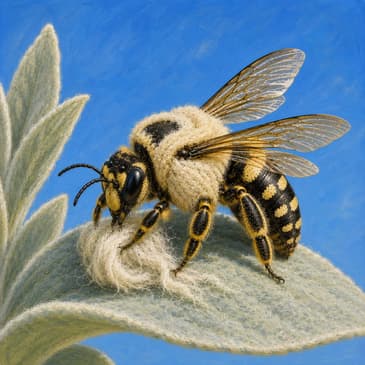
Say "wool" and you picture a sheep — so what do you do with a bee that shears wool off a living plant? Meet the wool carder bee: a thumbnail-sized native that scrapes the soft fuzz from fuzzy-leaved plants like lamb's ear, rolls it into little cotton balls, and felts them into a row of downy capsules where her young grow up. We get into how she "cards" plant wool the way spinners comb it for yarn, why a leaf's fuzz is really the plant's armor turned into a baby blanket, and the surprisingly fierce males who body-slam bumble bees to guard a patch of flowers. There are more than 160 kinds of wool carder bees in the world, and around 29 of them live right here in North America. Plus, the wool carder on your garden lamb's ear is probably a European transplant — but the West has natives of its own. Come find one.
KEY SOURCES
Carding behavior, nest construction & materials
- Gallagher, S. & Ellis, J.D. "European Wool Carder Bee, Anthidium manicatum." UF/IFAS Featured Creatures EENY-746 (2019). Females scrape trichomes with toothed mandibles, form a ball beneath the abdomen, line brood cells; nest sealed with particulate plug; males larger than females. entnemdept.ufl.edu
- Anthidium manicatum nesting notes (iNaturalist / Wikipedia syntheses): brood cells built primarily from plant hairs; additional materials include mud, resin, leaves; some plant substances are hydrophobic, possibly antimicrobial.
Native vs. introduced species
- Gonzalez, V.H. & Griswold, T.L. (2013). "Wool carder bees of the genus Anthidium in the Western Hemisphere: diversity, host plant associations, phylogeny, and biogeography." Zoological Journal of the Linnean Society 168(2): 221–425. — Anthidium is the sole carder-bee genus in the Americas; native western species include A. mormonum and A. utahense; all North American species are native except the introduced A. oblongatum (and A. manicatum).
- Griswold, T., Gonzalez, V.H. & Ikerd, H. (2014). "AnthWest, occurrence records for wool carder bees of the genus Anthidium in the Western Hemisphere." ZooKeys 408. DOI: 10.3897/zookeys.408.5633 — confirms A. utahense and A. mormonum as the two most-recorded western North American natives.
- Strange, J.P. et al. / Gibbs, J. & Sheffield, C.S. (2009). Range expansion of introduced A. manicatum in North America (first U.S. record near Ithaca, NY, 1963).
Territorial males
Behavioral accounts (Gonzalez & Griswold, 2013; popular summary "Fibers, forage, and fighting," Honey Bee Suite, 2023): males are larger than females; defend flower patches; chase and physically wrestle intruders, including bees far larger than themselves; use a resource-defense mating strategy.
#SecretPollinators #NativeBees #WildBees #Pollinators #WoolCarderBee #Anthidium #NativePollinators #BeeFacts #PollinatorGarden #LambsEar #SolitaryBees #WonderInTheGrass #Bees #iNaturalist #beeresearch #CarderBee #NorthAmericanBees #LambsEar #Nativeplants
About Secret Pollinators
A wonder-first science podcast about native bees, bumblebees, wild bees, and the lesser-known pollinators most of us walk right past every day.
Visit secretpollinators.com