Kelly Parks October 2025
Published: Why Bumble Bees Need Us to Count Them — and Find Their Nests | by Kelly Parks | Oct, 2026 | Medium
More than a quarter of North America's bumble bees are at risk
When people hear "save the bees," they usually picture honey bees in a managed hive. But the bees most in trouble are wild and native, and bumble bees are among the clearest examples.
An assessment led by the Xerces Society with the IUCN Bumblebee Specialist Group found that 28% of bumble bee species in Canada, the United States and Mexico fall into an IUCN threatened category (Xerces Society). We cannot protect what we cannot count, and for bumble bees the biggest blind spot is where they nest.
Bumble bees do work honey bees can't
Bumble bees perform buzz pollination: a worker grips a flower in her jaws and vibrates her flight muscles to shake loose pollen that is otherwise locked inside. Tomatoes, peppers and cranberries benefit significantly from it (Xerces Society). Most bees managed for crop pollination, including honey bees, do not buzz pollinate, which is why bumble bees are the primary pollinators for most greenhouse tomatoes (SARE).
They also work in conditions other bees avoid. Honey bees are not very active below 50°F (10°C), while bumble bees keep foraging down to about 45°F (7.2°C) (SARE). That makes them among the first bees active in late winter and the last in fall (Xerces Society).
The declines are documented, not hypothetical
• Rusty patched bumble bee (Bombus affinis): Federally endangered since 2017. It has declined about 87% since the late 1990s. It was once common across 28 states and the District of Columbia and now survives in small, scattered populations (USFWS).
• Franklin's bumble bee (Bombus franklini): Federally endangered since 2021. It has the smallest range of any North American bumble bee and has not been observed since 2006 (USFWS).
• Western bumble bee (Bombus occidentalis): Listed as Vulnerable on the IUCN Red List in the Xerces/IUCN extinction risk assessment (Xerces/IUCN summary).
The rusty patched bumble bee was the first bee in the continental U.S. to receive Endangered Species Act protection. In its 2017 listing announcement, the U.S. Fish and Wildlife Service named habitat loss, disease and parasites, pesticides, climate change and extremely small population size as likely causes, most likely in combination (as quoted by Beyond Pesticides).
Tracking numbers is how declines get noticed
The 28% figure came from comparing records. The assessment drew on more than 250,000 specimen records and compared each species' range, relative abundance and persistence before 2002 with 2002–2012 (Xerces/IUCN summary). Every new, reliable record makes the next comparison sharper.
Community science is filling that gap:
• Bumble Bee Watch lets anyone upload photos of bumble bees. Experts verify the identifications, and the records help researchers locate rare or endangered populations (GBIF).
• Bumble Bee Atlas projects, launched in 2018, send trained volunteers to survey assigned areas so scientists can track where and in which habitats each species lives (Xerces Society).
• In summer 2024, more than 900 Atlas volunteers across 20 states shared nearly 21,000 bumble bee observations, plus more than 7,800 incidental sightings through Bumble Bee Watch (Xerces Society).
• The Montana Bumble Bee Atlas launched in May 2024 (Xerces Society).
Volunteers photograph bees rather than collect them, so the surveys don't harm the populations they measure (Xerces Society).
Nests are the missing piece
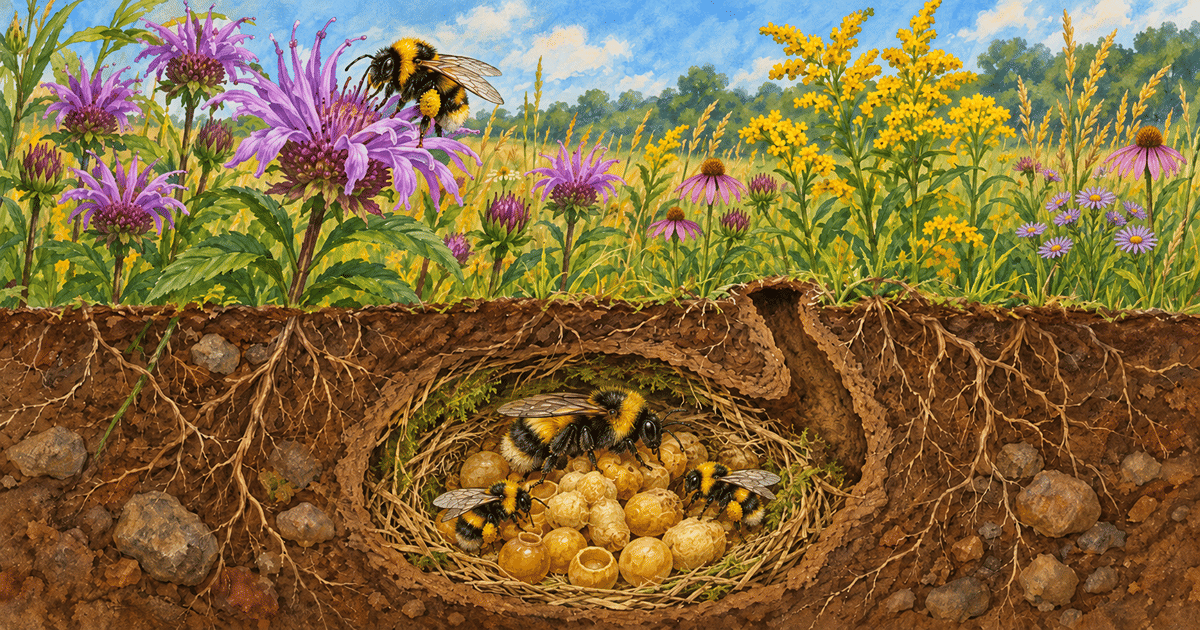
We know a lot about which flowers bumble bees forage on, and very little about where they nest. Researchers describe nesting ecology as a key knowledge gap, largely because bumble bee nests are so hard to find (Pugesek & Crone 2022).
That gap has real consequences. In 2020 the U.S. Fish and Wildlife Service decided designating critical habitat for the rusty patched bumble bee was not prudent, in part because its specific nesting and overwintering needs were not known (Pugesek et al., bioRxiv). For the western bumble bee, the Xerces Society notes that much less is known about where it nests and overwinters than about its foraging habitat, and calls this a possible primary barrier to conserving the species (Xerces Society).
Scientists have tested several ways to find nests:
• Human searchers watching for bee traffic: In a UK comparison, searchers found one nest per 1 hour 20 minutes of searching (Roberts & Osborne 2019, citing O'Connor et al. 2012).
• Detection dogs: Dogs matched human search rates in that same comparison. A British Army–trained dog found 33 wild nests of four species in Scotland (Waters et al. 2010). In another study, dogs detected nest material from 15 meters in training, but from under 1 meter once samples were buried or natural (Liczner et al. 2021).
• Thermal cameras: One nest found in 6 hours 48 minutes of searching. They were no better than human searches for below-ground nests (Roberts & Osborne 2019).
• Radio tags and markers to follow bees home: Difficult, because bees fly fast and can carry little extra weight (Greil et al. 2026).
• Watching nest-searching queens in spring: Queens search more thoroughly where nest densities are high, so their behavior may indicate good nesting habitat (Pugesek & Crone 2022).
Researchers conclude that new detection methods are still needed to find wild nests in larger numbers (Roberts & Osborne 2019). Until that happens, we are protecting the flowers bumble bees visit without knowing enough about the places their colonies begin.
What you can do
• Photograph and report. Submit bumble bee photos to Bumble Bee Watch. Experts verify each identification.
• Join an Atlas. Bumble Bee Atlas projects need volunteers to survey assigned areas, including in Montana (Xerces Society).
• Plant for early spring. Bumble bees are especially vulnerable early in the season, so early bloomers such as willows matter (Xerces Society).
• Leave some ground undisturbed. Many species nest underground in old rodent burrows, while others nest above ground in grassy tufts and debris (UC Davis field manual).
Sources
• Xerces Society: Bumble Bee Conservation
• Xerces Society: About Bumble Bees
• SARE: Bumble Bees as Managed Pollinators
• USFWS: Rusty patched bumble bee listed as endangered (2017)
• USFWS: Franklin's bumble bee listed as endangered (2021)
• The Conservation Status of Bumble Bees of Canada, the USA and Mexico
• Beyond Pesticides: rusty patched bumble bee
• GBIF: Bumble Bee Watch dataset
• Xerces Society: Bumble Bee Atlas expands to five new states
• Xerces Society: 2024 Bumble Bee Atlas field season
• Xerces Society: Montana Bumble Bee Atlas takes flight
• Xerces Society: Great Plains Bumble Bee Atlas
• Xerces Society: Western Bumble Bee Nesting Habitat
• Pugesek & Crone 2022, Ecological Entomology
• Pugesek et al., bioRxiv preprint
• Roberts & Osborne 2019, Journal of Apicultural Research
• Waters et al. 2010, detection dog study
• Liczner et al. 2021, PLOS ONE