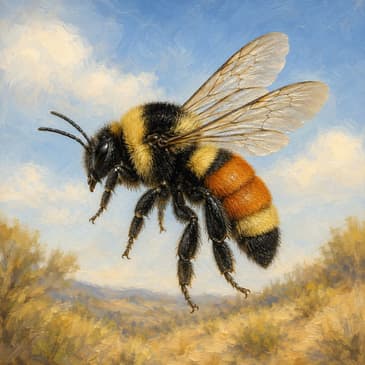
Why living alone beats living together for most of the native, wild bee world. This episode is about those bees — the quiet majority. How a hundred solitary females can nest side by side and still not be a colony. Why even the bumblebee, one of our few truly social native bees, starts and ends every year as a single bee alone underground. Why solitary doesn't mean being lonely, because it's actually the winning strategy for native, wild bees.
KEY SOURCES & DOIs
Proportion solitary / solitary life history
- Danforth, B.N., Minckley, R.L., Neff, J.L. (2019). The Solitary Bees: Biology, Evolution, Conservation. Princeton University Press. (Standard reference for the >90% solitary figure and solitary nesting biology.)
- Xerces Society — About Native Bees / Bring Back the Pollinators (conservation-status and natural-history reference; use as lead, verify specifics against primary literature).
Nesting aggregations vs. communal nesting
- Černá, K., Straka, J., et al. (2013). Neighbourhood Society: Nesting Dynamics, Usurpations and Social Behaviour in Solitary Bees. PLoS ONE 8(9): e73806. DOI: 10.1371/journal.pone.0073806
Bumblebee annual colony cycle
- Xerces Society — About Bumble Bees and Bumble Bees: Nesting and Overwintering (colony size 50–500; annual cycle; foundress and workers die, only mated gynes overwinter).
- Goulson, D. (2010). Bumblebees: Behaviour, Ecology, and Conservation (2nd ed.). Oxford University Press.
Social polymorphism in sweat bees
- Gibbs, J., Brady, S.G., Kanda, K., Danforth, B.N. (2012). Phylogeny of halictine bees supports a shared origin of eusociality for Halictus and Lasioglossum. Molecular Phylogenetics and Evolution 65(3): 926–939. DOI: 10.1016/j.ympev.2012.08.013 (documents Halictus rubicundus solitary at high latitude/altitude, eusocial in warm/low range).
- Field, J., Paxton, R.J., Soro, A., Bridge, C. (2010). Cryptic plasticity underlies a major evolutionary transition. Current Biology 20(22): 2028–2031. DOI: 10.1016/j.cub.2010.10.020 (H. rubicundus social plasticity tied to season length).
- Kocher, S.D., et al. (2018). The genetic basis of a social polymorphism in halictid bees. Nature Communications 9: 4338. DOI: 10.1038/s41467-018-06824-8 (Lasioglossum albipes; population-level genetic basis — distinct from individual plasticity).
Evolution of eusociality / reversals
- Danforth, B.N., Conway, L., Ji, S. (2003). Phylogeny of eusocial Lasioglossum reveals multiple losses of eusociality within a primitively eusocial clade. Systematic Biology 52(1): 23–36. DOI: 10.1080/10635150390132687
#SecretPollinators #WildBees #NativeBees #SolitaryBees #Bumblebees #SweatBees #Pollinators #BeeScience #Halictidae #Entomology #NatureLovers #BeeFacts #singleliving #alone #livealone #learnaboutbees #lonely #livingsingle
About Secret Pollinators
A wonder-first science podcast about native bees, bumblebees, wild bees, and the lesser-known pollinators most of us walk right past every day.
Visit secretpollinators.com