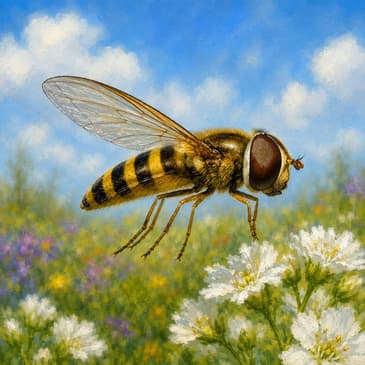
Hover flies hang in the air at eye level, hold perfectly still, and dart off the second you move — then come right back. If your garden's been "invaded" by little hovering insects this season, you're not being watched by tiny drones. You're watching hover flies.
This episode is a short, close look at one of the world's most underappreciated pollinators: the fly that wears a bee costume. Why they hover exactly where they do, how they hold that impossible mid-air stillness, why one is parked right next to you — and the strange double life that makes them quietly valuable in any garden. No equipment, no field trip. Just you, standing still for a minute, learning to see what's already there.
KEY SOURCES
Hovering, territoriality & flight control
- Collett & Land (1975). Visual control of flight behaviour in the hoverfly Syritta pipiens. Journal of Comparative Physiology. — station-taking, territoriality, male vs. female hovering function.
- Nicholas et al. / eLife (2026 reviewed preprint). Sexual dimorphism in sensorimotor transformation of optic flow. https://elifesciences.org/reviewed-preprints/109795v2 — males hold territories from a hovering stance, then high-speed pursuit.
- Hoverfly (Eristalis tenax) pursuit of artificial targets. PMC10088529. https://www.ncbi.nlm.nih.gov/pmc/articles/PMC10088529/ — male pursuit behavior from hovering stance.
- Pringle, J.W.S. (1948). The gyroscopic mechanism of the halteres of Diptera. Philosophical Transactions of the Royal Society B 233(602): 347–384. DOI: 10.1098/rstb.1948.0007 — foundational paper establishing halteres as gyroscopic angular-rate sensors. (Confirmed; classic primary source. Halteres named generically on air as "tiny knobbed organs"/"drumsticks" — no Latin spoken.)
Male/female hovering function (plain-language corroboration)
- UC Marin Master Gardeners: male hovering = territorial display while seeking females; female hovering = searching oviposition sites. (Extension source — corroborates primary literature above; used as lead, not sole citation.)
Pollination importance
- Rader et al. (2016), PNAS — non-bee insects (incl. Syrphidae) as crop pollinators; basis of "second most important after bees" framing.
- Doyle et al. (2020) — Diptera as second most important pollinating insect group; Syrphidae as dominant fly visitors.
- Flower visitation by hoverflies in a temperate plant–pollinator network. PMC6282941. https://www.ncbi.nlm.nih.gov/pmc/articles/PMC6282941/
- Frontiers in Plant Science (2023): Eupeodes corollae provides pollination + aphid biocontrol; Syrphinae larvae prey on aphids and other soft-bodied herbivores. https://www.frontiersin.org/journals/plant-science/articles/10.3389/fpls.2023.1118388/full
#SecretPollinators #HoverFlies #Syrphidae #Pollinators #FlowerFlies #NativePollinators #GardenWildlife #Diptera #Mimicry #Entomology #WildBees #PollinatorGarden #NatureObservation #BackyardNature #Aphids #Hover
About Secret Pollinators
A wonder-first science podcast about native bees, bumblebees, wild bees, and the lesser-known pollinators most of us walk right past every day.
Visit secretpollinators.com
[00:00:03] Welcome back to Secret Pollinators. I want to tell you a little bit about how my week has been going when I was walking out in the garden and, well, being invaded. There were little flies hanging in the air right at my eye level, holding completely still, kind of like tiny helicopters in midair.
[00:00:30] And every time I moved, one of them would zip off and then come right back to the exact same spot, hovering, watching me. And I started to wonder if they were trying to tell me something. They possibly were, but what they were actually doing turns out to be far more interesting than a subliminal message, if that's possible.
[00:00:56] So, today's episode is about hoverflies, what they are, why they hang in the air like that, and why the ones showing up in your garden are quietly doing you a couple of very big favors. That's not a bee. So, the very first thing to know about a hoverfly is that it's a fly wearing a bee costume.
[00:01:22] Look closely at one of these little hovering insects. They're kind of mesmerizing. And you'll probably think bee or wasp at first. The stripes, the yellow, the black, the general shape. And that's the point. But it's a fly. And once you know this, you can't unsee them. A bee or wasp has two pairs of wings, so four wings in total. But a fly has one pair, two wings.
[00:01:51] And that's actually where the scientific name for the whole group of flies comes from. A word that means two wings. Hoverflies have big fly eyes that take up most of the head and short, stubby antenna instead of the longer ones that you see on a bee. And here's the big giveaway. A bee almost never holds a dead still hover in open air.
[00:02:18] That parking in midair trick thing? Well, that's a fly thing. And the costume is doing the job. It's kind of a mimicry where the harmless animal evolves to look like the one that can defend itself. The hoverfly has no sting. It's completely harmless to you. But a bird that's been stung by a wasp once tends to leave anything yellow and black striped alone.
[00:02:45] So the fly gets a protection of a weapon it doesn't even actually own. It's a bluff. And it works so well that it even fooled you and me and generations of hungry birds. So the very first pleasure of a hoverfly is just catching the disguise. That's a fly. Look again. The hover itself. So now let's talk about the hovering.
[00:03:15] This is the thing that stops you in your tracks. Or at least it stops me in my tracks. And it deserves a closer look. When a hoverfly holds its position in the air, it's not drifting or coasting. It's actively pinning itself to one point in space, making constant tiny corrections against every little gust of wind or eddy of air. And trust me, it's pretty windy here in Montana.
[00:03:41] It's one of the most precise pieces of flight control you'll ever watch an insect perform. And you can watch it from a foot away. And it's—I'm not kidding when I say it's mesmerizing. It's crazy. It's crazy. Part of how they pull this off comes back to being a fly. Remember those two wings, where the bee has four? Well, flies traded the second pair of wings for a pair of tiny knobbed organs called halters.
[00:04:11] And if you think of them as two little drumsticks that beat in time with the wings, you'd be pretty close to being right. They work like little gyroscopes. And as the fly's body starts to tip or rotate, they sense it instantly and the fly cracks. And it does it faster than you could think about it. It's a built-in stabilization system. And it's a bigger part of why a hoverfly can hang so eerily still.
[00:04:40] Which is just mind-blowing. And here's the part I love. The hovering is not random. It usually means something. Which is exactly where I'm going next with this. Why it's hovering right at you. So, why was that fly hanging in the air right next to me, following me around, where it seemed? Well, here's the honest version.
[00:05:08] With the science separated from the story, what researchers have documented in this is that many hoverflies, particularly the males, stake out a patch of air and hold it, like a hovering station, watching for females to pass through, and darting out to chase off rival males or investigate anything that enters the space. The females, meanwhile, use the hovering to scout plants below for good places to lay eggs.
[00:05:38] So, the little insect parked at eye level next to you is most likely a male holding its territory. And I guess what happened is I wandered into his patrol zone. So, I was, as far as he's concerned, a large object that needs checking. When he zips off and snaps back to the same spot, that's him chasing an intruder and returning to his station.
[00:06:06] Now, I want to be careful here because it's tempting to say he's guarding you or curious about you. And that would be me putting a story on top of the behavior. What's actually documented is territory holding and chasing. The fly isn't really interested in you or me personally. I was just standing in his airspace. And that's not less charming to me. It's more.
[00:06:34] Because I walked into the middle of a tiny, invisible, territorial map laid over my garden. Wow. The double life. Here's where hoverflies quietly earn their keep. And it's a genuinely strange story. Because a hoverfly has two completely different lives. The adult you're watching hover feeds on nectar and pollen.
[00:07:00] And as it moves flower to flower to feed, the pollen rides along its body from bloom to bloom. So, the adult is a pollinator. And when scientists add up which insects matter most for pollination, hoverflies come up again and again right behind the bees. And I want to be straight about what that means. It's a general picture researchers keep landing across on many studies. But not one tidy measurement you can point to.
[00:07:32] It's a consistent finding. And that's why hoverflies get called some of the most valuable pollinators we have. One likely reason is they're not tied to a nest the way a bee is. A foraging bee has to keep returning home. While a hoverfly can wander. So, it's reasonable to think that lets them move pollen over long distances. Though I'd like to file that under sensible explanation rather than something I can hand you a real number for.
[00:08:00] That same insect started life as something you'd never connect to the elegant hoverer. Hoverfly eggs hatch into larvae. And in many kinds of hoverflies, not all of them, but many of them. Those large larpha are aphid hunters. Small, legless, slug-like. Easy to overlook completely. Working their way through the aphid colonies on your plants and eating them in large numbers.
[00:08:28] And I want to be precise because it matters. This is not every hoverfly. Because the family's enormous, around 6,000 species worldwide. And the larvae live all kinds of different lives. Some filter feed in still water. Some live in decaying matter. The aphid eaters are a major group within the family, but not the whole family.
[00:08:52] But if you've got aphids in your garden, like I do, and hoverflies show up, there's a good chance the two are connected. The aphids help draw the egg-laying females, and their larvae are now on cleanup duty. So the double life is real. But it's split across time. Predator as larvae. Pollinator as an adult. Same animal. Two jobs. Never at the same moment. Watching them.
[00:09:22] I'd like to end where this started. With just watching them. Because that's the whole reward here. Hoverflies are one of the easiest wonders to actually observe. They hold still, so you get a great look. And they're unbothered by you standing close. They show up right in the garden you already have. Especially in the warm stretch of a season. And now you're equipped you can catch the disguise. That's a fly, not a bee.
[00:09:50] And you can watch their little halters do the impossible job of holding them steady. You can read the hovering as a male holding his patch of air in your garden, or his territory, that he mapped out. And you can appreciate that that same insect was not long ago quietly eating aphids off the leaves in your garden. And none of that requires equipment or a trip anywhere.
[00:10:17] It requires standing still in your own garden for a minute and paying attention to the little helicopter parked at eye level. You're not being invaded, necessarily. Although, I really thought I was. You're being visited by one of the most underappreciated pollinators in the world, doing several jobs at once and holding a perfect hover the entire time. And it's kind of mesmerizing.
[00:10:44] So until next time, please keep watching the wild native bees and the flies in disguise, because they're probably watching you back. And thank you for listening. I really appreciate it, and I hope you learned something new. And I hope you share this with your friends so we can help protect our native wild pollinators.