
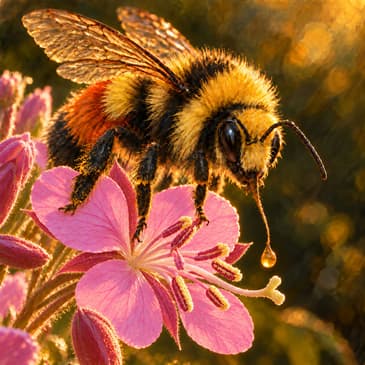
A viral post claims bumblebees stick out their tongues at sweet treats and shake their heads at bitter ones. It's based on a real 2026 study, and the real story is stranger than the caption.
In this episode, Kelly Parks walks through what scientists filmed when bumblebees tasted sugar, salt, and bitter droplets, from "lip-licking" tongue movements to head shaking and mouth wiping. She explains how researchers tested whether these were simple reflexes, why thirsty bees suddenly treated salt water like sugar, and how bee brain chemistry separates "wanting" from "liking" in a way that parallels what scientists see in mammals. She also covers where bees taste beyond their tongues, what this research does and doesn't tell us about a bee's inner life, and why a tiny mouthpart might be one of the best windows we have into how a bee experiences her world.
KEY SOURCES & DOIs
The 2026 orofacial reaction study
• Zhou, Y., Ingraham, T., Barron, A.B., Peng, F., & Solvi, C. (2026). Bumblebees' orofacial reactions to tastes provide evidence for affective evaluation. Proceedings of the National Academy of Sciences, 123(28), e2529114123. DOI: 10.1073/pnas.2529114123
• Nieh, J.C. (2026). Reading taste in a bee's face. Proceedings of the National Academy of Sciences, 123(29), e2619794123. DOI: 10.1073/pnas.2619794123 (commentary on the study)
• Phys.org (July 6, 2026). "Bees reveal emotion-like reactions, from 'lip licking' to head shaking, in new videos." Source for the 18-colony figure, slow-motion video, and the Peng quote.
•The Conversation (July 2026). "Bees' 'facial expressions' may be a sign of their inner lives." Written by a member of the research team; source for the pipette setup, the 40°C/104°F dehydration test, and the octopamine/dopamine vs. endocannabinoid results (the article doesn't name the endocannabinoid).
• Asian Scientist (August 7, 2026). "Bumblebees Make 'Yum' and 'Eww' Faces, Study Finds." Source for naming the endocannabinoid as anandamide and for the compounds being applied to the bee's thorax.
Where bees taste
• Harrap, M.J.M., Parkinson, R.H., Jones, H., & Wright, G.A. (2025). Bumblebees learn to use antennal and tarsal taste to predict the presence of nectar rewards in flowers. Journal of Experimental Biology, 228(20), jeb250535. DOI: 10.1242/jeb.250535
• Parkinson, R.H., Scott, J., Dorling, A.L., Jones, H., Haslam, M., McDermott-Roberts, A.E., & Wright, G.A. (2023). Mouthparts of the bumblebee (Bombus terrestris) exhibit poor acuity for the detection of pesticides in nectar. eLife, 12, RP89129. DOI: 10.7554/eLife.89129
Taste reactions and liking vs. wanting in mammals (background)
• Berridge, K.C. (2000). Measuring hedonic impact in animals and infants: microstructure of affective taste reactivity patterns. Neuroscience & Biobehavioral Reviews, 24(2), 173–198. DOI: 10.1016/S0149-7634(99)00072-X
• Darwin, C. (1872). The Expression of the Emotions in Man and Animals. John Murray, London.
#SecretPollinators #Bumblebees #WildBees #NativeBees #BeeScience #BeeBehavior #InsectCognition #AnimalBehavior #ScienceCommunication #ScienceTwitter #Pollinators #SciComm #Entomology #beetongues #bumblebeetongues #Wildbees
About Secret Pollinators
A wonder-first science podcast about native bees, bumblebees, wild bees, and the lesser-known pollinators most of us walk right past every day.
Visit secretpollinators.com