
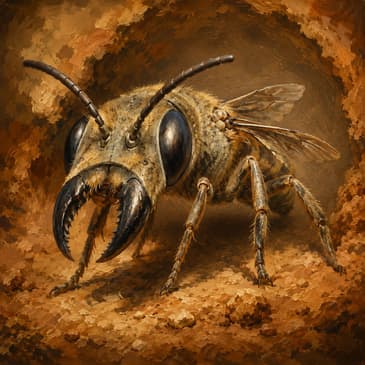
Do bees actually fight? Yes, and it's more brutal than most people imagine. In this episode: a desert bee whose large-headed males duel underground in fights that always end in death, an Australian burrowing bee whose males wrestle violently on open ground while birds pick them off, and two stingless bee species that wage genuine warfare with thousands of casualties and hostile nest takeovers. Plus the quieter, constant conflict at solitary bee nest entrances, and an honest look at where the “bee fight club” comparison holds up and where it falls apart. Wonder-first, science-grounded, and no honey bees required.
Key Sources
Macrotera / Perdita portalis — dimorphic males and lethal nest fighting
- Danforth, B.N. (1991). The morphology and behavior of dimorphic males in Perdita portalis (Hymenoptera: Andrenidae). Behavioral Ecology and Sociobiology 29: 235–247. DOI: 10.1007/BF00163980
- Danforth, B.N. & Desjardins, C. (1999). Male dimorphism in Perdita portalis (Hymenoptera, Andrenidae) has arisen from preexisting allometric patterns. Insectes Sociaux 46: 18–28. DOI: 10.1007/s000400050107
Amegilla dawsoni — male size, wrestling, and predation cost
- Alcock, J. (1996). Male size and survival: the effects of male combat and bird predation in Dawson's burrowing bees, Amegilla dawsoni. Ecological Entomology 21: 309–316. DOI: 10.1046/j.1365-2311.1996.00007.x
- Alcock, J. (1996). The relation between male body size, fighting, and mating success in Dawson's burrowing bee, Amegilla dawsoni. Journal of Zoology 239: 663–674.
- Alcock, J. (1997). Small males emerge earlier than large males in Dawson's burrowing bee (Amegilla dawsoni). Journal of Zoology 242: 453–462. DOI: 10.1111/j.1469-7998.1997.tb03848.x
- Alcock, J. (1997). Competition from large males and the alternative mating tactics of small males of Dawson's burrowing bee. Journal of Insect Behavior 10: 99–113. DOI: 10.1007/BF02765477
Tetragonula — interspecific warfare and nest usurpation
- Cunningham, J.P. et al. (2014). Bees at war: interspecific battles and nest usurpation in stingless bees. The American Naturalist 184(6). DOI: 10.1086/678399
- Xia, E. et al. (2025). Queen turnover, nest usurpation and colony mortality in wild nests of the stingless bees Tetragonula carbonaria and Tetragonula hockingsi. Austral Entomology 64(3): e70014. DOI: 10.1111/aen.70014
- Inter-colony fights in Tetragonula stingless bees result in temporary mixed-species worker cohorts. Apidologie (2022). DOI: 10.1007/s13592-022-00936-3
Gloag, R. et al. Nest defence in a stingless bee: what causes fighting swarms in Trigona carbonaria? (Meliponini).
#SecretPollinators #NativeBees #WildBees #BeeBehavior #Pollinators #Entomology #StinglessBees #SolitaryBees #BeeScience #NatureIsMetal #PollinatorPodcast #SciencePodcast #MMA #Fight #BeeBehavior #FightClub
About Secret Pollinators
A wonder-first science podcast about native bees, bumblebees, wild bees, and the lesser-known pollinators most of us walk right past every day.
Visit secretpollinators.com