
Transcript:
Speaker A:
Welcome back to Secret Pollinators,
a podcast that reveals the hidden heroes keeping our world in bloom.
I'm Kelly from Montana, and today we're solving one of the biggest mysteries in the pollinator world.
Where do all the bees go in winter?
Seriously?
You spend all summer watching bumblebees bounce from flower to flower.
Mason bees visiting your fruit trees.
Leafcutter bees trimming perfect circles from your roses.
Then November hits.
The frost arrives and nothing.
Your garden looks like a pollinator ghost town.
Most people assume they fly south for the winter, right?
Maybe they're somewhere warm.
But here's a plot twist.
They never left.
They're still in your yard,
buried under your feet,
tucked into hollow stems,
sheltered under leaf litter.
And here's the mind blowing part.
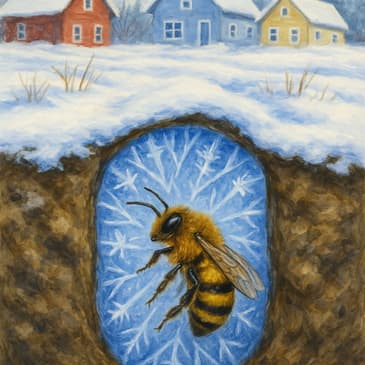
Native bees have antifreeze.
Yeah, antifreeze. Actual antifreeze proteins in their bodies that let them survive while the soil freezes solid all around them.
They need cold,
just like native plant seeds need cold stratification to germinate. And we talked about that in a previous episode.
Without enough freezing days,
they die.
What?
That's crazy.
Well,
this is episode 13.
Native bees have antifreeze.
Where your native bees really are right now and the incredible science of how they survive and what you need to do this week to help them make it to spring.
The underground bunker system.
Let's start with the biggest group.
About 70% of native bees nest underground.
Mining bees, digger bees, and sweat bees.
They're buried alive in your yard right now by choice.
And here's how it works.
In spring and summer, adult females emerge, mate, and excavate tunnels.
Each creates 20 to 30 underground chambers,
provisions each with pollen and nectar.
Lays one egg per chamber and seals it up and dies.
She never sees winter and she never sees her babies.
But Those babies,
they're 3 to 18 inches below your soil surface in a state called diapause.
Diapause is hibernation's hardcore cousin.
A genetically programmed shutdown triggered by day length and temperature.
So they're not sleeping.
They're just hitting pause on their entire biological system.
Not growing,
barely metabolizing,
basically suspended in time for eight to 10 months.
And here's something wild.
These underground nurseries are timed like Swiss watches.
Some species emerge in early spring,
others in summer,
others in fall.
All from the same patch of ground.
Now the antifreeze part.
These larva produce cryoprotectants,
which are proteins that prevent ice crystals from forming inside their cells.
The soil freezes solid all around them,
but their bodies stay protected.
Those proteins lower the freezing point of their fluids and prevent deadly ice crystal formation that would rupture their cells.
It's just incredible.
But here's the twist.
They need that cold.
They require chilling hours to complete development.
Without enough cold exposure,
their internal clocks scramble.
They can emerge too early, before flowers bloom,
or don't emerge at all.
It's exactly like cold stratification for seeds that we talked about in a previous episode.
They need winter to trigger the next stage.
So what you do right now determines whether they'll survive.
If you till your garden in fall,
you're destroying their chambers.
Spray pesticides for fall cleanup.
You're poisoning larvae underground.
Cover every inch with mulch or fabric.
You're eliminating nesting habitat.
Ground nesting bees need you to basically do nothing.
Nothing at all.
Leave bare soil patches,
skip the tilling,
and please just let them sleep.
The Cavity Crew what about cavity nesting bees like mason bees,
leaf cutter bees and small carpenter bees?
Well, it's the same strategy,
just a different location.
These bees nest in pre existing holes like hollow plant stems, beetle tunnels or gaps in stone walls or bee hotels.
Adult females partition the tube into tiny rooms using mud,
cut leaves or even wood pulp,
One egg and pollen provision per cell.
Then she seals the entrance and diesel and those babies are still in the tubes.
They complete most development by fall,
then overwinter as a prepupee or pupae,
transforming into adults inside their cocoons as spring approaches.
If your bee hotel has plugged holes with mud or leaf circles,
they're developing bees inside it right now,
hanging out in the dark for six to seven months.
And they're in diapause too.
Mason bees and leafcutter bees can survive down to 40 degrees below zero Fahrenheit.
They can handle freeze thaw cycles.
And basically they're built for cold.
But they can't handle getting wet.
Water is the enemy.
If it seeps into nesting tubes, they get fungal infections or drown.
And natural cavities work well because hollow stems angle downward for drainage.
And beetle holes have overhang protection.
And B hotels,
if they're mounted vertically,
you have to be careful because they're creating rain catchers.
So if you have a B hotel,
protect it now,
move it to an unheated shed or a garage or add a roof overhang.
You need ventilation too.
Sealed spaces trap moisture.
Bees need cooled and dry.
And here's what most people get wrong.
Never clean out a bee hotel in the fall.
I see this advice constantly. Harvest your cocoons.
No.
Leave them alone.
Those bees are in a delicate, dormant state.
Open their cocoons and you're exposing them to temperature fluctuations,
pathogens, and stress they can't handle.
Only harvest if you're doing scientific monitoring or if you're working with crown bees out of Washington state.
But basically, for backyard bee hotels,
please just let them be.
The bumblebee plot twist now Bumblebees.
I love bumblebees. I'm just obsessed with bumblebees.
But their winter strategy is completely different, and it's kind of heartbreaking.
All summer, you watch bumblebees visiting flowers, living in colonies with a queen and hundreds of workers.
When fall arrives, the workers die off.
By October, the entire colony is gone, except for one group,
the new queens.
Every colony produces new queens in late summer.
Daughters of the old queen.
They are the only bees that survive winter.
And their strategy?
Mate. Gorge on nectar and pollen to build fat reserves.
Find a hiding spot under leaf litter or in a rotted log, and hibernate alone.
A bumblebee queen spends six to eight months in torpor,
surviving on stored body fat.
She doesn't eat, she doesn't drink.
Her heart rate drops to a few beats per minute,
and basically she's in suspended animation.
And most don't make it.
The mortality rate is brutal,
70 to 95%,
depending on species and conditions.
Starvation,
freezing,
fungal infections. Predators are just getting crushed.
Each queen represents an entire future colony.
If she dies, that's hundreds of potential worker bees and dozens of new queens that will never exist.
This is why bumblebee populations are so vulnerable and why I'm so obsessed with helping them.
What do they need?
Well, first,
undisturbed habitat. Leaf litter, fallen logs, brush piles, unmowed edges.
If you rake every leaf and fall, you're potentially killing queens.
Remove all dead wood, you're removing hibernation sites.
Leave the lees.
Create a wild area where organic material accumulates.
Second,
late season flowers, which we discussed in previous episodes. Well,
new queens need to double their body weight in fat reserves to survive eight months long on nothing.
So those late season asters and goldenrods, they're basically life or death for bumblebee queens.
Cut back all your perennials in September.
Well, the queens have nowhere to forage.
Plant late bloomers like asters and goldenrod.
Joe Pye weed, Mountain mint.
They'll bloom into October and November.
And third,
early spring flowers.
Queens emerge in April, starving.
Without immediate nectar sources, they die.
And that is why dandelions are so important.
And spring, early blooming trees are critical.
Willows, maples, serviceberry. Spring beauty. Virginia bluebells.
Emergency rations for emergence. For emerging queens.
Pretty simple, right?
Speaker B: So the bottom line is basically do less.
Speaker A: Let it be wild.
Speaker B: You know where your native bees are. They're underground in tubes under leaves, protected.
Speaker A: By antifreeze proteins, waiting for spring.
Speaker B: Whether they survive depends on what you do in the next few weeks.
So your challenge,
if you choose to accept it, is pick one area this week and designate it a leave zone.
Corner of a bed, a section of your fence, patch under a tree.
Pile leaves, let stem stand,
leave it alone until May.
One small wild space supports hundreds of overwintering bees.
And take a photograph. And take me at Secret Pollinators.
Let's build a community of messy, beautiful, bee friendly yards.
If you have any questions,
please go to my website, secret pollinators.com and fill out the contact info or leave me a recorded voice message.
And if you're loving this show,
please.
Speaker A: Leave me a review.
Speaker B: It really helps others discover these incredible native bees that we're all trying to help and advocate for.
Next episode,
bees that don't wait for spring.
Winter warriors and zombie bees. Pollinating when it's literally freezing.
Antifreeze, perfect proteins, cold, active metabolism and truly bizarre adaptations.
You're listening to Secret Pollinators.
I'm Kelly from Montana, a certified pollinator steward.
Until next time,
leave the leaves and.
Speaker A: Let it be wild.
About Secret Pollinators
A wonder-first science podcast about native bees, bumblebees, wild bees, and the lesser-known pollinators most of us walk right past every day.
Visit secretpollinators.com