Cellophane Bees Make Natural Polyester That Chemists Can't Replicate
Transcript:
Speaker A: welcome back to Secret Pollinators.
I'm your host, Kelly Parks. And today is a really interesting episode because somewhere under your feet right now,
in a patch of soil, a sandy bank, a gap in the lawn,
there's a tunnel a few inches deep and no wider than a pencil.
And at the bottom of it,
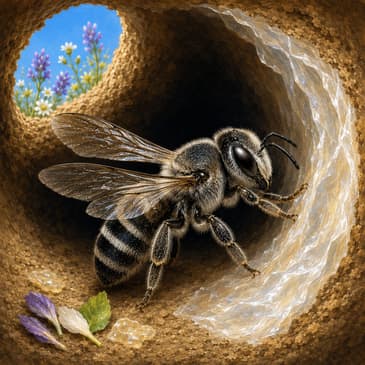
a native bee is painting.
She's using her tongue. She's applying clear liquid to the walls of the tunnel, layer after layer.
And when it dries, it becomes something remarkable.
A transparent, waterproof, flexible bag.
It looks like cellophane,
it behaves like plastic, and it resists water, mold and bacteria,
and no one has been able to reproduce it.
So today we're going to talk about the cellophane bees and what that material actually is and how that native bee makes it,
why it stumps chemists,
and why you've almost certainly walked past a colony of hundreds without noticing a thing.
Meet the painter.
The bees in question are the plaster bees, the polyester bees, the cellophane bees.
All three names describe the same behavior from different angles.
And in North America, the ones you're most likely to encounter belong to the genus Colettes.
There are around 100 species on this continent, and most of them look,
at first glance,
unremarkable.
They're medium sized with a fuzzy thorax,
pale bands of hair across the abdomen,
brown, tan,
pretty much unassuming,
the kind of bee you walk right past.
The tell is in the face.
These bees have a short, blunt tongue.
And unlike almost every other bee, it's forked at the tip,
two lobes splayed slightly apart, kind of like a tiny brush.
And for a long time, that forked tongue confused people.
It's the wrong shape for drinking deep nectar, and it looks primitive,
but it isn't primitive. It's a specialized applicator.
That tongue is how she builds the cellophane,
What She's Actually Making.
Here's how the process works.
The female digs her tunnel first,
usually in bare, well drained soil, and often at a slight angle,
sometimes a foot deep.
At the end of the tunnel, she excavates a small chamber, the brood cell.
Then she goes back to the entrance and starts producing secretions from a gland in her abdomen called the Dufour's gland.
In most bees, this gland produces relatively simple compounds.
But in these bees, it produces something entirely different.
She brings that secretion forward,
works it with her mandibles, or tiny teeth and that forked tongue,
and paints it onto the walls of the brood cell.
She applies it in overlapping strokes, and she does it again and again.
And as the layers dry and cure,
they polymerize,
chemical bonding into long chains.
What started out as a liquid becomes a continuous membrane,
clear,
slightly rubbery.
If you peel one out of the ground intact,
and you're holding basically what looks like a tiny sandwich bag with a bee larva inside.
The chemical name for what she's made is a laminated polyester.
It's a natural polymer, and it's the closest thing in the insect world to industrially manufactured plastic film,
like,
I don't know, cling wrap or something.
She made it with her mouth in the dark,
underground.
Why? It's hard to Copy.
The material has properties that would be extremely useful if we could manufacture it.
It's waterproof.
I mean, brood cells have been found submerged in flooded soil with the larva inside,
dry and alive.
It's antimicrobial. It resists the fungi and bacteria that would otherwise destroy a food store sitting in a damp,
warm dirt for months.
It's flexible without cracking. It's biodegradable.
And it's produced at an ambient temperature from a small volume of biological secretion with no heat,
no pressure, and no petroleum.
I mean, industrial polyester requires all of those things.
High heat catalysts, controlled conditions,
and fossil feedstock.
Researchers have analyzed the composition and identified the general class of compounds involved.
Macrocyclic lactomes,
among others.
And there's active interest in the material for bio degradable packaging and medical applications.
But identifying what something is made of is not the same thing as knowing how to make it.
The bee's process involves a specific sequence of secretion.
The mechanical working of the material,
the layering,
the curing conditions inside a sealed underground chamber.
So you can reproduce the ingredient list in a lab,
but you don't get the film.
You get a big mess.
So the recipe is in the behavior,
not just the chemistry.
The cities you don't see.
Cellophane bees are solitary, and we've talked about solitary bees in many of my previous episodes.
Every female digs her own tunnel,
provisions her own cells, and seals them and dies.
No queen, no workers, no shared labor.
But they're gregarious, and that distinction matters.
Where the soil is right, hundreds or thousands of females will nest in the same patch,
each one independent, each one a few inches from her neighbor.
From above, it looks like a scatter of small holes,
each with a low ring of excavated dirt around it.
In early spring, these aggregations produce one of the most startling sights in native bee biology.
A low drifting cloud of bees hovering a few inches above the ground.
Those are the males which emerge first, patrolling and waiting for the females to surface.
And they can't sting you. Male bees have no stinger. A stinger is a modified egg laying structure and males just don't have one.
The females can sting technically, but they're so reluctant that most people who've handled them have never been stung.
And this is the moment cellophane bees get reported to exterminators.
A homeowner sees a thousand bees swirling over the lawn in March and assumes the worst.
In six weeks they'll be gone entirely and the soil will be better aerated than it was before.
Where to find them?
These native bees are among the earliest bees of the year and many are tied to spring blooming trees and shrubs like willow, maple, serviceberry. And some are tightly specialized on a single plant genus.
The unequal cellophane bee is a good example. It emerges in late winter or very early spring sometimes when there's still snow at the edges of things.
And it's strongly associated with the red maple and willow bloom.
And in the fall, a different set of species emerges to work. Goldenrod and aster.
We've talked about that in previous episodes.
So there's a spring wave and an autumn wave with a gap in between.
What to look for on the ground is bare or sparsely vegetated soil well drained.
It's often sandy or sandy loam, sand, south facing slopes, path edges,
the dead patch in a lawn,
sandy road cuts or bare ground under your deck.
And what to look for on the bee is that fuzzy thorax, pale abdominal bands and the heart shaped face.
The head is noticeably wider at the top and tapers towards the mouth,
which gives it a distinctive look. Once you've seen it,
and if you find an aggregation, the single best thing you can do is absolutely nothing.
Don't mulch it,
don't seed it, don't treat it.
Bare ground looks like neglect to a lot of people and it's habitual to want to,
you know, cover it up.
But it's also habitat to about 75% of native bee species.
Outro
So a solitary bee, a forked tongue,
an abdominal gland and a waterproof polyester film that our best chemists can characterize but cannot manufacture.
Isn't nature interesting?
And this bee has been doing it for something like a hundred million years.
And she's doing it right now. A few inches under a bare patch of soil and she'll be sealed up and gone before most people even notice anything at all.
So remember,
until next time,
keep watching. The native bees, because they're probably watching you back.
And thank you so much for listening to this episode. I really appreciate it.
And I also did another episode about native bees have antifreeze, I think, last fall,
which you should listen to, because native bees are just incredibly fascinating,
and the things they do that we never notice ever,
are just simply remarkable.
About Secret Pollinators
A wonder-first science podcast about native bees, bumblebees, wild bees, and the lesser-known pollinators most of us walk right past every day.
Visit secretpollinators.com
[00:00:03] Welcome back to Secret Pollinators. I'm your host, Kelly Parks, and today is a really interesting episode. Because somewhere under your feet right now, in a patch of soil, a sandy bank, a gap in the lawn, there's a tunnel. A few inches deep and no wider than a pencil. And at the bottom of it, a native bee is painting. She's using her tongue, she's applying clear liquid to the walls of the tunnel, layer after layer.
[00:00:33] And when it dries, it becomes something remarkable. Transparent, waterproof, flexible bag. It looks like cellophane. It behaves like plastic. And it resists water, mold, and bacteria. And no one has been able to reproduce it. So today we're going to talk about the cellophane bees. And what that material actually is and how that native bee makes it. Why it stumps chemists.
[00:01:03] And why you've almost certainly walked past a colony of hundreds without noticing a thing. Meet the painter. The bees in question are the plaster bees, the polyester bees, the cellophane bees. All three names describe the same behavior from different angles. And in North America, the ones you're most likely to encounter belong to the genus Colletes.
[00:01:31] There are around a hundred species on this continent. And most of them look, at first glance, unremarkable. They're medium-sized with a fuzzy thorax, pale bands of hair across the abdomen. Brown, tan, pretty much unassuming. The kind of bee you walk right past. The tell is in the face. These bees have a short, blunt tongue.
[00:01:57] And unlike almost every other bee, it's forked at the tip. Two lobes splayed slightly apart, kind of like a tiny brush. And for a long time, that forked tongue confused people. It's the wrong shape for drinking deep nectar. And it looks primitive. But it isn't primitive. It's a specialized applicator. That tongue is how she builds the cellophane.
[00:02:25] What she's actually making. Here's how the process works. The female digs her tunnel first. Usually in bare, well-drained soil and often at a slight angle. Sometimes a foot deep. At the end of the tunnel, she excavates a small chamber. The brood cell. Then she goes back to the entrance and starts producing secretions from a gland in her abdomen called the Dufour's gland.
[00:02:53] In most bees, this gland produces relatively simple compounds. But in these bees, it produces something entirely different. She brings that secretion forward. Works it with her mandibles, or tiny teeth, and that forked tongue. And paints it onto the walls of the brood cell. She applies it in overlapping strokes. And she does it again and again. And as the layers dry and cure, they polymerize.
[00:03:23] Chemical bonding into long chains. What started out as a liquid becomes a continuous membrane. Clear, slightly rubbery. If you peel one out of the ground intact, and you're holding basically what looks like a tiny sandwich bag with a bee larva inside. The chemical name for what she's made is a laminated polyester. It's a natural polymer.
[00:03:49] It's the closest thing in the insect world to industrially manufactured plastic film. Like, I don't know, cling wrap or something. She made it with her mouth. In the dark. Underground. Why it's hard to copy. The material has properties that would be extremely useful if we could manufacture it. It's waterproof.
[00:04:18] I mean, brood cells have been found submerged in flooded soil with the larva inside, dry and alive. It's antimicrobial. It resists the fungi and bacteria that would otherwise destroy a food store sitting in a damp, warm, dirt for months. It's flexible without cracking. It's biodegradable.
[00:04:43] And it's produced at an ambient temperature from a small volume of biological secretion with no heat, no pressure, and no petroleum. I mean, industrial polyester requires all of those things. High heat, catalysts, controlled conditions, and fossil feedstock. Researchers have analyzed the composition and identified the general class of compounds involved.
[00:05:11] Macrocyclic lactones, among others. And there's active interest in the material for biodegradable packaging and medical applications. But identifying what something is made of is not the same thing as knowing how to make it. The bees process involves a specific sequence of secretion. The mechanical working of the material. The layering. The curing conditions inside a sealed underground chamber.
[00:05:40] So, you can reproduce the ingredient list in a lab, but you don't get the film. You get a big mess. So, the recipe is in the behavior. Not just the chemistry. The cities you don't see. The cellophane bees are solitary. And we've talked about solitary bees in many of my previous episodes.
[00:06:06] Every female digs her own tunnel, provisions her own cells, and seals them, and dies. No queen, no workers, no shared labor. But they are gregarious. And that distinction matters. Where the soil is right, hundreds or thousands of females will nest in the same patch. Each one independent. Each one a few inches from her neighbor. From above, it looks like a scatter of small holes.
[00:06:34] Each with a low ring of excavated dirt around it. In early spring, these aggregations produce one of the most startling sites in native bee biology. A low, drifting cloud of bees hovering a few inches above the ground. Those are the males which emerge first, patrolling and waiting for the females to surface. And they can't sting you. Male bees have no stinger. A stinger is a modified egg-laying structure, and males just don't have one.
[00:07:03] The females can sting technically, but they're so reluctant that most people who've handled them have never been stung. And this is the moment cellophane bees get reported to exterminators. A homeowner sees a thousand bees swirling over the lawn in March, and assumes the worst. In six weeks, they'll be gone entirely, and the soil will be better aerated than it was before. Where to find them?
[00:07:31] These native bees are among the earliest bees of the year. And many are tied to spring-blooming trees and shrubs like willow, maple, serviceberry. And some are tightly specialized on a single plant genus. The unequal cellophane bee is a good example. It emerges in late winter or very early spring, sometimes when there's still snow at the edges of things. And it's strongly associated with the red maple and willow bloom.
[00:07:59] And in the fall, a different set of species emerges to work goldenrod and aster. We've talked about that in previous episodes. So there's a spring wave and an autumn wave with a gap in between. What to look for on the ground is bare or sparsely vegetated soil, well-drained. It's often sandy or sandy loam, south-facing slopes, path edges, the dead patch in a lawn,
[00:08:28] sandy road cuts, or bare ground under your deck. And what to look for on the bee is that fuzzy thorax, pale abdominal bands, and the heart-shaped face. The head is noticeably wider at the top and tapers towards the mouth, which gives it a distinctive look once you've seen it. And if you find an aggregation, the single best thing you can do is absolutely nothing. Don't mulch it. Don't seed it.
[00:08:57] Don't treat it. Bare ground looks like neglect to a lot of people. And it's habitual to want to, you know, cover it up. But it's also habitat to about 75% of native bee species.
[00:09:16] So a solitary bee, a forked tongue, an abdominal gland, and a waterproof polyester film that our best chemists can characterize but cannot manufacture. Isn't nature interesting? And this bee has been doing it for something like 100 million years.
[00:09:43] And she's doing it right now, a few inches under a bare patch of soil. And she'll be sealed up and gone before most people even notice anything at all. So remember, until next time, keep watching the native bees because they're probably watching you back. And thank you so much for listening to this episode. I really appreciate it.
[00:10:12] And I also did another episode about native bees have antifreeze, I think last fall, which you should listen to because native bees are just incredibly fascinating. And the things they do that we never notice ever are just simply remarkable. And I'll see you next time.