
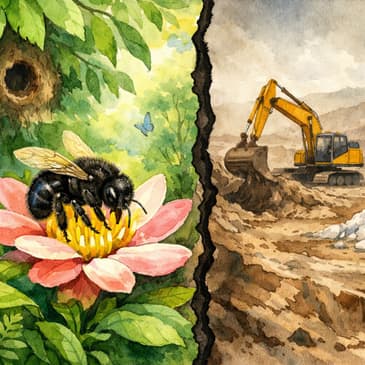
Brazil's "Lithium Valley" is booming—and native stingless bees are disappearing. In March 2026, Brazil votes on whether to protect these ancient pollinators from mining operations. Kelly explores the uncomfortable conflict between electric vehicles and biodiversity, and asks: Are we trading one crisis for another?
KEY SOURCES
Lithium mining and stingless bees in the Jequitinhonha Valley
- Mongabay, "Beekeepers in Brazil worry lithium mining puts their bees in jeopardy" (January 2026) — beekeeper testimony from the valley; Ministry of Environment proposed resolution establishing mandatory procedures for active search, rescue, relocation, and monitoring of native stingless bee colonies in areas authorized for vegetation suppression, including mining projects; Sigma Lithium did not respond to requests for comment.
- Mongabay, "In Brazil's Jequitinhonha valley, communities share how to reduce lithium mining impacts" (April 2025) — region holds up to 85% of Brazil's known lithium deposits; Sigma Lithium's Greentech plant operating since 2023.
- Mongabay, "Locals in a Brazilian valley report health issues after arrival of lithium mine" (November 2024) — Sigma's waste rock pile covering 560,000 square meters; reported respiratory illness, river siltation, structural damage from blasting.
- Dialogue Earth, "Brazilian lithium pitched as 'carbon neutral' relied on offset project linked to deforestation" (November 2025)
- Cultural Survival / Jequitinhonha Valley community report — projected 195.6 hectares of tailings, roughly 30% more than comparable Brazilian mines.
Regulatory and legal context
- Decree 11.120/2022, published July 2023 — opened foreign trade operations in Brazilian lithium minerals and derivatives.
- Federal Public Ministry (MPF) recommendation, September 2025 — asked the National Mining Agency to suspend research and mining authorizations in Araçuaí, Itinga and neighboring municipalities pending consultation under ILO Convention 169. Covered by Mining.com, "Brazil prosecutors call for halt on lithium mining in Minas Gerais" (September 2025).
Peru stingless bee legal rights
- Provincial Municipality of Satipo, Peru — Municipal Ordinance No. 33-2025-CM/MPS (October 2025), granting legal rights to native stingless bees within the Avireri-VRAEM Biosphere Reserve. Earth Law Center.
- Municipality of Nauta, Loreto — parallel ordinance (December 2025).
- Wang, S.-J., & Wubie, A. J. (2026). Correspondence in Nature on the first legal rights granted to an insect.
- The Guardian; Inside Climate News (Teresa Tomassoni); Smithsonian Magazine, "Honey-Making Stingless Bees in the Peruvian Amazon Become the First Insects to Gain Legal Rights" (January 2026).
Stingless bee biology and meliponiculture
- Michener, C. D. (2013). The Meliponini. In Vit, P., Pedro, S. R. M., & Roubik, D. (eds.), Pot-Honey: A Legacy of Stingless Bees. Springer.
- Slaa, E. J., Sánchez Chaves, L. A., Malagodi-Braga, K. S., & Hofstede, F. E. (2006). Stingless bees in applied pollination: practice and perspectives. Apidologie, 37(2), 293–315. DOI: 10.1051/apido:2006022
- Giannini, T. C., et al. (2015). Native and non-native supergeneralist bee species have different effects on plant-bee networks. PLOS ONE.
#GreenEnergy #LithiumMining #ElectricVehicles #ElectricCars #EVs #NativeBees #StinglessBees #Brazil #ClimateChange #Biodiversity #PollinatorConservation #EnvironmentalJustice #IndigenousRights #SustainableMining #RenewableEnergy #ClimateAction #BatteryRecycling #EnvironmentalImpact #GreenEnergyDilemma #DarkSideOfGreenEnergy #Tesla #NativePollinators
About Secret Pollinators
A wonder-first science podcast about native bees, bumblebees, wild bees, and the lesser-known pollinators most of us walk right past every day.
Visit secretpollinators.com