
EPISODE DESCRIPTION
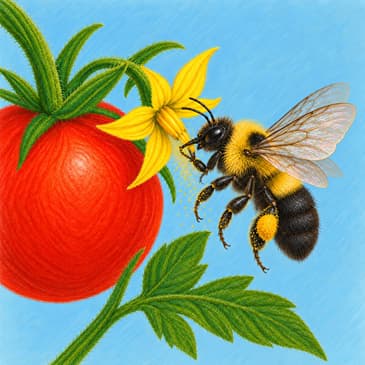
Your tomato flowers are keeping a secret. They lock their pollen inside a sealed yellow cone and offer no nectar at all, waiting for a visitor that can shake the pollen loose. In this episode, we explore buzz pollination: how bumblebees fire their flight muscles with their wings folded to vibrate flowers open, why there's no single magic frequency, why honey bees don't do it, and how this trick evolved about forty-five separate times across bees. We look at what a buzzing bee actually adds to a tomato that can pollinate itself, how bumblebees transformed greenhouse tomato growing, and how to hear buzz pollination happening in your own garden.
KEY SOURCES & DOIs
Tomato flower structure and self-pollination
AHDB, "Tomato flower structure and fertilisation" (anthers release pollen through longitudinal slits). https://potatoes.ahdb.org.uk/knowledge-library/tomato-flower-structure-and-fertilisation
Switzer, C.M., & Combes, S.A. (2017). Bumblebee sonication behavior changes with plant species and environmental conditions. Apidologie, 48, 223–233. DOI: 10.1007/s13592-016-0467-1 (~8% of flowering plants, ~20,000 species, with poricidal anthers)
University of Maryland Extension, "Tomato Pollination and Bumblebee Visits" (2023) (wind is usually enough for field pollination; bees increase fruit set)
Buzz mechanics
Woodrow, C., Jafferis, N., Kang, Y., & Vallejo-Marín, M. (2024). Current Biology, 34(18), 4104–4113. DOI: 10.1016/j.cub.2024.07.044 (buzz bursts of 100–400 Hz lasting 200–2,000 ms; used here for background only)
Rosi-Denadai, C.A., et al. (2020). Buzz-pollination in Neotropical bees: genus-dependent frequencies and lack of optimal frequency for pollen release. Insect Science, 27, 133–142. DOI: 10.1111/1744-7917.12602
Pritchard, D.J., & Vallejo-Marín, M. (2020). Floral vibrations by buzz-pollinating bees achieve higher frequency, velocity and acceleration than flight and defence vibrations. Journal of Experimental Biology, 223, jeb220541. DOI: 10.1242/jeb.220541
Harder, L.D., & Barclay, R.M.R. (1994). The functional significance of poricidal anthers and buzz pollination: controlled pollen removal from Dodecatheon. Functional Ecology, 8, 509–517. DOI: 10.2307/2390076
Morgan, T., Whitehorn, P., Lye, G.C., & Vallejo-Marín, M. (2016). Floral sonication is an innate behaviour in bumblebees that can be fine-tuned with experience in manipulating flowers. Journal of Insect Behavior, 29, 233–241. DOI: 10.1007/s10905-016-9553-5
Honey bees and evolution
King, M.J., & Buchmann, S.L. (2003). Floral sonication by bees: mesosomal vibration by Bombus and Xylocopa, but not Apis, ejects pollen from poricidal anthers. Journal of the Kansas Entomological Society, 76, 295–305
Stroh, E.L. (2025). Characterizing bee communities and pollen limitation in Indiana specialty crops. PhD thesis, Purdue University. https://hammer.purdue.edu/articles/thesis/Characterizing_bee_communities_and_pollen_limitation_in_Indiana_specialty_crops/27910515
Stroh, E., Leach, A., Mateos-Fierro, Z., & Kaplan, I. (2024). Distinct pollinator communities persist among co-flowering specialty crops in Indiana. Journal of Pollination Ecology, 37, 269–283. DOI: 10.26786/1920-7603(2024)808
Cardinal, S., Buchmann, S.L., & Russell, A.L. (2018). The evolution of floral sonication, a pollen foraging behavior used by bees (Anthophila). Evolution, 72, 590–600. DOI: 10.1111/evo.13446
Cooley, H., & Vallejo-Marín, M. (2021). Journal of Economic Entomology, 114(2), 505. DOI: 10.1093/jee/toab009 ("more than half of all bee species can buzz pollinate")
What the buzz is worth, and greenhouse history
Cooley, H., & Vallejo-Marín, M. (2021). Buzz-pollinated crops: a global review and meta-analysis of the effects of supplemental bee pollination in tomato. Journal of Economic Entomology, 114(2), 505. DOI: 10.1093/jee/toab009 (71 experiments; +64.72% fruit weight with buzz-pollinating bees, +85.37% with open pollination; non-buzzing bees, auxin, and mechanical vibration not significant)
Velthuis, H.H.W., & van Doorn, A. (2006). A century of advances in bumblebee domestication and the economic and environmental aspects of its commercialization for pollination. Apidologie, 37, 421–451 (40,000 ha of tomatoes pollinated by bumblebees in 2004)
Ohio State University Extension, "Bumble Bee Pollination in Tomato Greenhouses," ENT-0092 (common eastern bumblebee most widely used in North America)
Precision pollination review, Agronomy 12(2):518 (2022), citing truss-vibration and pulsating air-jet studies (historical mechanical pollination). https://www.mdpi.com/2073-4395/12/2/518
Cool-weather flight (Segment Five)
Heinrich, B. (2004). Bumblebee Economics (rev. ed.). Harvard University Press (pre-flight warm-up by shivering flight muscles)
TRANSCRIPT:
Kelly:
Welcome to Secret Pollinators. Walk out to a tomato plant in the middle of summer and look at the flowers.
They're small, yellow, and a little droopy.
Most people walk right by them.
But that little flower is keeping a secret.
It locks its pollen away, and it only gives it to something that knows how to shake it loose.
I call it the tomato conspiracy.
Not because anyone's hiding anything from you,
but because the flower itself is.
So today's question,
do tomatoes really need bumblebees?
And the answer is way more interesting than a simple yes or no.
The flower that keeps the secret.
Most flowers put their pollen out in the open.
It sits on the outside of the anthers, the pollen-bearing parts,
and any visitor brushing past it picks some up.
Well, a tomato flower does something different.
Its anthers are joined together into a narrow yellow cone that points straight down the middle of the flower.
The anthers split open on the inside of that cone,
so the pollen spills into a sealed tube.
The only way out is the opening at the very tip.
So picture a salt shaker. Turn it upside down, and almost nothing comes out.
Shake it,
and the pollen pours.
And the tomato isn't unusual in this.
Botanists estimate that around 20,000 species of flowering plants,
roughly 8% of them, keep their pollen locked inside anthers that release it only through small pores.
Eggplants, blueberries, cranberries,
they all share the same basic idea.
Here's the other half of the secret. Like most flowers built this way, the tomato offers no nectar. There's no sugar reward. Sitting at the bottom of the bloom,
the only thing a visitor can take away is pollen.
So the flower is making a very particular deal.
It isn't paying every insect that lands,
it's paying the ones that can open the lock.
Now, here's where the conspiracy gets a twist.
A tomato flower can self pollinate.
It's self fertile, which means pollen from its own cone can fertilize its own ovary.
It doesn't need pollen from another plant, and it doesn't strictly need a bee.
What it needs is a shake out. In a garden or a field, the wind does some of that work,
rocking the stems and knocking a little pollen loose into the stigma, the part of the flower that receives it. And that's why tomatoes set fruit even when no bee ever visits it.
But a breeze is a clumsy tool.
It shakes the whole plant gently and at random.
And that really raises the question,
can the flower manage it on its own?
Why is it built so perfectly for a very specific kind of visitor.
The buzz
the tomato flower visitor it's built for, is actually a buzzing bee.
When a bumblebee lands on a tomato flower,
she curls her body around that yellow cone and holds on tight.
Then, then she switches on her flight muscles, which are the same powerful muscles that normally drive her wings.
But her wings stay folded,
and instead of turning that energy into flight,
she sends it into her own body.
The whole bee becomes a vibrating instrument, and the vibration travels straight into the flower.
Pollen streams out of the tip of the cone and lands on her.
Scientists call this sonication, and most of us know it as buzz pollination.
These buzzes are short and intense.
Each burst lasts anywhere from a fraction of a second to about 2 seconds.
And bees produce them at somewhat between 100 and 400 vibrations per second,
depending on the bee and the flower.
And we know that a flower buzz is its own special thing,
because studies comparing a bee's different buzzes found that the vibrations she makes on a flower reach higher frequencies, higher speeds and higher accelerations than the buzz she makes while flying and higher than the buzz she makes when she's defending herself.
And you can hear the difference.
So stand near a tomato plant on a warm day, and when a bumblebee starts working a flower, the sound changes.
It jumps up into a higher, sharper pitch than anything like her flying hum.
Once you learn that sound,
you'll be able to pick it out every time.
And there's another surprise on how the pollen comes out.
A flower like this doesn't dump everything at once.
Each buzz releases only a part of what's inside,
so the pollen is handed out in portions. Visit after visiting,
the flower rations its reward,
and the bee has to learn her part.
Experiments with bumblebees found that buzzing flowers is innate. A bumblebee knows how to do it without being taught. But with experience handling flowers,
she fine tunes her buzz.
Born knowing the trick and getting better with practice.
The bee that can't buzz
Now for the bee, most people picture when they think of pollination.
The honeybee.
Well,
honeybees don't buzz, pollinate. They can fly and they can buzz in flight, but they don't use that vibration to shake pollen out of flowers.
Researchers testing bees on flowers with locked anthers found that bumblebees and carpenter bees ejected pollen with their body vibrations and honeybees did not.
With no nectar to offer them and no way to unlock the pollen, there's very little in a tomato flower for a honeybee.
And that shows up in the field, too.
A three year study of crop pollinators on an indiana farms Found that spring crops like apples, blueberries,
Were dominated by honeybees. But summer tomatoes told a different story.
Tomato flowers were dominated by wild bees and particularly bumblebees.
So the tomato conspiracy was never about the honeybees doing a bad job,
the flowers speaking a language they just don't use.
And that language is old.
The ability to buzz flowers Is spread across the bee family tree, from bumblebees to carpenter bees to many kinds of small, solitary bees,
Roughly half of all the bee species can do it. And when researchers map the behavior across bee evolution,
they found it may go all the way back to the common ancestor of bees, somewhere between 100 and 145 million years ago.
And it didn't just arise once across the bee family tree. It has evolved independently about 45 times.
45 separate times, bees arrived in the same solution.
Grab the flower,
fire the flight muscles,
and shake.
What's the buzz worth?
So it's kind of back to our question. If a tomato can pollinate itself,
what does a buzzing bee actually add?
Well, in 2021, researchers pulled together decades of tomato pollination experiments from around the world,
71 experiments from 24 studies,
and asked exactly that.
And the results were clear.
Compared with flowers that received no pollination help at all,
Flowers pollinated by buzzing bees Produced fruit that weighed about 65% more on average.
Flowers left open to natural pollination,
wind, and visiting insects,
well,
did even better,
about 85% more.
And here's the part that surprised me.
Several other methods didn't make a significant difference at all to fruit weight in that analysis.
That included bees that don't buzz, Hormone sprays, and machines that vibrate the plants so the flower can make a tomato on its own.
But a tomato that's been properly shaken By a buzzing bee Tends to be a bigger tomato.
That difference is why commercial greenhouses changed how they grow tomatoes.
Inside a greenhouse, there's no wind, and for years, growers had to create the shake themselves,
Vibrating the flower clusters by hand or blowing air across the plants.
It was slow, repetitive work,
Done over and over throughout the season.
And then, in the mid-1980s,
commercially reared bumblebee colonies Became available For greenhouse pollination.
Growers could set a colony among the plants and let the bees do the shaking.
And that changed the industry.
Tomatoes became the main reason Bumblebees are raised commercially at all.
And by 2004,
bumblebee colonies were pollinating an estimated 40,000 hectares of tomatoes in north america. The species most widely used is the common eastern bumblebee,
an ancient partnership between flowers and buzzing bees ended up reshaping one of the world's most important greenhouse crops,
The buzz in your own garden.
So greenhouses buy their bumblebees and your garden gets them for free.
And that Indiana study found something else about field tomatoes. Their fruit set showed signs of being pollen limited,
meaning more pollination could have produced more fruit.
So when a wild bumblebee shows up in your tomato patch, she's adding something the breeze can't.
And here's how to find her.
If you go out on a warm day when your tomatoes are in bloom and listen before you look,
a second or two of that high pitched buzz is the sound of a flower being unlocked.
Then you'll find the bee. She'll be hanging from the flower body, wrapped around that yellow combination.
And if the light is behind her, you may even catch a faint puff of pollen coming out of the tip.
Bumblebees are also early risers and cool weather workers.
They can warm up their flight muscles by shivering them before takeoff,
which lets them fly in cooler conditions than many other bees.
So don't only look at midday. Cool mornings can be worth a visit, too.
And once you know the sound, you'll start hearing it everywhere.
On blueberry blossoms, on eggplant flowers, on wildflowers, that same downward pointing cone.
Every one of them is running the same quiet pollen for the bees that know how to shake.
So do tomatoes really need bumblebees?
Well, to make a tomato?
No, not really. But to make a great tomato.
That's where bumblebees earn their keep.
And it's exactly why commercial growers pay for bumblebee colonies instead of shaking the flowers themselves.
And that's the real tomato conspiracy.
Not a secret someone kept,
but a secret the flowers been keeping in plain sight all along.
Well, thank you so much for listening. I really appreciate it.
And remember, keep watching those wild native bees, because they're probably watching you back.
About Secret Pollinators
A wonder-first science podcast about native bees, bumblebees, wild bees, and the lesser-known pollinators most of us walk right past every day.
Visit secretpollinators.com