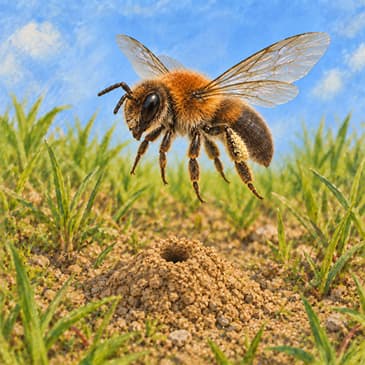
Those tiny volcanoes of soil in your spring lawn are front doors. Behind each one, a female mining bee is building an underground nursery. Here's what those holes really are, why you won't see them in late summer, why these bees are gentle, how their timing shifts with the weather, and how to find them next spring.
KEY SOURCES & DOIs
Mining bee biology and nest structure
- Michener, C. D. (2007). The Bees of the World, 2nd ed. Johns Hopkins University Press. Andrenidae; scopa and pollen transport.
- Danforth, B. N., Minckley, R. L., & Neff, J. L. (2019). The Solitary Bees: Biology, Evolution, Conservation. Princeton University Press.
- Schrader, M. N., & LaBerge, W. E. (1978). The nest biology of the bees Andrena (Melandrena) regularis Malloch and Andrena (Melandrena) carlini Cockerell. Illinois Natural History Survey Biological Notes 108. Nest depth of 6–7 inches.
- Missouri Department of Conservation. Andrenid Bees (Miner Bees). Branching tunnels ending in brood cells; waterproof cell lining secretion.
- Cane, J. H. (1991). Soils of ground-nesting bees: texture, moisture, cell depth and climate. Journal of the Kansas Entomological Society, 64(4), 406–413.
Ground-nesting prevalence and nesting habitat
- Antoine, C. M., & Forrest, J. R. K. (2021). Nesting habitat of ground-nesting bees: a review. Ecological Entomology, 46(2), 143–159. DOI: 10.1111/een.12986
- Xerces Society (2017). Nesting & Overwintering Habitat for Pollinators and Beneficial Insects. xerces.org. Tillage destroys ground nests.
- Wild Pollinator Partners / Fletcher Wildlife Garden: tilling destroys andrenid nests.
- Iowa State University Extension, Yard and Garden: Mining Bees. Grass is thin before the bees arrive; entrances are not damaging; sting risk is low.
Aggregations and communal nesting
- Paxton, R. J., Thorén, P. A., Tengö, J., Estoup, A., & Pamilo, P. (1996). Mating structure and nestmate relatedness in a communal bee, Andrena jacobi (Hymenoptera, Andrenidae), using microsatellites. Molecular Ecology, 5(4), 511–519. Shared entrances with independent provisioning.
- Hoge, S., Kueneman, J., Fordyce, R., Dobler, C., Odanaka, K., & Danforth, B. N. (2026). Emergence dynamics and host-parasite associations in a large aggregation of Andrena regularis (Hymenoptera: Apoidea: Andrenidae). Apidologie. DOI: 10.1007/s13592-026-01256-6. The E37 cemetery study.
Emergence timing
- Cane, J. H. (2021). Global warming, advancing bloom and evidence for pollinator plasticity from long-term bee emergence monitoring. Insects, 12(5), 457. DOI: 10.3390/insects12050457. Four ground-nesting species over 12–24 years; first emergence varied 4–6 weeks and tracked thermal cues.
Pollination
- Russo, L., Park, M. G., Blitzer, E. J., & Danforth, B. N. (2017). Flower handling behavior and abundance determine the relative contribution of pollinators to seed set in apple orchards. Agriculture, Ecosystems & Environment, 246, 102–108. DOI: 10.1016/j.agee.2017.05.033
- Park, M. G., Raguso, R. A., Losey, J. E., & Danforth, B. N. (2016). Per-visit pollinator performance and regional importance of wild Bombus and Andrena (Melandrena) compared to the managed honey bee in New York apple orchards. Apidologie, 47, 145–160.
- Schrader & LaBerge (1978), above: A. regularis as a blueberry pollinator.
- Park, M. G., Blitzer, E. J., Gibbs, J., Losey, J. E., & Danforth, B. N. (2015). Negative effects of pesticides on wild bee communities can be buffered by landscape context. Proceedings of the Royal Society B, 282(1809), 20150299. DOI: 10.1098/rspb.2015.0299. Wild bee abundance and species richness declined linearly with pesticide use one year after application; fungicides contributed significantly; surrounding natural habitat buffered the effect. Abstract verified.
- Tang, J., Quan, Q.-M., Chen, J.-Z., Wu, T., & Huang, S.-Q. (2019). Pollinator effectiveness and importance between female and male mining bee (Andrena). Biology Letters, 15(10), 20190479. PMCID: PMC6832193. Reviews Andrena as efficient pollinators of apple, pear, apricot, sweet cherry, blueberry and oilseed rape.
- Tepedino, V. J., Alston, D. G., Bradley, B. A., Toler, T. R., & Griswold, T. L. (2007). Orchard pollination in Capitol Reef National Park, Utah, USA. Honey bees or native bees? Biodiversity and Conservation, 16, 3083–3094. DOI: 10.1007/s10531-007-9164-8
- Garratt, M. P. D., et al. (2023). Addressing pollination deficits in orchard crops through habitat management for wild pollinators. Ecological Applications. DOI: 10.1002/eap.2743. Ground-nesting Andrena identified as especially important UK apple pollinators.
- Garibaldi, L. A., et al. (2013). Wild pollinators enhance fruit set of crops regardless of honey bee abundance. Science, 339(6127), 1608–1611. DOI: 10.1126/science.1230200. 41 crop systems worldwide.
Specialist mining bees
- Larkin, L. L., Neff, J. L., & Simpson, B. B. (2008). The evolution of a pollen diet: host choice and diet breadth of Andrena bees. Apidologie, 39, 133–145. Aster-family specialists (subgenus Callandrena) with branched scopal hairs.
#WildBees #NativeBees #MiningBees #GroundNestingBees #SolitaryBees #SecretPollinators #BeeScience #Pollinators #WildBeeWonder #UndergroundHeroes
About Secret Pollinators
A wonder-first science podcast about native bees, bumblebees, wild bees, and the lesser-known pollinators most of us walk right past every day.
Visit secretpollinators.com