Bee, Wasp or Fly? It's spring. Things are emerging. Something just buzzed past your ear, and your shoulders went up to your eyeballs. But was it a bee? A wasp? A fly? A genuinely surprising number of the "bees" in your garden are actually flies wearing a very convincing costume. In this episode, Kelly walks you through a five-second checklist — wings, antennae, eyes, waist, hair — that'll make you the most confident pollinator ID-er on your block. Plus, the hoverflies fooling everyone, the bee flies zooming over your dirt banks, and why bees are basically wasps that went vegetarian 125 million years ago.
How to tell if your pollinator is a bee, wasp or fly | The Great Sunflower Project
#SecretPollinators #PollinatorPodcast #NativeBees #Pollinators #BeeID #Hoverflies #BeeFly #Bombyliidae #Syrphidae #NativePollinators #BeeOrNot #PollinatorEducation #BackyardScience #CitizenScience #PollinatorGarden #SavetheBees #MontanaPollinators #SpringPollinators #WildBees #NatureNerd #EntomologyPodcast #SciencePodcast #NaturePodcast #MimicryInNature #PlantTheSpecies #LetItBeeWild #Flies #Wasp #Bumblebee #NativeBees
About Secret Pollinators
A wonder-first science podcast about native bees, bumblebees, wild bees, and the lesser-known pollinators most of us walk right past every day.
Visit secretpollinators.com
Speaker A: welcome back to Secret Pollinators. I'm Kelly Parks, your host and today we're doing something that I genuinely can't believe I haven't done yet.
A crash course in telling a bee from a wasp from a fly.
It's the perfect time because everything's emerging and in the next few weeks you're going to see a lot of little buzzing bodies.
I want you to be able to look down at them and know roughly what you're looking at.
So hopefully by the end of this episode, you'll have a five second checklist you can run in your head the next time something lands on a dandelion or your native tulips.
No microscope required, no bug degree required,
just your eyes and a little bit of curiosity.
So let's go the lineup. First, the suspects.
Worldwide, there are about 20,000 species of bees and around 4,000 of them live in North America.
But most people hear bee and picture a honeybee.
Honeybees are only one species.
The rest,
mason bees, mining bees, sweat bees, leaf cutter bees,
bumblebees. Which are my favorite? Well, those are your native bees. And most of them are solitary.
Most of them don't sting. They're very docile and most of them you've never noticed.
Then there's wasps.
Around 100,000 species worldwide,
also overwhelmingly solitary and also mostly not aggressive.
The yellow jackets and the hornets everyone's scared of, well,
they're a tiny slice of the wasp world.
That was tough to say.
And flies,
the order Diptera. That name literally means two wings and about 150,000 described species.
But honestly, the real number is probably a million plus.
Many of them are pollinators and some of them look exactly like bees on purpose. But we'll get there with that.
Three insects, three different superpowers.
So let's figure out who's who.
The five second checklist.
Here's five things to look at.
You won't catch them all on a moving bug, but you only need two or three to make the call.
And number one,
count the wings.
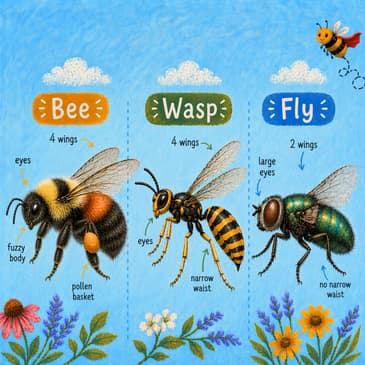
Bees have four wings.
Two pairs hook together in flight with these tiny little hooks called Hamulae.
Looks like one wing, but it's two.
And wasps have four.
Same deal.
Flies have two wings and that's the whole reason for their name.
One pair Diptera.
And people say, but Kelly, I can't count the wings on something moving that fast.
And I agree because I can't either.
But here's how I cheat.
Flies evolve their back wings into little drumstick shaped things called halters.
And I love this word. They vibrate at the same frequency as the wings and they work like little gyroscopes.
It's literally how flies pull off those insane aerial hairspin turns.
You know, the ones you've tried to fly a swat of fly you lost.
Well,
that's the reason.
And if you ever get a clear photo,
you can sometimes see them little Q tips sticking out behind the wings.
And the halters are one of the coolest evolutionary inventions in the whole insect world.
And they're the dead giveaway for that's a fly.
Now number two, look at the antenna.
Bees. Well,
they're long and elbowed, kind of bent in the middle like a little arm.
And wasps, well, they're also long and often thread like sometimes elbowed flies. Well, they're short and stubby, sometimes so short it looks like the fly doesn't even have any antennae,
usually with a little bristle coming up off the tip.
I mean,
they're very hard to see.
But if they're long and bendy,
it's either a bee or a wasp. And if it's tiny,
it's a fly.
Now number three, look at the eyes.
Bees eyes are oval on the sides of the head and reasonably sized.
Wasps are similar but often kidney shaped on the sides of their head.
And flies, well,
their eyes are huge,
sometimes cover most of the head and sometimes they meet on top.
If you look at a fly and feel like the eyes are bigger than the body,
that's because they kind of are so small eyes on the side of the head would be a bee or a wasp.
And big googly eyes wrapping around. That's a fly.
Now number four,
the waist.
This is where wasps out themselves because wasps have a narrow, pinched waist,
like somebody squeezing them right behind a thorax.
And you know the phrase wasp waist.
It's a real anatomical thing. Skinny, shiny, almost elegant.
Bees have a waist, but it's thicker, fuzzier and less dramatic.
And flies have basically no waist.
Their body's more compact, more continuous from head to butt.
See a clear hourglass with a shiny, skinny connector. Well, that's a wasp.
And number five, the hare.
And this is the magic bee trait,
one of the traits that secretly defines what a bee is.
Bees have branched hairs.
So every single hair on a bee's body is feathery,
like side branches coming off the main hair.
And you can't see this with the naked eye, but under a microscope,
bee hair looks like a tiny cedar branch.
Why, you ask? Well, because branched hair is incredible at catching pollen.
And here's the wild part.
A bee is essentially a wasp that went vegetarian about 125 million years ago.
Bees evolved from predatory wasp ancestors,
and when they switched to eating flower products instead of other insects,
they grew fuzzy, branched pollen, grabbing Velcro all over their bodies.
And that's it.
That's a bee, a fuzzy vegetarian wasp that's docile and nice. And wasps, meanwhile, have a simple kind of sparse hairs and they look shiny, almost naked.
Flies have bristles,
stiff, simple hairs.
Some flies are fuzzy bee flies, some hover flies, but their fuzz is not branched.
So something very fuzzy, covered in dusty yellow pollen, looking a little disheveled. That's almost certainly a bee.
Bonus behavior.
Here's a quick bonus layer because honestly, sometimes you can tell before you even see the bug clearly what it is.
Bees are methodical. They land on a flower and they spend time on it.
They're working,
they move to the next flower,
usually something similar. They're on the job now. Wasps are nervy, often patrolling,
often hunting.
Many wasps are predators, looking for caterpillars or spiders or other insects to eat.
The ones at your picnic, well, they're looking for protein and sugar.
Fast and a little erratic.
And flies, well, they dart,
they hover,
they land,
fly off, land again a foot away.
Hoverflies in particular hold a position in midair, like tiny helicopters.
They're kind of mesmerizing too.
And bees don't really do that. Bees fly point to point and flies while they're freestyle.
The tricksters.
This is where it gets genuinely fun,
because some flies have figured out that looking like a bee or a wasp is an excellent survival strategy. I mean, you can't blame them.
And if you, like, if you look like something that can sting the things that want to eat you, like birds, lizards, spiders, they're going to leave you alone.
And that's called Batesian mimicry. And flies are the world champions of this.
Meet the hoverflies. There's about 6,000 species and a huge number of them look like honeybees and bumblebees or yellow jackets.
Some are stunningly convincing.
Yellow stripes, the right buzz, even the wing pattern.
But remember your checklist. Two wings, short antennae,
huge eyes,
no skinny waist, and they hover like, I mean, they really hover,
like they're parked in the air.
Next time you see something yellow and black just sitting in midair over a flower, look closer.
Odds are it's a hoverfly.
And hoverflies are major pollinators in a lot of ecosystems. They're the second Most important pollinator group after bees.
They're out here doing the work quietly in a bee costume.
And then they're bee flies.
These are the tiny little fuzzy torpedo shaped insects that you see in early spring hovering over warm dirt banks with a long needle like spear sticking straight out in front.
And they look like kind of tiny fuzzy bumblebees,
but they're flies with two wings and they have enormous eyes and an absolutely wildlife cycle.
I mean many bee flies are parasites of solitary bees.
The female flecks her eggs into the burrows of the ground nesting bees and her larvae eat the bee larva.
It's just so dark and also fascinating.
In Montana, bee flies are everywhere in April and May. And if you see something that looks like a fuzzy cotton ball with a spear on the front hovering over a bare patch of dirt, well that's a bee fly.
What's emerging right now.
Here's a quick field guide for what you're likely seeing outside right now and at least around in Montana.
Queen bumblebees.
They're big,
they're fuzzy and they're slow flying because they're looking for nesting sites.
They're just heavy and cold and beautiful.
I'm seeing them right now and I just can't stop watching them.
Then there's mining bees and they're small solitary bees, often on willows and early flowers. They're ground nesting and completely harmless Mason bees. While they're stocky,
often shiny metallic blue or black,
they're caviting nesters.
And then there's bee flies as I mentioned,
fuzzy little spear faced hoverers over bare dirt hoverflies which are mesmerizing. And they're starting to show up wherever the flowers are.
And queen yellow jackets.
Yep,
the one wasp most people wish would stay in bed.
But right now it's just the queen alone, hunting for a spot to start her colony.
So don't kill her because one queen in April means one small manageable colony in August instead of a replacement queen from somewhere else. Starting over in a stress state because that's when they get meaner.
And if you want to practice your id,
the Great Sunflower Project has a really nice visual slide guide and I'll drop it in the show notes.
So let's recap your five second checklist.
Two wings. It's a fly.
Enormous googly eyes.
That's also a fly.
Hovering motionless.
It's a fly.
Narrow, pinched, shiny waist.
That's a wasp.
Long elbowed antennae on a long body. Well that could be a bee or a wasp.
Tiny, stubby antennae.
That's a fly.
And fuzzy and covered in pollen. That's a bee.
And methodically working a patch of flowers.
That's also a bee.
And that's it.
You're now roughly 90% of the way to knowing what's buzzing past your ear.
And here's the thing.
Once you can tell them apart,
you could stop swatting at the hoverflies.
You stop panicking over bee flies.
You start noticing how many different kinds of bees are actually in your yard or in your container or on your ranch.
And that kind of makes your garden get bigger just by looking harder.
Well, I want to thank you so much for listening. And if this episode helped, the single best thing you can do is send it to one of your friends who's been swatting at hoverflies all spring,
and you can tell them to stop. And it's a fly,
a big, important pollinator.
Tell them it's helping.
You can always find me@secretpollinators.com and until next time, not a bird,
not a plane,
just a tiny superhero.