
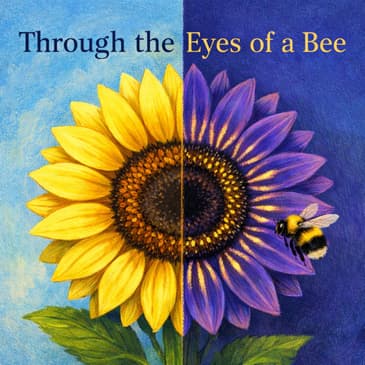
Bees have five eyes, can see colors that don't exist in the human visual spectrum, and navigate by reading polarized light patterns in the sky like a living GPS. With the National Geographic Secrets of the Bees special fresh in everyone's minds, this is the episode that goes deeper — into the visual system that makes all that extraordinary bee behavior possible. And yes, it changes how you'll think about your garden.
Watch Secrets of the Bees TV Show - Streaming Online | Nat Geo TV
#SecretPollinators #BeeVision #CompoundEyes #NativePollinators #PollinatorGarden #UVVision #BeeScience #SecretsOfTheBees #NatGeo #BumblebeeLove #NativePlants #PollinatorSteward #NationalGeographic #SecretsofBees #NativeBees #WildBees #JamesCameron #bees
About Secret Pollinators
A wonder-first science podcast about native bees, bumblebees, wild bees, and the lesser-known pollinators most of us walk right past every day.
Visit secretpollinators.com
Speaker A:
So National Geographic just dropped Secrets of the Bees. And if you haven't watched it,
you need to stop what you're doing.
James Cameron. Erdie Gregory. Medical grade cameras inside a live hive.
It's absolutely stunning.
But here's what it didn't tell you.
While you were watching those bees navigate the world with what looked like effortless instinct,
zipping from flower to flower,
finding their way home across miles of landscape,
you're watching something that makes our best GPS technology look like a paper map.
Welcome back to Secret Pollinators.
I'm Kelly Parks, your host, and today we're going inside the most remarkable visual system in the insect world.
So buckle up, because bees don't just see the world differently than we do.
They see a completely different world.
Five eyes?
Yes,
five.
Let's start with something that surprises most people.
Bees have five eyes,
not two, Five.
You've got two big compound eyes on the sides of the head,
and those are the ones you can actually see.
But tucked on top of the head,
almost hidden,
are three tiny, simple eyes called ocelli.
They're arranged in a little triangle, and they don't form images the way compound eyes do.
They're more like light meters,
which, you know, pick up brightness, detecting the horizon,
helping the bee stay level in flight.
Think of them as the autopilot. When, while the compound eyes are doing the actual navigation.
Now, the compound eyes, this is where it gets wild.
Each one is made up of thousands of individual lenses called ommatidia.
Each lens captures a tiny slice of the world,
and the brain stitches all of those slices together into a mosaic view.
It's not the,
you know, crisp,
high definition image that you read with. It's more like a beautifully functional patchwork,
optimized not for resolution,
but for something far more useful.
Speed and information.
The color shift.
Here's where your brain has to do a little work.
We see in red, green and blue. That's our world. And bees also see these colors,
but theirs are shifted. They see green, blue, and ultraviolet.
UV light that is completely invisible to us.
Red, to a bee, looks like black. A gorgeous red poppy,
dark and unremarkable.
But that same poppy almost certainly has UV patterns on its petals,
which kind of are like landing guides or nectar markers or visual bullseyes that bees can read like a neon sign.
And it gets better.
Bees can see a color we don't even have a word for.
Researchers call it bees purple,
a combination of yellow and UV wavelengths that sit completely outside the human experience.
We can't even imagine it. Our Brains literally don't have the architecture for it.
And flowers have been speaking this language for millions of years.
We just finally figured out they were talking.
The GPS that runs on sunlight.
Now, here's the part that connects directly to what you watched in Secrets of the Bees.
All that extraordinary foraging behavior,
the navigation across vast different distances,
and finding the hive again. Well, how do they do it?
Polarized light.
When sunlight scatters through the atmosphere, it creates patterns of polarized light in the sky.
Light traveling in specific, predictable directions.
And we can't see these patterns, but bees absolutely can.
A 2025 study published in Biology Letters confirmed that bumblebees use both their compound eyes and. And their ocelli to detect polarized light.
And that which system takes over depends on brightness,
how bright the daylight is.
Well,
if it's bright, compound eyes leave.
But if it's dim,
dawn and dusk, the ocellis step in.
It's a living switching GPS system.
And it works even when the sun is hidden behind the clouds, because UV light penetrates cloud cover.
I mean, we've all been sunburned on a cloudy day, haven't we?
So on an overcast day, when you can't even find your car in the parking lot,
a bee is navigating with pinpoint accuracy, using a solar compass that never goes offline.
Carl von Frisch,
who won the Nobel Prize for decoding the waggle dance,
figured it out in the 1940s that bees were using polarized light.
Well,
we're still unraveling just exactly how.
Slow down. You're moving too fast.
One more thing, and this is kind of personal for me.
Bees have an incredibly high flicker fusion rate.
And what that means is they can process visual information much faster than we can,
where we see smooth, continuous motion. You know, like a flower swaying in the wind,
a bee sees individual frames.
Fast moving. Things that blur for us are crisp and clear for them.
And that's why swatting at a bee never really works. By the time your hand is halfway through the swing, they've already processed the threat and made a decision.
But here's the part I think about as a certified pollinator steward. It also means that bees can track the subtle micro movements of flowers in ways we completely miss.
The angle of a petal,
a shift in iridescence,
patterns that appear and disappear depending on the angle of light.
Flowers aren't passive in this relationship.
They're actually advertising actively in a visual language refined over a hundred million years.
And you know what?
Bees are reading every word.
What this means for your garden.
So what do you do with all of this?
Well, you plant for uv.
Native wildflowers that evolved alongside native bees almost always have UV patterns.
Their co evolved pollinators can see many of the ornamental cultivars you find at big box garden centers. Well,
they've been bred for color traits that we find appealing and in the process those UV signals have been blurred or lost entirely.
So a bee landing on an overbred double petunia is like walking into a grocery store where all the signs have been removed.
Everything looks vaguely food shaped,
but nothing tells you where anything is.
While native plants, they still have their signs up and they're absolutely critical for wild bee conservation.
Coneflowers, black eyed Susans, native asters, goldenrod,
whatever's native in your area,
the plants your local bees evolve with, well,
they're still broadcasting loud and clear frequencies that we can't see,
but that wild bees absolutely can.
James Cameron said something in the press for Secrets of the Bees that really stuck with me.
He said there are two kinds of secrets.
The one science knows that the public doesn't,
and the ones the bees have managed to keep from science until now.
Well, B vision sits in both categories.
We know enough to be astonished.
And there's still enough mystery left to keep researchers publishing papers trying to map exactly how those five eyes work together,
how polarization compass switches between systems and what B's purple actually looks like from the inside.
And we might never know that last one,
but I think that's okay,
because some things are better left as theirs.
Until next time,
keep looking closer.
And thank you for listening to my podcast, the Secret Pollinators.