That snap from the bug zapper on the patio? It's usually killing a night pollinator and almost never a mosquito. When researchers counted every insect six zappers killed over a full summer, only two-tenths of one percent were biting flies — the rest were harmless aquatic insects, natural pest-controllers, and the night-flying moths that pollinate in the dark while we sleep. This episode unpacks why the device is aimed at the wrong target from the start (mosquitoes don't hunt by light — they hunt by the CO₂ and heat your body gives off), what's really dying in that electric grid, and the simpler, cheaper things that actually keep the biters off you. A short, clear look at a familiar summer sound — and the quiet cost of that glowing purple lamp.
KEY SOURCES & DOIs
The primary study — non-target kill counts
- Frick, T. B., & Tallamy, D. W. (1996). Density and diversity of nontarget insects killed by suburban electric insect traps. Entomological News, 107(2), 77–82. — The six-trap, summer-1994 Newark, Delaware study; 13,789 insects killed, 31 biting flies (0.22%), ~48% non-biting aquatic insects, 13.5% predators and parasites.
Mosquito host-seeking cues (CO₂, heat, skin chemistry)
- Cardé, R. T. (2015). Multi-cue integration: how female mosquitoes locate a human host. Current Biology, 25(18), R793–R795. DOI: 10.1016/j.cub.2015.07.057
- McMeniman, C. J., Corfas, R. A., Matthews, B. J., Ritchie, S. A., & Vosshall, L. B. (2014). Multimodal integration of carbon dioxide and other sensory cues drives mosquito attraction to humans. Cell, 156(5), 1060–1071. DOI: 10.1016/j.cell.2014.01.044
Nocturnal moth pollination
- Macgregor, C. J., Pocock, M. J. O., Fox, R., & Evans, D. M. (2015). Pollination by nocturnal Lepidoptera, and the effects of light pollution: a review. Ecological Entomology, 40(3), 187–198. DOI: 10.1111/een.12174
- Hahn, M., & Brühl, C. A. (2016). The secret pollinators: an overview of moth pollination with a focus on Europe and North America. Arthropod-Plant Interactions, 10(1), 21–28. DOI: 10.1007/s11829-016-9414-3
#SecretPollinators #NativeBees #WildBees #Pollinators #Moths #NocturnalPollinators #Mosquitoes #BugZapper #BackyardEcology #NatureFacts #Entomology #PollinatorConservation #ScienceForEveryone #HawkMoth #NightPollinators #MothPollinators
About Secret Pollinators
A wonder-first science podcast about native bees, bumblebees, wild bees, and the lesser-known pollinators most of us walk right past every day.
Visit secretpollinators.com
[00:00:04] Welcome back to Secret Pollinators. Today, that sound you know from summer patios, you know, the sharp electric snap of a bug zapper, and the question almost nobody asks about it, what's actually dying in there? Because it turns out the answer is almost never the thing you bought it for. We'll walk through what science says, what the physics of the whole device is aimed at, which is the wrong target, and
[00:00:32] what's really being pulled out of the night air over your yard. The device that solves the wrong problem. Let's start with what a bug zapper is really trying to do. Well, it's a light, usually ultraviolet, surrounded by an electrified grid. An insect flies towards the glow, touches two wires with a high voltage, completes the circuit, and that's a snap you hear when they die.
[00:01:01] The entire design rests on one assumption, that the insects bothering you are drawn to light. And for the insect people actually want gone, which is the biting mosquito, that assumption is simply wrong. Mosquitoes don't hunt by light. The females, which are the ones that bite you, they find you by carbon dioxide you exhale, by your body heat, by the chemistry of your skin and sweat.
[00:01:25] So a glowing purple lamp in the corner of the yard isn't sending any of the signals a mosquito is built to follow. She mostly ignores it and comes for you instead.
[00:01:36] The number that ends the argument. Now, this isn't a matter of opinion because somebody actually counted. Back in 1994, two researchers at the University of Delaware set up six bug zappers around suburban yards. And across an entire summer, they collected and identified every single insect the devices killed.
[00:02:03] The total came to nearly 14,000 insects. And of those 14,000, the number that were biting flies like mosquitoes and biting gnats together was 31.
[00:02:19] 31. That's about two-tenths of one percent. But let's put it another way. For every biting insect one of those devices killed, it killed several hundred that were never going to bite anyone. So if the job is stopping mosquitoes, the device is, well, by its own body count, failing about 99.8 percent of the time.
[00:02:48] So what's in the bug zapper tree? Well, if it isn't mosquitoes, then what is it? In that Delaware count, the single largest group, nearly half of everything killed, was a harmless, non-biting aquatic insect that had drifted in from nearby water. Things like midges and caddisflies. These are the insects that feed the fish, the frogs, the birds, and the bats.
[00:03:15] They're the base of a food web, and the zapper was quietly clear-cutting them. Then there was another group that stings a little differently once you understand it, predators and parasites. Better than one in eight of the insects killed were the very bugs that keep the pest populations down on their own. Ground beetles, parasitic wasps, the unpaid pest control crew already working in your yard for free.
[00:03:44] And among the rest were moths. Which brings us to the part of this show that's closest to home. The night shift. Here's what gets lost in all of this. Because a lot of pollination doesn't happen in daylight. It happens after dark or on the night shift. And I've done an episode about this, so you'll have to take a look at the night shift episode.
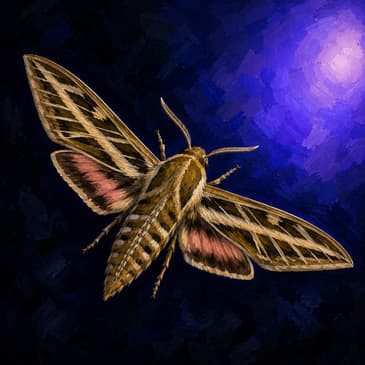
[00:04:12] And we discuss why moths are a big part of that crew. Hawk moths, owlet moths, they move between flowers all night long, carrying pollen on their bodies from bloom to bloom. And doing work that mostly goes unwatched because, well, we're asleep when it happens. A UV light in the dark to a moth is close to irresistible. So a zapper doesn't just fail to catch mosquitoes.
[00:04:37] It reaches out in the night and pulls in the pollinators that were doing something useful. And kills them for the crime of being attracted to light. And there's a quieter cost too. A zapper doesn't only kill what would have come near you anyway. It draws insects from a wide, wide surrounding area, concentrating the losses on the local night community. So you're not clearing your patio. You're technically thinning the neighborhood.
[00:05:11] What actually works? So if the bug zappers out, then what's in? Well, the good news is the real answers are simpler and cheaper than the thing that doesn't work. Mosquitoes are weak flyers, and a plain oscillating fan on a patio will keep them off you better than any lamp. Because they can't push through the moving air. And that's why when it's really windy, you don't notice very many mosquitoes.
[00:05:38] And also get rid of standing water because that cuts off the next generation before it hatches. That's where they breed. Screens keep them out of the house. And if you genuinely want to trap the biters, the traps that work are the ones that lie to a mosquito's senses. The ones that give off carbon dioxide and warmth to mimic a breathing body. Not the ones that just glow.
[00:06:04] Every one of those options solves your problem without emptying the sky of moths. So the next time you hear that snap, you'll know what it really means. It's not a mosquito defeated. But native wild pollinators who are useful, they're gone. Zap! Well, thank you very much for listening. I really appreciate it.
[00:06:28] And until next time, keep watching the wild native bees because you know they're probably watching you back.