
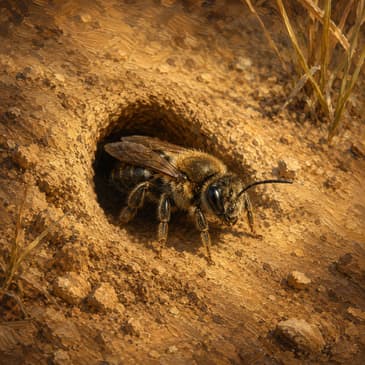
Most native bees don't live in hives — they live alone, underground, in tunnels a single female digs herself. This episode is about what those ground-nesting bees need from a patch of bare earth: the right soil texture, a bit of slope, sun, and above all the right dampness held steady across the ten or eleven months they spend below the surface. It's also about what disappears when that ground gets covered — by any large development, and increasingly by the data centers going up fast across the country. The honest catch: nobody has studied the bee side of that build-out yet. Studies take time. The mechanism is clear; the measurements aren't there.
KEY SOURCES
Proportion of ground-nesting bees
- Antoine CM, Forrest JRK. "Nesting habitat of ground-nesting bees: a review." Ecological Entomology 46:143–159, 2021. DOI: 10.1111/een.12986 — reports the primary range: Cane & Neff (2011) put underground nesters at 64%; Harmon-Threatt (2020) at 83% (excluding parasitic species). Use "most" on air — do not state a single percentage as fact. The popular "70%" (Xerces, USDA) sits inside this range but isn't the precise figure.
Soil texture and species specificity
- Cane JH. "Soils of ground-nesting bees: texture, moisture, cell depth and climate." Journal of the Kansas Entomological Society 64:406–413, 1991 — sand percentages of 34–94% across 32 species; larger bees toward clay-richer soils.
Nest-site characteristics (bare ground, temperature, hardness, moisture)
- Kordges et al. "Barefoot Trees for Bees: Nesting Site Characteristics of the Ground-Nesting Bee Andrena vaga in an Urban Environment." 2025. PMC12535216 — measured nesting sites vs. uncolonized controls; distinguishing factors were bare-ground proportion, soil temperature, soil hardness, and water content. This is the Segment Two/Three anchor.
Nesting depth and bare-soil requirement
- Vaughan M et al. "Enhancing Nest Sites for Native Bee Crop Pollinators." USDA Agroforestry Note 34 / Pollinator Partnership — brood cells 6 to 36+ inches down; direct soil-surface access required; sloped/well-drained sites preferred.
Data center land/water footprint (context only — none of these address bees)
Lincoln Institute of Land Policy, "Data Drain," 2026; UGA CAES field report on data centers and groundwater, 2026
#SecretPollinators #NativeBees #WildBees #GroundNestingBees #MiningBees #Pollinators #BeeScience #DataCenters #Pollination #SoilHealth #NaturePodcast #SciencePodcast #Entomology #PollinatorHabitat #BeeFacts
About Secret Pollinators
A wonder-first science podcast about native bees, bumblebees, wild bees, and the lesser-known pollinators most of us walk right past every day.
Visit secretpollinators.com