
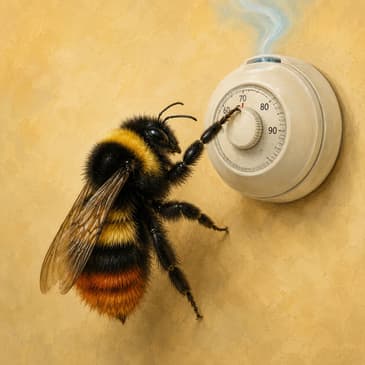
A brand-new study — published this week in the Journal of Animal Ecology — just revealed something remarkable about bumble bee colonies: they function as living thermostats, maintaining their brood at a precise 30 to 33 degrees Celsius, which is 86 to 91 degrees Fahrenheit, using only the bodies of their workers. When temperatures drop, bees vibrate their flight muscles to heat the nest. When it gets too hot, they fan their wings — a living air conditioning system. And when heat events become extreme, the entire colony redirects its labor away from foraging to cooling, with cascading effects on pollination. Kelly breaks down the science of bumble bee thermoregulation, the critical role of underground nest sites, and what this research means for how we think about wild bumble bee habitat. It's not just about flowers. It's about what's happening below the surface.
#BumbleBees #BumbleBeeSciece #BeeScience #NativeBees #WildBees #Pollinators #PollinatorScience #BeeNesting #GroundNestingBees #BeeHabitat #Superorganism #ColonyBehavior #InsectThermoregulation #BeeConservation #NativeBeeHabitat #BombusImpatiens #SecretPollinators #NaturePodcast #SciencePodcast #WildlifeScience #NatureLovers #EntomologyNerd #Entomology #BeeResearch #NewResearch #JournalOfAnimalEcology #AuburnUniversity #NCState #PollinatorProtection #SaveTheBees #BackyardBees #BeeNerd #InsectScience #MindBlown #ScienceIsAmazing #LivingThermostat #UndergroundBees
About Secret Pollinators
A wonder-first science podcast about native bees, bumblebees, wild bees, and the lesser-known pollinators most of us walk right past every day.
Visit secretpollinators.com
[00:00:04] Welcome back to Secret Pollinators. I'm your host, Kelly from Montana, and today we're going underground. We're going to talk about bumblebees, specifically what happens inside their nests, how a little tiny bumblebee colony can regulate its own temperature with extraordinary precision, and why the location of their nest in the ground can mean life or death.
[00:00:32] And what a study published this week, yes, this week, in the Journal of Animal Ecology, just revealed that scientists didn't fully understand until now. So, this is an episode about bumblebees as something you've never thought of them as before. Not just pollinators, not just fuzzy bees, superorganisms.
[00:01:01] The bumblebee colony as a single living thing. So, let's start with a concept that changes everything about how we think about bumblebees. A bumblebee colony is not a collection of individual insects doing their own things.
[00:01:23] It's, in the truest sense, kind of a single organism made of dozens of bodies working together. And I want to be really clear about the scale, because this is not a honeybee hive. A honeybee colony can have easily 50,000 workers. 50,000. But a bumblebee colony?
[00:01:47] Well, depending on the species and the time of year, you might have 50,000 workers. Maybe 100. A thriving colony of the common eastern bumblebee, the species at the center of this new research? Well, it might have a few hundred at peak season. I mean, that's it. It's a small team, a skeleton crew, you know, by insect standards.
[00:02:16] Scientists call this a superorganism. The colony breathes together, regulates temperature together, makes decisions together. No single bee is in charge. And no bee holds the whole plan. But together, this tiny workforce does something that would be impossible alone. They maintain a precise internal temperature.
[00:02:45] And here's a number that will stop you cold, because it totally stopped me. 30 to 33 degrees Celsius, which is 86 to 91 degrees Fahrenheit. That's the temperature range a bumblebee colony must maintain inside the nest. Specifically around the brood. The developing larvae and pupae for the next generation to survive.
[00:03:13] Not approximately 30 degrees or 86 degrees. Not somewhere in that range when it's convenient. The temperature consistently, whether it's snowing outside or blazing, has to be maintained. So, think about what it takes to hold 86 to 91 degrees Fahrenheit in a hole underground.
[00:03:39] I mean, no mechanical system. No thermostat on the wall. No heating or cooling equipment of any kind. Just 50 to 100 bees. When temperatures drop, when temperatures drop, the worker bees press their bodies against the brood cells and vibrate their flight muscles. Essentially shivering.
[00:04:05] Generating body heat and radiating it directly into the developing young. It just blows my mind. When temperatures rise, those same workers fan their wings inside the nest, circulating air like a little ventilation system. And so, this is not instinct, you know, in the simplest sense. It's collective intelligence.
[00:04:34] A tiny colony monitors its own internal temperature and it deploys workers as needed. Incubators when it's cold. Air conditioners when it's hot. Every bee has a role. And if that role isn't filled, if there aren't enough workers to fan or not enough to incubate, the colony falters. The brood suffers. And the whole system can collapse.
[00:05:02] With only 50 bees, there's really no margin for error. And that's the foundational insight from new research out of Auburn University and North Carolina State. And it reframes everything about bumblebee vulnerability. Because here's the question they asked that almost no one had asked before.
[00:05:30] What happens to the colony and not the individual bee, but the whole colony when temperatures change? Underground. The original smart home. So before we get into what the research found, I'd like to talk a little bit about where bumblebees actually live. Because this turns out to be the whole story.
[00:05:56] Most bumblebee species in North America and most other places around the globe nest underground. Not in a hive. Not in a box. Underground. In old rodent burrows. The abandoned tunnels left by mice and voles. In natural cavities in the soil. In thick root masses under meadow grasses. Sometimes half a meter down. And sometimes even deeper.
[00:06:31] Soil is one of the best natural insulators on Earth. It buffers temperature extremes. So on a summer day that hits 38 degrees Celsius, which is 100 degrees Fahrenheit at the surface. It might only register as 28 degrees Celsius or 82 degrees Fahrenheit a few inches underground. The Earth absorbs heat slowly and releases it slowly.
[00:06:56] And it creates a stable pocket of air that wild bumblebee nests have exploited for millions of years. And the new study did something elegant to test this. The researchers built simulated underground nests. Instrumented cavities in the ground. And also set up above-ground nest boxes like the ones used in commercial agriculture.
[00:07:22] And they monitored the temperature inside both without any bees present over time. So the difference was stark. Above-ground nest boxes experienced far wider temperature swings. They heated up faster. They hit higher peaks. I mean, that's kind of to be assumed, right? The soil insulation that underground nests enjoy.
[00:07:49] The thermal buffer that wild bumblebees depend on. Well, it just simply wasn't there. And for a colony that needs to hold, you know, 30 to 33 degrees Celsius or 86 to 90 degrees Fahrenheit with its own bodies, that difference is everything. And here's the twist. And this is what makes the new research genuinely surprising.
[00:08:16] Warmer temperatures within a range can actually help underground bumblebee colonies. When ambient temperatures are moderately high, the workers don't have to work as hard to incubate the brood. They can spend less energy on internal heating and more on foraging, which is gathering the pollen and the nectar the colony needs to grow. Warmer soil means the colony gets to use its workforce more efficiently.
[00:08:47] But only up to a point. The breaking point. It's that point, the threshold where warmth stops being an advantage and starts being a crisis. And it's where the story gets really urgent. When temperatures push to or into extreme heat, well, it flips the whole equation.
[00:09:12] Because worker bees that were foraging and gathering food, you know, building up the colony's resources, they get pulled off the task because they're needed inside. The nest is getting too hot. So the brood, those precise temperature-sensitive developing larvae, are at risk. The colony has to redirect its labor. Van, van, van. Van, van, van. Those little wings.
[00:09:41] You can just see them now. So workers press into the entrance tunnels and beat their wings. They push hot air out of the nest. And the more workers are deployed to van, well, all those foraging trips that aren't happening, the pollen that isn't coming in, the nectar that isn't being stored, the colony starts running a deficit.
[00:10:06] And if you think of it like a business, where the entire staff is getting pulled off of sales to deal with an emergency, and the emergency might get handled, but the revenue stops. And if the emergency lasts long enough, or comes back often enough, the business fails. And this is exactly what the researchers found when they tracked bumblebee visits to cucumber flowers at six sites between Georgia and Michigan.
[00:10:34] And cucumbers are perfect for this kind of study because they require insect pollination. And bumblebees visit them readily. And they can be grown in pots with identical conditions at multiple sites. The researchers could watch in real time how temperatures affected the bees' ability with their jobs. And what they found? As temperatures rose in extreme ranges, the foraging visits dropped.
[00:11:05] So the bees that should have been working those flowers were inside managing the nest. And the colony's capacity to pollinate its entire function in the ecosystem was being sacrificed to keep itself alive. And the above-ground nest boxes, well, you know, the ones used in commercial agriculture, sitting on the soil surface with no insulation. They were experiencing those extreme temperatures far more often.
[00:11:36] And far more severely. Why this changes the conversation about wild bumblebee nests. Here's the part that hit me the hardest when I did this research. We talk a lot, I mean a lot, about what bumblebees need above-ground. Flowers, pollen, nectar sources, diverse plant communities. And all of that matters enormously.
[00:12:04] And we've covered it on multiple, well, almost probably every episode of this podcast. And I'll keep covering it because it's really important. But the new research shifts the spotlight underground to the nest itself. And specifically, to whether the nest has adequate thermal protection. For wild bumblebees, that means habitat with good underground nesting sites.
[00:12:33] And those are old rodent burrows, undisturbed soil, dense root systems. It's basically shaded ground that doesn't bake in the afternoon sun. It's the kind of habitat that maintains a stable microclimate, a foot below the surface. And honestly, most of us never think about that. But here's something we're sitting with.
[00:12:59] A lot of what makes good wild bumblebee nesting habitat looks to the human eyes like nothing much. Like totally an unimportant area. It could be a weedy corner field. A brushy hillside with leaf litter. A shaded patch of unmown grass at the edge of a meadow. Old wood. Old debris.
[00:13:28] Old holes in the ground. The kinds of places that get cleaned up. Because it seems we're kind of obsessed with cleaning everything up. But underground, those scrubby, unremarkable patches may be thermal refuges. Places where the soil stays cool enough, long enough, for a colony to make it through a heat event without redirecting its entire workforce to air conditioning.
[00:13:57] So, the study's authors note that conservation strategies need to start thinking about the nesting environment, not just the food sources, as critical factors in bumblebee resilience. Protecting shaded habitat. Maintaining soil integrity. Avoiding unnecessary disturbance of ground that might be hosting a colony you can't see.
[00:14:25] So, you don't have to see a bumblebee nest to be able to protect one. And I think that's the key or the secret. The bee you think you know. So, let's bring this back to the bumblebee in our yards. We've all watched them. Big, fuzzy, moving slowly from flower to flower. Unhurried. Unconcerned.
[00:14:53] They seem like the most relaxed creatures in the insect world. I find them completely mesmerizing to watch. And now you know what's happening underground while that bee is out foraging. There's a colony, maybe 50 workers, maybe 100, and maybe a few hundred, at the absolute peak. Holding a narrow temperature window with their own bodies. Not 50,000.
[00:15:23] Just 50. The system is running constantly. And every rule has to be filled. The bee you see on your flowers is part of a system that's far more complex than it looks. And it's entirely different from honeybees in boxes.
[00:15:50] And this is what I mean when I say we've barely started understanding what's happening in wild bee communities. We've been studying bumblebee individuals for a long time. We've been studying colonies in boxes, in labs, in managed agricultural settings.
[00:16:13] But the thermal dynamics of wild underground nests, the actual conditions these bees evolved in, it's only now starting to come into focus. This research is new, published this week. And what it tells us is that a bumblebee colony is not just a group of insects using flowers. It's a precision system. A thermal engineer.
[00:16:41] Collective intelligence running a living thermostat. It deserves to be in the ground. And we need to protect it. So the next time you see a bumblebee working a flower, imagine what's below the surface. A little colony running its own temperature.
[00:17:09] A small network of workers doing the math in real time. You know, incubate, fan, forage, fan some more. Keeping the brood alive to the degree. New science. Same astonishing bumblebees. Thank you so much for listening. I hope you've been able to take some new information away today. And please share it with your friends.
[00:17:38] Until next time. Watch the bees. They're probably watching you back.