Everybody knows grasses are wind-pollinated. Right? RIGHT?? Turns out the textbooks have been quietly leaving something out. Bees — honeybees, bumblebees, sweat bees, mining bees — are visiting grass flowers and combing pale yellow pollen straight off the anthers. And they're doing it without the usual floral road signs: no nectar, no big colorful petals, no UV bullseyes. So how on earth are they finding it? In this episode we dig into the surprising science of grass pollen as bee food, the new (and shockingly recent) research showing five genera of bees collecting pollen from a single turfgrass species, what cues bees use to spot grass anthers in a sea of green, and why the lawn under your feet might be quietly feeding the bees you're trying so hard to save with your wildflowers. Spoiler: the cemetery bees from Episode 37 were in on this all along.
#SecretPollinators #NativePollinators #NativeBees #PollinatorScience #BeeScience #LawnsForBees #NoMowMay #PollinatorPodcast #NaturePodcast #SciencePodcast #PlantTheSpecies #LetItBeWild #LeaveTheLeaves #GrassPollen #WildBees #SolitaryBees #Andrena #Bumblebees #HoneyBees #SweatBees #PollinatorConservation #NativePlants #PrairieGrasses #BeeFriendlyLawn #UrbanEcology #BackyardScience #PollinatorGarden #Entomology #Apidae #BeeFacts #WildBees #Lawn #Pollen
About Secret Pollinators
A wonder-first science podcast about native bees, bumblebees, wild bees, and the lesser-known pollinators most of us walk right past every day.
Visit secretpollinators.com
[00:00:03] Welcome back to Secret Pollinators. I'm your host, Kelly from Montana, and today's episode is one I've been buzzing to record. Pardon the pun, because it's a perfect example of how rules we learned about pollination are, well, way more interesting than the textbook version. And today we're talking about grass.
[00:00:31] You know, lawn grass. Yes, grass. Stuff under your feet. And we're talking about how bees, and not just a few bees, but lots of bees are quietly using it as a pollen pantry. And how researchers are finally figuring out how the bees even find this stuff. So, by the end of this episode, I hope you're going to look at your lawn differently. I promise.
[00:01:00] The Wind Pollinated Myth. And Why It Stuck. Okay, so here's a quick refresher. When biologists divide up the pollination world, they put plants into buckets. You know, bee pollinated, bird pollinated, bat pollinated, wind pollinated. And grasses, the whole grass family, got dropped into the wind bucket. And honestly, it made sense.
[00:01:25] I mean, grass flowers don't look like flowers. They don't have any big bright petals, no nectar, and no scent that'll knock you over. Well, the only scent grass has, I think, is when you mow it. They just sort of hang there. Tiny little dangling anthers in the breeze, releasing clouds of pollen so light it floats for miles. That's not a bee strategy. That's a wind strategy.
[00:01:57] And grass is really good at it. Around 12,000 species of grass on Earth, and almost all of them rely on wind to move pollen. That's how your hay fever happens, by the way. We all know about that. And that haze of grass pollen drifting through June? Well, it's not for the bees, but it's for the breeze.
[00:02:20] So when textbooks said grasses are wind pollinated, full stop, end of conversation, they weren't exactly wrong. They were just incomplete. Because, well, apparently nobody told the bees. The research catching up to the bees. So here's where it gets fun. For decades, every now and then, somebody would notice it.
[00:02:46] A backyard naturalist, a beekeeper, a botanist drinking tea in their tent. They'd watch a bee land on a grass head, comb up pollen, and fly off. And they'd think, well, that's weird. And maybe that bee's confused. And then they'd move on. That's kind of what led me to create this episode. Then somebody started counting.
[00:03:12] Researchers at the University of Georgia and the USDA started watching grass lawns in the south. Just regular old turf grass. You know, the stuff people grow in their yards. And that's what they found made it into the journal Insects. There were 13 types of bees present in those turf grass lawns. 13.
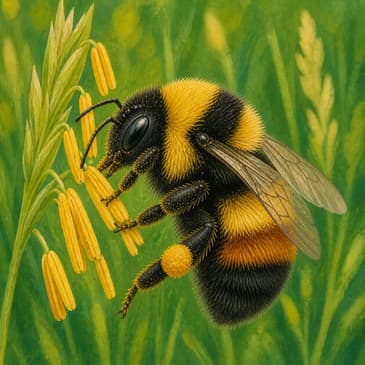
[00:03:42] And five of those were directly collecting pollen from the turf grass flowers. Sweat bees, bumble bees, honey bees, mining bees. All five. Working a plant the textbooks had written off. Then they did it again with Baha'i grass. Same family, different species. Also wind pollinated.
[00:04:08] Also planted on golf courses and in yards across the warmest parts of the U.S. They watched those grass patches in central Georgia and 10.6% of all the foraging bees they observed were on it. Honeybees, bumble bees, sweat bees. First report of its kind. First time anybody had bothered to write it down. And those aren't isolated weirdos.
[00:04:34] Up in the U.K., observers have watched bumble bees, honeybees, combing pollen out of meadow foxtail. Same behavior, different continent, different grass. And then remember my episode about the cemetery bees? The five million bees nesting under Eastland Cemetery in Ithaca?
[00:04:57] When researchers analyzed what those bees were feeding their babies, a huge chunk of it was grass pollen. Those bees were stuffing their nests with pollen off the lawn grass growing right over their heads from the cemetery. So the picture's shifting. And fast. Grasses aren't bee plants in the way that, you know, like a sunflower is a bee plant. The grass isn't advertising.
[00:05:25] The grass isn't paying for service. But the bees showed up anyway. And are we the only ones now starting to ask the obvious question? How are they finding it? The sensory memory. How does a bee even find this stuff? Well, here's why this is genuinely cool.
[00:05:54] Bees, for the most part, are built to find flowers. You know, flowers with a capital F. Flowers. The whole pollinator flower handshake evolved together. Flowers send signals and bees receive them. Bees see an ultraviolet, blue and green. Their vision is actually pretty low resolution. And that means that a bee can't see fine detail the way we can. But she's got incredible sensitivity to color contrast and pattern.
[00:06:23] And she picks out a flower against the green background. She follows the nectar guides, those secret UV bullseyes painted on the petals, right to the goods. Well, bees also have a wild sense of smell. Who knew? Their antennae are basically perfume detectors. They can pick up floral scent on the wind from meters away.
[00:06:48] So if you combine vision and scent, that's how bees pin down a flower from far off. And then home in close. Now, think about a grass head. Long, skinny, the same color as everything around it. No nectar. So the plant isn't pumping out, you know, the come-hither floral perfume that flowers are. And no bright petals, no UV bullseye.
[00:07:17] No shape that screams, land here! By every rule of pollinator signaling, a grass head is technically invisible. Except the anthers. When a grass flowers, I don't know if you've noticed this before, but those tiny little dangling structures, the anthers, actually change color. They go yellow or purple, and bright purple in subspecies.
[00:07:47] And that's the moment they're shedding fresh pollen. And the plant isn't doing it for the bees. It's doing it because that's when the pollen is ripe. But to a bee's color-sensitive eye, a stem subtly dotted with bright yellow or purple speckles, well, that's a signal. Even if the plant didn't mean to send one. And the observers all describe the same thing.
[00:08:17] Bumblebees pick the grass heads with the freshest, brightest anthers. They skip the ones that have already shed. And they learn the pattern. So they come back. And then they tell each other. And if they're honeybees, they literally waggle-dance the location. And there's another thing. Pollen has its own scent. And pollen has its own taste.
[00:08:45] Bumblebees have been shown to taste pollen with their antennae and decide on the spot whether to keep collecting or move on. So even without nectar guides, even without floral perfume, the pollen itself is broadcasting, quietly. I'm here. I'm fresh. I'm worth your time. And here's the kicker. Bees are smart. Like, genuinely smart.
[00:09:13] Once a bee figures out a particularly shape and combo color, like, for example, a tall green stem with little yellow anthers, that that means a payday, well, she remembers it. And then she tells her colony, the behavior spreads. Which means the more grasses we leave standing long enough to flower, the more bees learn that grasses are food.
[00:09:41] So the less we mow, the more the lesson sticks. Why grass pollen matters. And you might be thinking, like, you know, I've been thinking, okay, fine, bees sometimes use grass. But is grass pollen actually any good for them? And that's a great question, so let's talk nutrition. Pollen is bee protein. It's where baby bees get their amino acids, you know, their lipids, their sterols,
[00:10:10] everything they need to grow from a tiny egg into a flying adult. And it turns out different pollens have very different nutritional profiles. Some pollens are protein-rich, and some are fat-rich, and some are missing key compounds entirely. And grass pollen historically got a reputation as kind of mediocre. Lower in protein than legume pollen. Not super exciting.
[00:10:38] And for a long time, researchers basically said, even if bees collect it, it's not real bee food. Except, well, it kind of is. A 2024 paper looking at 109 co-flowering plant species across the Great Basin and in eastern Sierra showed that bees aren't looking for the single best pollen. They're looking for the right mix.
[00:11:04] They balance their diets across many sources. A protein-heavy pollen here, a fat-heavy pollen there, and yes, sometimes a more average pollen too, because variety, not perfection, is what builds healthy bees. And in 2025, a bombshell paper from Oxford in the journal Nature
[00:11:30] identified six specific steriles in pollen that bees absolutely cannot live without. Six tiny molecules. The thing missing from every commercial pollen substitute. And here's where it gets interesting for grass. Those steriles come from a wide range of plants, and even pollen we used to call terrible, is part of the broader nutritional pool that keeps bees alive.
[00:12:00] So, tell me again that grass is a pollinator desert? Really? So, what this means for us, and our yards, and our county parks, and the highway median that nobody mows? Because here's where it gets practical. And if you're listening to my podcast, odds are you're already doing the work. Native plants, no pesticides,
[00:12:29] leaves in the fall, all the good stuff that helps our wild bees. So, what does grass as a bee food actually change? Well, three things. First, mow less, or mow some, not all. Because here's the thing, a grass that's mowed every week never gets to flower,
[00:12:57] never gets to produce those bright yellow or purple anthers, and never feeds a single bee. The five type of bees in the Georgia study that the team found in that turf grass, well, they were on lawns where grass was allowed to grow long enough to bloom. So, if you can leave a strip, a corner, in the back 40 of your yard, anywhere the mower doesn't reach, the grass will flower,
[00:13:26] and the bees will find it and they're built for this. And second, stop apologizing for native grasses. If you live in a part of the country where native plant communities include prairie grasses, little bluestem, big bluestem, side oats, gamma, prairie drop seed, those grasses are part of the bee food web. And not like in the same way that coneflowers are, but they're still a part of it.
[00:13:56] And they're often drought tolerant, deep rooted, climate adapted. Plant them, let them flower. They're doing more than anyone thought. And third, rethink the highway median, the county park, the schoolyard, every patch of grass that gets mowed twice a week to keep it tidy. Well, that's a bee buffet that nobody's eating. If you have any influence over public mowing policy,
[00:14:24] even a small one, even just an email to your parks department asking if they consider a no-mo-may or a let it flower August, that matters. And every little bit helps. The bees were already willing. We're the ones who keep cutting them off. So, your lawn, well, it isn't a desert. It's just been on mute. Well,
[00:14:54] I want to thank you for listening and remember, grass pollen. It's a real thing. Five types of bees on a single turfgrass species. And the bees figuring this out a long, long, long time before the textbooks did. So, remember to look for bees in your lawn. I've been doing that and it's kind of remarkable. Until next time,
[00:15:24] watch the bees because they're watching back.