Reading Time: 5 minutes
Quick - picture a bee.
Got it? Let me guess: you probably imagined something fuzzy, black and yellow, buzzing around flowers.
But here's the question most people never think to ask: Was that a honeybee or a bumblebee?
If you're like most people, you probably use those names interchangeably. They're both bees. They're both important pollinators. What's the difference, right?
Turns out, the difference is HUGE. And understanding it will completely change how you think about the pollinators in your garden.
The Tale of Two Bees
Let's start with the basics, because these two bees are as different as hawks and hummingbirds.
Honeybees: The Organized Workforce
European honeybees (Apis mellifera) are the bees you see in white box hives. They're:
Social insects living in permanent colonies of 20,000-80,000 individuals
Hierarchical with a queen, drones, and worker castes
Honey producers - they store surplus nectar as honey to survive winter
Imported to North America in the 1600s for honey and wax production
Managed by beekeepers for agriculture and honey harvest
Smooth-bodied with less fuzz than you might expect
Bumblebees: The Wild Ones
Bumblebees (Bombus species - we have about 50 species in North America) are:
Social but smaller - colonies of 50-400 individuals that die off each winter
Native to North America - they evolved here alongside native plants
Extremely fuzzy - covered in dense, insulating hair
Annual colonies - only the new queens survive winter underground
Wild - they nest in abandoned rodent burrows, grass clumps, and cavities
No honey storage - they make just enough food to feed current larvae
So they're both social bees that live in colonies, but that's where the similarities pretty much end.
The Pollination Showdown
Now here's where it gets interesting. Both bees pollinate flowers, but they do it completely differently - and those differences matter a LOT.
Round 1: Cold Weather Performance
Winner: Bumblebees (knockout)
Bumblebees can fly in temperatures as low as 40°F. They can actually generate heat by vibrating their flight muscles, warming themselves up before takeoff like tiny fuzzy helicopters.
Honeybees? They stay home if it's below about 55°F.
Why this matters: Those early spring fruit blossoms - apples, cherries, blueberries - often bloom during cold, drizzly weather. Bumblebees are out there working. Honeybees are not.
In my Montana garden, I see bumblebees working in April when there's still snow in the shade. The honeybees don't show up until late May.
Round 2: Rain Tolerance
Winner: Bumblebees
Bumblebees will work in light rain. Their dense fur sheds water, and their smaller colonies mean individuals take more risks to gather food.
Honeybees stay in the hive during rain. They have 40,000 sisters who can cover for them.
Why this matters: In rainy springs (or places like the Pacific Northwest), bumblebees might be the only pollinators working your garden for weeks.
Round 3: Flower Specialization
Winner: Bumblebees
Here's the big one: Bumblebees can "buzz pollinate."
They grab onto a flower and vibrate their flight muscles at a specific frequency - about middle C on a piano. This literally shakes the pollen out of the flower like a tiny earthquake.
Tomatoes, blueberries, cranberries, peppers, eggplants - these flowers have pollen locked inside tubes. Bumblebees can get it. Honeybees cannot.
Watch a bumblebee work a tomato flower and you'll literally hear the buzzing change pitch. It's like watching a specialist with a power tool while everyone else has hand tools.
Round 4: Efficiency on Specific Crops
Winner: It depends
For mass agriculture (almonds, for example), honeybees win because:
You can move thousands of hives to the same field
They're predictable and manageable
They work long hours in good weather
For crops like:
Tomatoes → Bumblebees win (buzz pollination)
Blueberries → Bumblebees win (buzz pollination + cold tolerance)
Native wildflowers → Bumblebees win (co-evolved relationship)
Squash and pumpkins → Specialist native bees win (but that's another story)
Round 5: Gentleness
Winner: Bumblebees
Bumblebees CAN sting (females only, and they can sting multiple times unlike honeybees). But they're remarkably docile. I've had them land on my hand, bump into me, work flowers inches from my face - never been stung.
Honeybees are more defensive because they have a hive full of stored honey to protect. They're not aggressive, but they're more likely to perceive you as a threat.
Why this matters: You can create bumblebee habitat right in high-traffic areas without worry. Kids can observe them up close.
The Real Kicker: Agricultural Dependence
Here's the fact that surprised me most:
We commercially manage honeybees. We don't manage bumblebees.
In the US, we truck millions of honeybee hives around the country to pollinate crops. It's a multi-billion dollar industry. Almond growers in California import 2.8 million colonies every February.
But bumblebees? We're just starting to rear them commercially for greenhouse tomato production. For the most part, bumblebees are wild, unmanaged, and doing their thing without any human intervention.
That means:
Honeybees = we control their populations through beekeeping
Bumblebees = they depend entirely on habitat availability
When you hear about "pollinator declines," honeybee numbers are actually increasing globally (more beekeepers). But several North American bumblebee species are genuinely struggling because we've destroyed so much habitat.
What Your Garden Actually Needs
If you're trying to support pollinators, here's the key insight:
Honeybees don't need your help. They have beekeepers. They have managed colonies. They're fine.
Bumblebees DO need your help. They need:
Places to nest (leave some areas "messy" with grass clumps and leaf litter)
Flowers from early spring through fall
Overwintering sites for queens (leave leaves and stems standing)
No pesticides
When you plant pollinator habitat, you're not really helping honeybees (though they'll visit). You're helping bumblebees and the other 4,000 native bee species that have no one managing them.
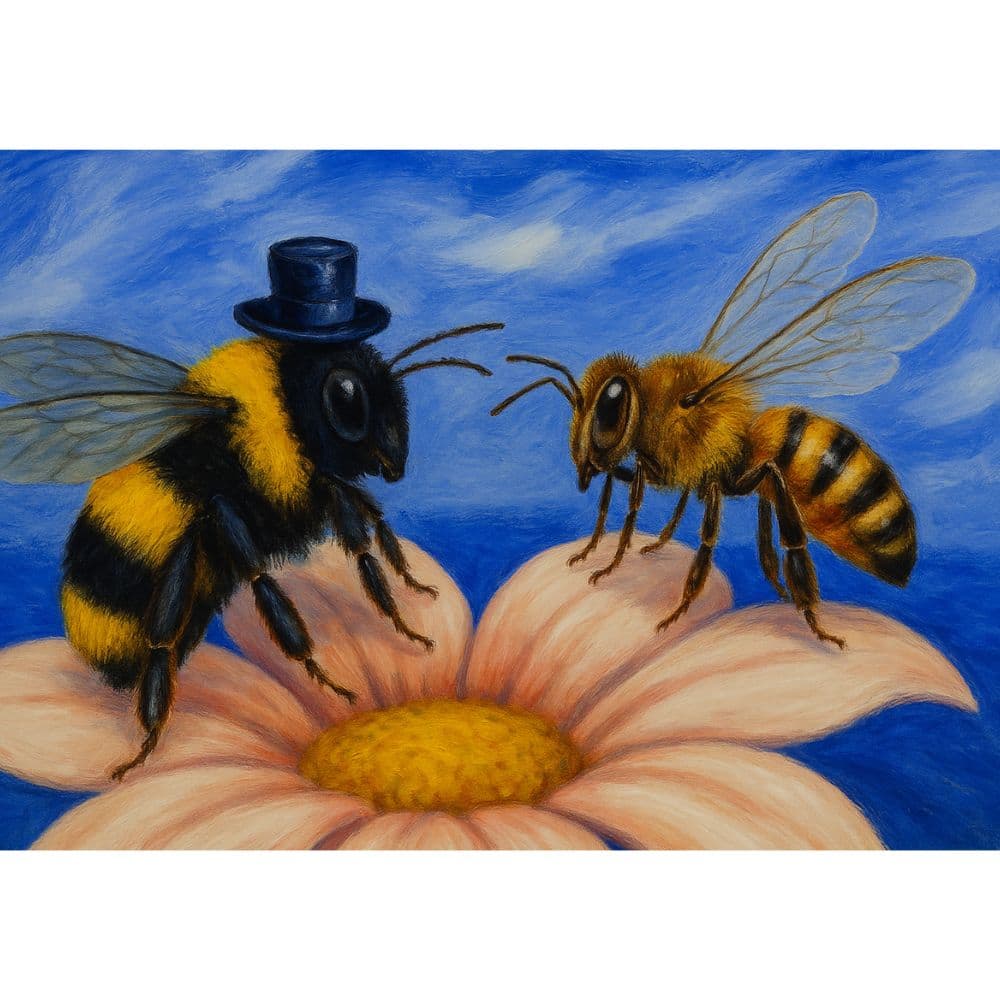
How to Tell Them Apart
Once you know what to look for, it's easy:
Bumblebees:
VERY fuzzy - like they're wearing a fur coat
Fatter/rounder body shape
Usually larger (but not always)
Often have rusty/orange patches or white tail bands
Make a deep, loud buzz
Honeybees:
Less fuzzy - smoother, shinier appearance
More streamlined/elongated body
Fairly consistent size (workers are all sisters)
Usually amber/brown and black striped
Higher-pitched buzz
The easiest test? If it looks like it should be cold (super fuzzy), it's probably a bumblebee. If it looks sleek, it's probably a honeybee.
The Takeaway
Both bees are amazing. Both pollinate. Both deserve our appreciation.
But when you're thinking about "saving the bees," remember:
Honeybees → managed species, not native, thriving globally with beekeeper support
Bumblebees → wild native species, declining in many areas, need habitat support
The next time you see a big fuzzy bumbler working your flowers in the cold spring rain, give them some respect. They're out there doing a job honeybees won't do, with no backup colony, no beekeeper, no one managing their population.
They're just wild native bees, doing what they've done for millions of years - as long as we give them a place to do it.
Going Deeper
Want to learn how to identify different bumblebee species and create habitat specifically for native bees? The Secret Pollinators podcast dives deep into native bee biology, identification, and conservation.
Until next time - keep your eyes open. The secret pollinators are everywhere.
Kelly Parks
Certified Pollinator Steward
Montana
More Native Bee Resources
Ready to create bumblebee habitat? Learn what native bumblebees need to nest and forage successfully.
Have questions? Leave a comment - I read and respond to every one.
Thank you for reading!