
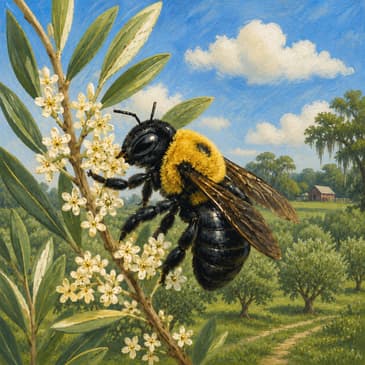
The US olive oil market is worth nearly three billion dollars — and 95 percent of it is imported. But across seven American states, a small, quality-focused domestic industry is growing. And native bees, without invitation or management, are showing up in those groves every spring and doing something that a landmark 2013 study in Science confirmed: improving crop fruit set in ways that honey bees alone cannot match.
Episode 41 follows olive trees from California's Central Valley to Georgia's coastal plain, and the native bee communities — mining bees, sweat bees, carpenter bees — that found them.
Secret Pollinators is a solo narration science podcast about native and wild bees and the lesser-known pollinators shaping the world around us.
#SecretPollinators #NativeBees #OliveOil #AmericanOliveOil #WildBees #Pollinators #MiningBees #SweatBees #CarpenterBee #OliveGrove #ExtraVirginOliveOil #BeePodcast #NaturePodcast #SciencePodcast #Pollination #BeeScience #GeorgiaOlives #CaliforniaOliveOil #GroveToTable #FoodScience #WildBees
About Secret Pollinators
A wonder-first science podcast about native bees, bumblebees, wild bees, and the lesser-known pollinators most of us walk right past every day.
Visit secretpollinators.com
Speaker A: Welcome back to Secret Pollinators.
I'm your host, Kelly Parks. And today I'm going to start with a number.
$3 billion.
That's the value of the olive oil market as of 2024.
And it's growing really fast. And it's actually projected to nearly double by 2033.
And most all of the olive oil is imported from Spain, Italy and Greece,
because that's kind of what we think about when we think of olive oil.
But quietly, across seven American states, something is changing.
Domestic olive oil is earning international awards.
And until I did this research, I had no idea.
And native bees, without invitation,
as usual,
without management,
without anyone asking,
are playing a role that science is only beginning to measure.
Seven states.
I think most people think of the Mediterranean hillsides when they think of olive oil,
but the American olive oil picture looks a little bit different.
There's 40,000 acres in seven states,
and California leads it with 95% of domestic production,
which is, you know, coming out of the Central Valley.
But Texas has become the second largest producer.
And then Georgia,
Arizona, Florida, Oregon and Hawaii, they all have working groves, too,
and they're not hobby farms.
Georgia's Woodpecker Trail Olive Farm has won at the world Olive Oil competition,
which is the most prestigious olive oil quality contest in the world.
And Texas Hill country olive oil has also one.
America,
you know, basically imports 95% of the olive oil it consumes. So the domestic industry is small,
but it's quality focused and it's really growing.
It's also doing something that Mediterranean growers didn't have to reckon with,
producing olive oil inside native bee territories that never knew olives existed.
How olives pollinate well,
olive trees basically evolved as wind pollinated plants.
The flowers are tiny,
there's virtually no nectar, and the pollen is extraordinarily light because it's designed to drift.
So most cultivars can self pollinate.
The wind handles it perfectly.
But cross pollination,
pollen moving between two compatible trees changes the outcome. And studies show cross pollination can boost olive yield by 10% or more.
It affects the fruit set.
It influences the chemistry of the oil itself.
So wind is reliable and wind is ancient.
But wind doesn't choose which tree to visit next.
And that's where the bees come in.
Seven bee communities.
Here's what makes the American olive oil story unusual.
In the Mediterranean, the bees and the olive trees developed in the same landscape over millions of years.
Whatever relationship exists there was built very slowly.
And in the US the olive trees arrived in territories where native bees had Never encountered them.
California's Central Valley groves bloom in the spring alongside populations of ground nesting mining bees and metallic green sweat bees.
It's crazy. And the Texas hill country, well,
it has its own distinct native fauna with different species, different timing and different behavior.
And then Georgia's coastal plain,
while it hosts easy eastern carpenter bees,
which they're large enough that when they land on an olive branch, the flowers move. I mean, they're kind of big native bees.
Mining bees dominate Georgia's spring orchard surveys.
I mean, that's well documented. And swept bees work the small flowers that the larger bees pass by. But none of these bees were waiting for olives.
They're generalists, opportunists. They find whatever pollen is around and kind of wherever it exists within their territory.
So the olive bloom arrives in pretty much April and May across the Southeast. And in California, it's spring also.
So in every case, the timing lands squarely inside peak native bee foraging season.
So the olive pollination wasn't really designed.
It just sort of fits the uninvited partner.
So a $3 billion market,
which is mostly imported,
with a small domestic industry chasing quality.
And the quality chase is real because American olive growers are winning international awards.
And the premium and extra virgin segments are the fastest growing parts of the market.
And under that,
in groves from California to Georgia,
native bees are cross pollinating trees that no one asked them to cross pollinate.
Growers who plant cover crops between rows and leave bare ground margins for ground nesting bees,
which we've talked about in lots of previous episodes,
particularly the ones about large scale agriculture. And of course, they avoid broad spectrum insecticides during the blooms.
They are basically, whether they know it or not,
supporting a pollination network that they didn't build.
I mean, the bees showed up because olives bloom,
flowers exist,
bees find flowers and pollen moves.
That's 300 million years of behavior operating right now in an American crop that basically didn't exist a decade ago.
Quite remarkable, wouldn't you say?
I think the most fascinating thing that I learned researching this episode is that the. The domestic olive oil industry in the United States is young,
it's ambitious,
and largely flying under the radar.
So are the bees working those olive groves?
I mean,
neither is waiting for permission to be successful,
and I just think that's incredible.
And I encourage everyone to please support and buy domestic American olive oil.
Thank you so much for listening and I hope to see you next episode.
And until that time, watch the bees, because they're probably watching you back whether you know it or not.