(And It's Hiding in Their Field Margins)
By Kelly Parks | November 2025
I'm wearing a t-shirt right now that's basically the future of conservation in fabric form.
It's from TS Designs in North Carolina—a company making natural fiber t-shirts with earth-friendly printing, all within a transparent U.S. supply chain. This cotton was grown in America, by American farmers, and turned into a finished shirt entirely in the United States. "Dirt to shirt," they call it.
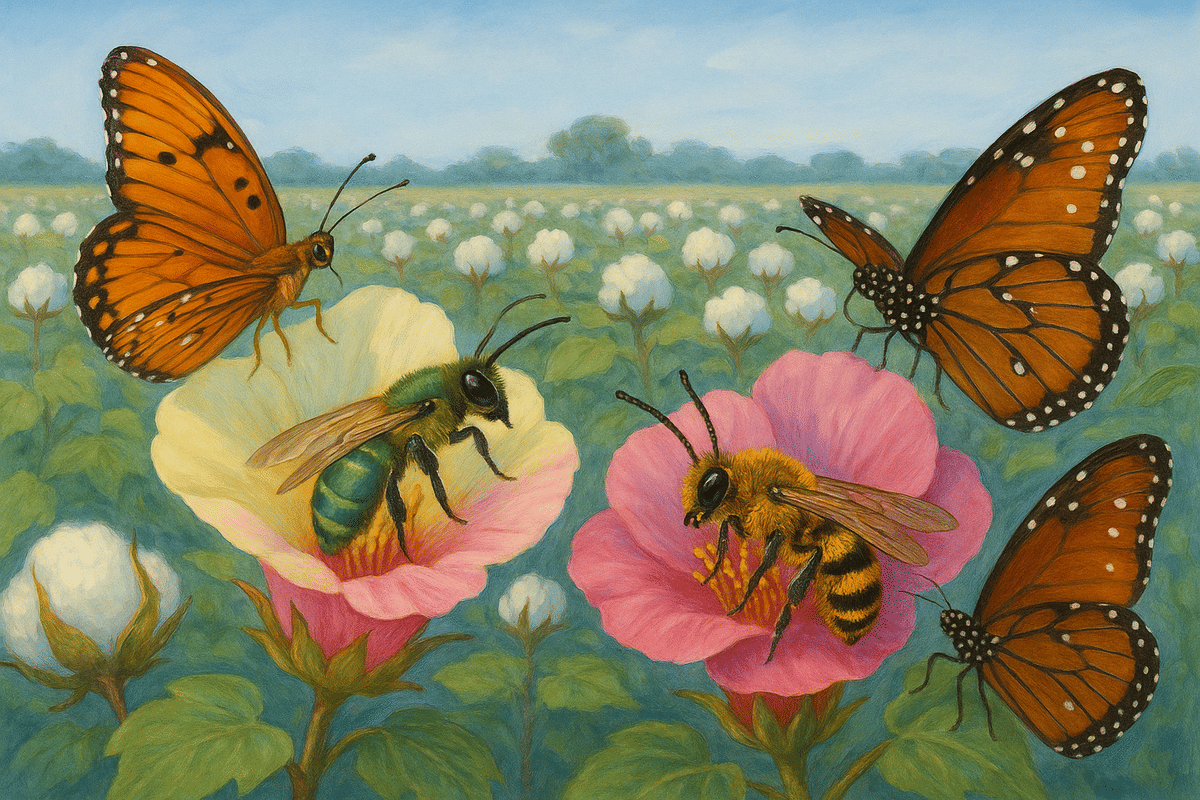
But here's the wild part: the workers boosting yields in those Carolina cotton fields aren't on the payroll. They're native bees, butterflies, and flies living in the field margins most farmers mow down.
And the economic data? It's staggering.
The Research Nobody's Talking About
Recent studies from Texas A&M, University of Texas Austin, and research in Brazil all reached the same conclusion: native pollinators can increase cotton yields by 12-24%.
Not honeybees. Wild native bees and butterflies. The ones already living near cotton fields.
Let me put that in farmer terms: In the UT Austin study, cotton farmers saw an 18% yield increase when pollinator diversity was high. That translates to $108 more per acre. Do the math for a 500-acre operation—that's $54,000 in additional revenue.
For doing what? Leaving some field margins unmowed.
Wait, Doesn't Cotton Self-Pollinate?
I get this question every time. Yes, cotton absolutely self-pollinates. It can produce fiber-filled bolls all on its own.
But here's the thing: Cotton does it better with help.
When a native bee visits a cotton flower, the mechanical vibration from its body triggers more complete pollen release. That creates cross-pollination between plants, which produces larger bolls with more seeds and higher quality fiber.
Think of it like sweeping versus vacuuming. Both work. But one is faster, more thorough, and picks up stuff the broom misses.
The Texas A&M study caged cotton plants with and without native long-horned bees (Melissodes tepaneca). The results? Individual bolls visited by bees were 24% heavier than flowers excluded from pollinators.
Twenty-four percent. For a "self-pollinating" crop.
It's Not Just Bees
Here's where it gets even more interesting: University of Texas researchers found that butterflies and flies together contribute an estimated $120 million annually to Texas cotton production.
Not because they're more efficient than bees—they're not. But because on hundreds of acres, they fill the gaps bees can't reach:
Bees work mornings
Butterflies work hot afternoons when bees quit
Flies work cool, cloudy conditions
Together, they create pollination coverage across more hours of the day, more field locations, more weeks of bloom. It's a team effort, and that diversity is worth millions.
The Slow Fashion Connection
Companies like TS Designs are proving that American-made cotton can compete on quality and values. They're building transparent supply chains, supporting local farmers, and showing consumers that slow fashion—quality over disposability—actually works.
And here's what makes the native pollinator research so relevant: The farmers in TS Designs' network who care about land health and sustainable practices are exactly the ones most likely to support native bee habitat. The model they've built creates conditions where pollinators thrive.
Nobody planned it that way. But supporting American farmers and supporting native pollinators? They're the same goal.
What This Means for You
If you're a cotton farmer: The five practices that boost pollinator populations cost nothing to implement. Most actually save money (less mowing, less edge maintenance). Extension agents have the research. Try it on a test plot. Track your yields. The data speaks for itself.
If you care about fashion and sustainability: Every time you choose American-made cotton from companies doing it right, you're voting for a system where agriculture and conservation work together. Your clothing choices matter for 4,000 native bee species.
If you're just bee-curious: This story shows why native pollinators matter beyond gardens and wildflowers. They're providing real economic value to working farms. And they need our help.
Go Deeper
I've created two ways to explore this story:
🎙️ Listen to the podcast episode: "The $500 Million Cotton Secret" breaks down the economic case for farmers, compares wild bees vs. honeybees, and shares real farmer success stories. Perfect for your commute or while working in the field. (12 minutes)
📄 Read the full research article: "Slow Fashion's Hidden Allies: The Partnership Between Native Bees and American Cotton Farmers" dives deep into the peer-reviewed studies, explores the TS Designs story, and shows how slow fashion and pollinator conservation intersect. Includes all citations and references. (15-minute read)
The Bottom Line
Cotton farmers are facing tough times. Input costs rising. Margins tight. Market pressure intense.
But native bees, butterflies, and flies represent a zero-cost way to boost yields. That's not environmentalism. That's smart agriculture.
The $500 million secret? It's been hiding in field margins all along. Not just bees—the whole diverse pollinator team working together.
Sometimes your most valuable workers aren't on the payroll. They're in the margins you've been mowing down.
Share This Story: Know a cotton farmer? Extension agent? Someone who cares about sustainable fashion? Share this post and help spread the word about native pollinators and agriculture.
Thank you for reading!
Kelly Parks is the host of The Secret Pollinators podcast, giving North America's 4,000 native bee species the voice they've never had. With an MS in Business Management she bridges conservation science with economic reality to show how supporting native pollinators is just smart business.