
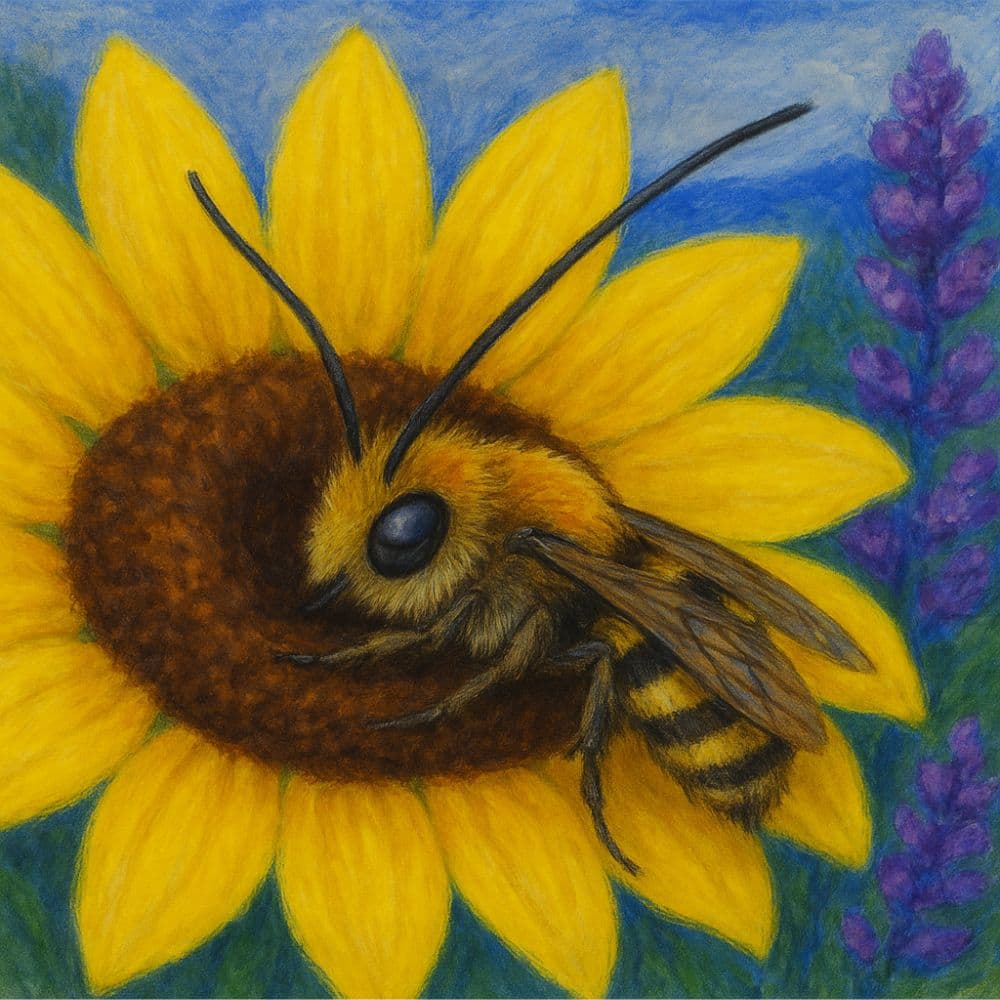
(Long Horned Bees Sleep Inside Flowers - And You Can See It Happen at Dusk)
Reading Time: 6 minutes
Last July, a friend texted me a photo at 8:45 PM: "Is this bee dead? Found him in my sunflower. Should I help?"
The photo showed a male long horned bee, antennae dangling, legs tucked, absolutely motionless inside a sunflower head.
"He's not dead," I texted back. "He's asleep. Go check your other sunflowers - you'll probably find more."
Five minutes later: "OH MY GOD THERE ARE SEVEN OF THEM. This is the cutest thing I've ever seen."
Welcome to the world of long horned bees - one of the most magical behaviors in the native bee world, something happening right now in gardens across North America that most people have never noticed.
Let me introduce you to long horned bees, the sunflower specialists who literally sleep on the job.
The Dusk Discovery That Changes Everything
Here's an observation challenge that will blow your mind:
On a warm summer evening, about 30 minutes before dark, walk out to any sunflowers, coneflowers, or mallow plants in your yard. Look closely at the flower heads.
You'll see bees. But these bees aren't moving.
They're gripping the petals or disk florets with their mandibles (jaws), legs tucked up, antennae drooping forward. They look like they're hugging the flower. Because they are. They're sleeping.
The first time I witnessed this, I thought something was wrong. These bees looked... too still. I gently touched one with a blade of grass. He shifted slightly, repositioned his grip, and went back to sleep.
I stood there for 20 minutes as the light faded, watching more males fly in and claim sleeping spots. Some flowers had three or four bees clustered together, all settling in for the night.
It was one of those moments where you realize there's an entire world of behavior happening around you that you've completely missed.
Meet the Long Horned Bees (And Those Impressive Antennae)
Long horned bees belong to the genus Melissodes, and there are about 120 species in North America. They're medium-sized, fuzzy bees that fly mid-summer through early fall - peak sunflower season.
Here's how to identify them:
The Antennae (The Giveaway) Males have extraordinarily long antennae - sometimes longer than their entire head and thorax combined. When they're flying, these antennae trail behind them. When they're sleeping, they droop forward like sleepy whiskers. This is the most distinctive feature.
Females have much shorter antennae (still longer than most bees, but not dramatically so).
Size and Build About the size of a honeybee, sometimes slightly larger. Robust, fuzzy bodies with dense hair on the thorax.
Color Most are tan, brown, or grayish with light-colored hair bands across the abdomen. Some species have greenish or bluish metallic tints. They're not as flashy as some native bees - more earth-toned and practical-looking.
Flight Pattern Fast and direct. Males often patrol flowers in a distinctive pattern, checking blossom after blossom rapidly.
Behavior This is the real identifier: if you see a bee sleeping in a flower at dusk, and it's a male with long antennae, you've found a long horned bee.
The first time you correctly identify one, you'll start seeing them everywhere. They're common, just overlooked.
Why Males Sleep in Flowers (And It's Not Just Convenience)
The sleeping behavior is specific to males, and there's a fascinating reason why:
Male long horned bees don't have nests.
Female long horned bees excavate burrows in the ground - often in bare soil, paths, or lightly vegetated areas. They provision cells, lay eggs, seal them up, and continue the cycle.
But males? They emerge from their mother's nest, spend their entire adult lives looking for females to mate with, and have nowhere to go at night. No nest. No home base. No safe shelter.
So they sleep where they forage: inside flowers.
There's actually an advantage to this strategy. By sleeping in flowers, males are in prime position when females arrive at dawn to forage. They wake up already at the breakfast buffet, ready to encounter potential mates.
I've watched this play out. As the sun rises and flowers start opening, the sleeping males wake up, groom themselves, and immediately start patrolling. Within minutes, females arrive to collect pollen. The males are already there, waiting.
It's efficient. It's strategic. And it's absolutely adorable to watch.
The Sunflower Connection (Specialists in a World of Generalists)
Long horned bees are often called "sunflower bees" because of their strong association with sunflowers and related plants in the Asteraceae family.
Here's what makes them special:
They're Oligolectic This means they specialize in a limited group of plants. While honeybees will visit dozens of different plant families, many long horned bee species focus primarily on sunflowers, coneflowers, asters, and mallow family plants.
They've Co-evolved Long horned bees and sunflowers evolved together. The bees' timing, tongue length, and behavior match perfectly with sunflower bloom times and flower structure.
They're Exceptionally Efficient Because they specialize, long horned bees are phenomenally good at pollinating their chosen plants. A sunflower visited by long horned bees produces more viable seeds than one visited only by generalist pollinators.
In my garden, I grow several varieties of sunflowers specifically to attract long horned bees. The 'Lemon Queen' perennial sunflowers are absolutely covered with them from July through September.
I've also found them on purple coneflowers, blanket flowers, black-eyed Susans, and wild mallows. Anywhere there are daisy-type flowers, long horned bees show up.
How to Find Sleeping Bees (Your Step-by-Step Guide)
Want to witness this magical behavior yourself? Here's how:
Timing Late summer evenings (July through September in most areas). Start checking about 30-45 minutes before sunset.
Location Focus on sunflowers (annual or perennial), coneflowers, asters, black-eyed Susans, and mallow plants. The larger the flowers, the easier it is to spot sleeping bees.
What to Look For Males gripping petals or center disk florets with their mandibles. Their bodies will be still, legs tucked, antennae drooping forward. They often hang upside down or at angles - wherever they managed to grab hold.
Multiple Bees Check several flowers. You'll often find multiple males sleeping in the same area, sometimes even in the same flower head.
Observation Protocol Don't touch them. They're sleeping and vulnerable. Just watch. Bring a camera if you want - this makes for stunning photos. The low evening light is perfect.
Morning Encore If you find sleeping bees at dusk, go back at dawn. Watch them wake up, groom, and start their day. It's equally magical.
I make this a ritual every summer. Around 8 PM on warm evenings, I walk through my garden checking flowers. It never gets old finding new sleeping bees.
The Other Long Horned Bee Species (It's Not Just Sunflowers)
While sunflower specialists get the most attention, there are long horned bees that specialize in other plant families too:
Mallow Specialists (Melissodes agilis and others) These focus on hibiscus, hollyhocks, and native mallows. If you have rose mallows or prairie mallows, watch for long horned bees in late afternoon.
Evening Primrose Specialists (Melissodes denticulata) These are active at dusk and dawn when evening primrose flowers are open. They'll sleep in the flowers overnight.
Generalist Species Some long horned bees visit a wider range of flowers but still show the characteristic sleeping behavior.
The key feature across all species is those long antennae on males and the sleeping-in-flowers behavior. Once you know what to look for, you can identify the genus even if you can't pin down the exact species.
Why This Matters (Beyond the Cute Factor)
Long horned bees sleeping in flowers is charming, yes. But there are bigger implications:
Pollination Specialists Are Vulnerable Because long horned bees depend on specific plant families, they're vulnerable when those plants disappear. Native sunflowers, asters, and mallows are declining in many areas. When the flowers go, the bees go.
Timing Matters Long horned bees emerge mid-to-late summer. If your garden only has spring flowers, you're not supporting these bees. They need bloom continuity through September.
Ground-Nesting Needs Female long horned bees need bare or lightly vegetated soil for nesting. Heavy mulch, solid lawns, and hardscaping eliminate nesting opportunities.
Pesticide Exposure Bees sleeping in flowers are especially vulnerable to pesticides sprayed at dusk or dawn. If you're seeing sleeping long horned bees, that's a powerful reason to avoid chemical sprays.
When you understand that those sleeping bees represent a critical pollinator for native wildflowers and crops, the behavior becomes more than cute - it becomes a conservation story.
Supporting Long Horned Bees (It's Easier Than You Think)
Want to help these sleeping beauties thrive? Here's what works:
Plant Their Favorites Sunflowers (any variety, but perennial 'Lemon Queen' and 'Maximilian' are outstanding), purple coneflowers, black-eyed Susans, native asters, hibiscus, hollyhocks, and prairie mallows.
Bloom Through Summer Make sure you have flowers blooming July through September. This is peak long horned bee season.
Leave Bare Soil Females need exposed soil for nesting. Leave some patches unmulched - sunny spots are ideal.
Skip the Pesticides Especially at dusk when males are settling in to sleep. They're vulnerable and exposed.
Protect Sleeping Sites If you find flowers with sleeping bees, avoid cutting those flowers until after dawn when the bees have woken up and left.
In my garden, I've stopped deadheading sunflowers and coneflowers in August specifically to preserve sleeping sites. The spent flowers look a little messy, but they're serving an important purpose.
The Magic of Seeing What's Always Been There
Here's what happened after I started looking for sleeping long horned bees:
I realized they'd been in my garden for years. I'd just never looked at the right time. I'd walk past my sunflowers during the day, completely unaware that every evening, they transformed into tiny bee hotels.
I started recognizing individual males by their sleeping spots. There was one male who claimed the same coneflower for five consecutive nights. Another who always chose the lowest sunflower in a cluster.
I became protective of those sleeping bees. When evening storms rolled in, I worried about them. When they were gone in September, I missed them.
Most surprisingly, I started telling everyone about sleeping bees. Friends, clients, strangers at the garden center. The reaction is always the same: disbelief, then wonder, then an immediate plan to check their own flowers at dusk.
That's the power of this observation. It's accessible, magical, and impossible to forget once you've seen it.
Going Deeper
Want to learn how to identify long horned bees from other look-alikes, understand their complete lifecycle, and discover the best plants to support them? That's exactly what I explore on The Secret Pollinators podcast.
Until next time - check your flowers at dusk. You might have houseguests you never knew about.
Kelly Parks Certified Pollinator Steward, Montana
Long Horned Bee Resources
Want to see sleeping bees? Check sunflowers and coneflowers 30-45 minutes before sunset in July through September.
Looking for ground-nesting sites? Leave some bare, sunny soil exposed. Avoid heavy mulch in potential nesting areas.
Have questions? Leave a comment - I read and respond to every one.
Thank you for reading!