
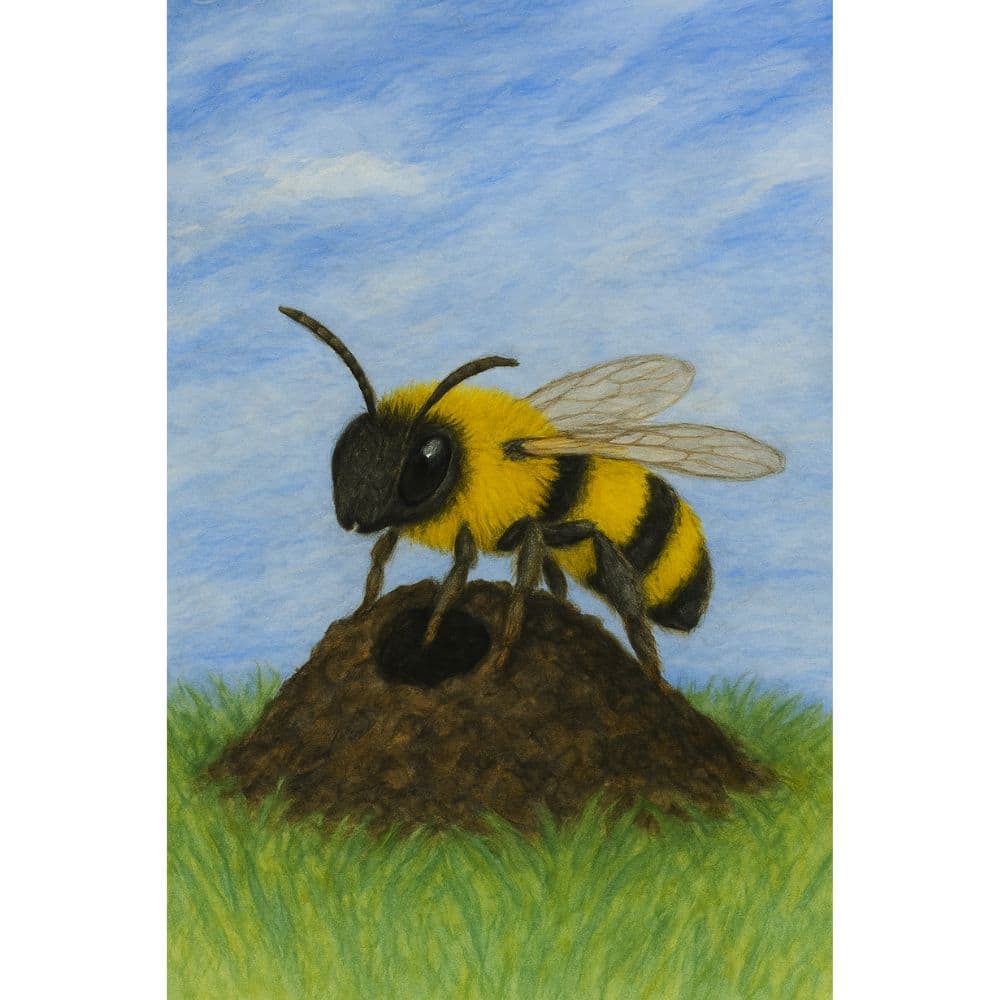
Those tiny holes appearing in your lawn this spring? Before you panic and reach for pest control, there's a 70% chance you're looking at the front door of one of North America's most important pollinators.
Mining bees—also called digger bees—are ground-nesting native bees that create small bur
rows in bare or sparse soil. Here's what most people don't know: 70% of native bee species actually nest underground. While honeybees get all the attention with their above-ground hives, most native bees are quietly raising their young in tunnels beneath our feet.
If you've noticed small mounds of soil with pencil-eraser-sized holes in your lawn or garden beds, you're witnessing one of nature's most beneficial behaviors.
What Are Mining Bees?
Mining bees belong primarily to the genus Andrena. With over 1,300 species in North America, they're one of the most diverse native bee groups on the continent.
Female mining bees dig underground tunnels, creating branching chambers where they provision each egg with pollen and nectar before sealing it up. Each female works alone (they're solitary bees), and each tunnel is her own independent nest.
How to recognize them:
Size ranges from 1/4 inch to 3/4 inch long
Often fuzzy with pale hair bands on the abdomen
Quick, darting flight close to the ground
Active early spring through summer
Individual holes with small dirt mounds nearby
How to Identify Mining Bees vs. Other Ground Insects
You see holes and think "pest problem." But knowing the difference matters—and it's easier than you think.
Mining bees are NOT:
Yellow jackets: Yellowjacket nests have constant traffic—dozens of wasps coming and going. Mining bee holes have just one female visiting periodically. Yellowjackets are smooth and shiny; mining bees are fuzzy.
Cicada killer wasps: These are huge (1.5+ inches) with much larger soil mounds, active mid to late summer. Mining bees are spring-active and much smaller.
Ants: Ant holes have fine, powdery soil with constant ant traffic. Mining bee holes have coarser particles and one solitary resident.
What confirms you have mining bees:
Activity during morning to mid-afternoon (mining bees are day-active)
Fuzzy, bee-shaped insects near holes
Females returning with visible pollen on hind legs or belly
Holes in well-drained soil with some sun exposure
Peak activity in spring (March-May for most species)
Quick confirmation: Sit quietly near the holes for 5-10 minutes in the morning. If you see a small, fuzzy bee flying in and out, you've got mining bees. They're surprisingly predictable once you know what to watch for.
The Secret Life Underground
Each female digs a main tunnel 6-12 inches deep with several side chambers branching off. It's exhausting work that can take several days. She makes dozens of flower trips to create a single pollen ball in each chamber—enough food to fuel one bee from egg to adulthood. Once provisions are ready, she lays one egg on top, seals that chamber with soil, and moves on to the next.
The lifecycle:
Early spring: Female emerges, mates, begins digging her tunnel
Spring/early summer: Provisioning and egg-laying (the visible activity you see)
Summer: Eggs hatch, larvae feed on stored pollen, develop into adults
Fall/winter: New generation remains underground in sealed chambers
Following spring: Cycle begins again when temperature and day length trigger emergence
The bees creating holes this spring are last year's daughters, waiting underground all winter for the right moment to emerge. This means every hole you see represents not just this season's nest, but potentially generations of mining bees returning to the same favorable location.
Why Mining Bees Are Beneficial (Not Pests)
Those holes represent free, expert pollination services for every flowering plant within a half-mile radius.
They're early emergers. Many species are active before honeybees in spring—crucial for early fruit trees (apples, cherries, plums) and spring vegetables. They might be responsible for a significant portion of your garden harvest.
They're efficient. Unlike honeybees (mainly after nectar), mining bees are serious pollen collectors. They're fuzzy, messy workers that crawl deep inside flowers—making them more efficient pollinators than honeybees for many crops.
They're harmless. Mining bees can technically sting but almost never do. They're gentle and non-aggressive. You can walk barefoot over their nests without issue. Males can't sting at all.
They're temporary. The holes appear in spring but by mid-summer, nesting is done. Your lawn returns to normal. It's typically a 4-8 week window of visible activity.
They improve soil. All that digging aerates your soil, improving drainage and root growth.
Why You Shouldn't Fill in the Holes
Filling in mining bee holes is:
Pointless - They'll just re-excavate
Harmful - You're burying baby bees alive if eggs are already laid
Shortsighted - You have native pollinator habitat, which is increasingly rare
The holes are temporary. The pollination benefits are permanent.
How to Support Mining Bees
If you want to support these underground pollinators—and improve pollination in your garden—here's what actually helps:
Leave bare ground. Mining bees need exposed soil to nest. This doesn't mean abandoning your whole yard—paths, edges of garden beds, south-facing slopes, and areas under trees where grass struggles anyway are perfect spots. Even a small bare patch can host multiple mining bee nests.
Skip dense, thick grass. Ironically, perfect lawns make nesting impossible. They prefer sparse grass or bare patches. Consider leaving some areas less intensively managed.
Reduce mulch coverage. Heavy mulch everywhere eliminates ground-nesting habitat. Leave some sections mulch-free where soil can warm in the sun. A 2-foot square of bare soil near flowers is more valuable than you'd think.
Avoid pesticides. Ground-nesting bees are especially vulnerable to lawn treatments that persist in soil. If you're treating for grubs or other lawn pests, you're also killing mining bees and their developing larvae underground.
Plant early-blooming flowers nearby. Create a pollinator garden with early spring flowers like crocuses, native violets, willows, and fruit tree blossoms near their nests. The closer flowers are to nesting sites, the more efficient their foraging becomes.
The best part? Mining bees will find suitable sites on their own if you simply make ground accessible. Unlike mason bees who benefit from bee houses, mining bees are particular about soil type, drainage, and sun exposure—they're better at choosing their own real estate than we are at creating it for them.
The Surprising Diversity of Mining Bees
There are over 100 species of Andrena mining bees in Montana alone, where I live. Some emerge when snow is still on the ground. Others nest in July. Some are tiny—barely 1/4 inch. Others are nearly an inch long.
This diversity means different species are active at different times, pollinating different flowers. You might have spring mining bees in April and completely different species in July—in the same lawn.
The size, color, timing, and flowers they visit all provide identification clues. (Want specifics? Our Native Bee Identification Guide has photos, range maps, and field marks for the mining bees in your region.)
What Those Holes Really Mean
If mining bees are nesting in your yard, your soil isn't too compacted, you're not using heavy pesticides, and there are enough flowers nearby that females decided your property was worth the investment.
That's worth celebrating.
A lawn full of small dirt mounds doesn't look like magazine perfection. But those wild, untidy spaces are where pollinators thrive, and a few temporary holes in exchange for robust pollination? That's a trade worth making.
Living With Mining Bees: Practical Tips
Mow as usual. The tunnels are underground—surface mowing doesn't harm them.
Water normally. Mining bees choose well-drained sites, so regular watering is fine.
Educate neighbors. Explaining they're temporary, beneficial native bees (not pests) usually helps with concerned neighbors or HOAs.
Document it. Taking photos of nesting activity can be fascinating. You'll start recognizing individuals and noticing their pollen loads—turning a "lawn problem" into an observation opportunity.
The Bottom Line
Mining bees are North America's hidden pollination workforce. They don't make honey or live in hives you can point to. But they're under your lawn, under your garden path, doing essential pollination work.
Those holes aren't damage. They're doorways to an underground nursery where the next generation of pollinators is being raised.
All they're asking: don't fill them in, don't spray them, and leave them a few flowers to visit.
That's a pretty good deal.
Want to learn more about the native bees in your yard? Check out our Native Bee Identification Guide with photos, field marks, and identification tips for 50+ species. And if you enjoyed this post, subscribe to The Secret Pollinators podcast, where we explore the fascinating lives of the 99% of bees that don't make honey.
Have mining bees nesting in your yard? I'd love to hear about it!
Thank you for reading!