Reading Time: 5 minutes
You're working in the garden on a hot summer day. Suddenly, a tiny insect lands on your arm. It's attracted to your sweat.
Your first instinct? Probably to swat it away.
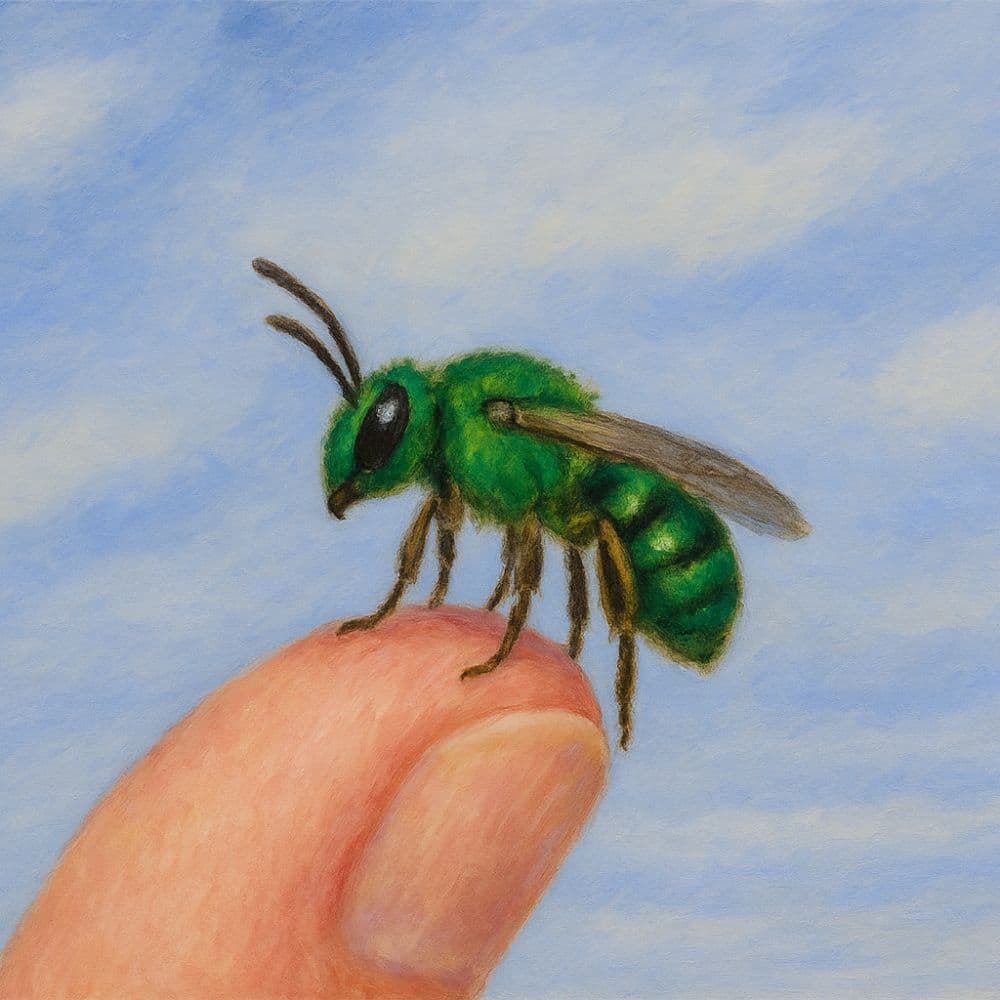
But wait - take a closer look before you do. If it's iridescent green or blue, about the size of a grain of rice, and seems more interested in your perspiration than stinging you... congratulations! You've just met one of North America's most underappreciated pollinators: the sweat bee.
And despite the slightly off-putting name, these tiny metallic jewels are absolutely fascinating.
What Even IS a Sweat Bee?
Sweat bees belong to the family Halictidae, and North America has over 500 species. They range from:
Tiny (2-3mm - smaller than a grain of rice)
Small to medium (4-10mm - about the size of a housefly)
Colors from metallic green and blue to copper, black, or even striped like miniature honeybees
The ones people notice most are the metallic green ones - they look like flying emeralds when the light hits them right.
Why Are They Called "Sweat Bees"?
Here's the thing that freaks people out: some species are attracted to human perspiration. They're seeking the salt and moisture.
On a hot day in my Montana garden, I'll have 2-3 sweat bees land on my arms while I'm weeding. They'll walk around, seemingly tasting my skin, then fly off. It's weird at first, but once you know they're harmless, it's actually kind of endearing.
They're not trying to bite you. They're not aggressive. They're just... thirsty, basically. And a little salty snack never hurt.
The Sting Question Everyone Asks
Yes, female sweat bees CAN sting. They have stingers.
BUT - and this is a big but - sweat bee stings are:
Extremely rare (they're among the least aggressive bees)
Very mild (rated 1.0 on the Schmidt Sting Pain Index - the lowest possible score)
Described as "a tiny spark" or "like a brief pinprick"
Almost always accidental (you'd have to trap or squeeze one)
For reference, a honeybee sting is rated 2.0, and a yellowjacket is 2.0-3.0.
I've had sweat bees land on me hundreds of times. Never been stung. Not once. And I'm someone who works in the garden in shorts and tank tops all summer.
The danger level? Approximately zero.
Why These Tiny Bees Matter So Much
Here's what most people don't realize: sweat bees are essential pollinators of native wildflowers, vegetables, and fruits.
Despite their tiny size, they're extremely efficient pollinators because:
They Work Early and Late
Many sweat bee species are active early in the morning and late in the evening when other bees have called it quits. They're out there working when temperatures are cooler, extending the pollination window.
They're Native Specialists
Unlike honeybees (which are European imports), sweat bees co-evolved with North American native plants. They've been pollinating our ecosystem for millions of years. They know exactly when to emerge, which flowers to visit, and how to work them efficiently.
They're Everywhere
Sweat bees are one of the most abundant bee groups in North America. If you have native flowers, you have sweat bees - you just might not have noticed them because they're so small.
They Pollinate Your Garden Vegetables
Sweat bees are excellent pollinators of:
Tomatoes
Peppers
Cucumbers
Squash
Strawberries
Stone fruits
And dozens of native wildflowers
That perfect heirloom tomato? Thank a sweat bee.
The Metallic Green Ones Are Just the Beginning
Most people only notice the bright metallic green sweat bees (usually Agapostemon species). But the family includes incredible diversity:
Pure Metallic Green Bees (Agapostemon)
Head to toe iridescent green
Medium-sized for sweat bees
Males and females both metallic
Absolutely stunning in sunlight
Green Head, Striped Body (Agapostemon females of some species)
Metallic green head and thorax
Black and white striped abdomen
Look like tiny jeweled bumblebees
All-Black Sweat Bees (Lasioglossum)
Small and dark
Often mistaken for flies
Incredibly common but overlooked
Some of the most important native pollinators
Copper and Bronze Species
Metallic copper or bronze coloring
Look like flying pennies
Less common but spectacular
In my garden, I've identified at least 6 different sweat bee species. Most people would walk right past them and see "nothing."
How Sweat Bees Live
Here's what makes sweat bees even more interesting: they have diverse social structures.
Some species are:
Solitary - One female, one nest, no helpers. She does everything herself.
Communal - Multiple females share a nest entrance, but each provisions her own cells. Like roommates with separate bedrooms.
Semi-social - Some females work together, but there's no clear queen. More like a collective.
Eusocial - A few species have true queens and workers, like honeybees (but way smaller and less organized).
This diversity is fascinating from an evolutionary perspective. Scientists study sweat bees to understand how social behavior in insects evolved.
Where They Nest
Most sweat bees are ground nesters. They dig small burrows in:
Bare soil (compact but workable)
Between paving stones
Edges of lawns
Garden beds before mulch gets applied
South-facing slopes and banks
The entrance holes are tiny - about the diameter of a pencil lead. You could have hundreds of sweat bee nests in your yard and never notice them.
How to Identify Sweat Bees
Size Check: Small! Usually 5-10mm long. If it's bee-shaped but housefly-sized, it might be a sweat bee.
Color Check:
Metallic green, blue, copper, or bronze = probably a sweat bee
All black but very small = possibly a sweat bee
Striped but tiny = maybe a sweat bee
Behavior Check:
Visiting tiny flowers that bigger bees ignore
Landing on your sweaty skin
Multiple bees going in and out of pencil-sized holes in the ground
Working flowers early morning or evening
The Definitive Test: Take a photo and zoom in. If it has a metallic sheen and delicate features, you've got a sweat bee.
Why You Should Love Them (Even If They Land on You)
I'll be honest: the first time a sweat bee landed on my arm, I was weirded out. It felt invasive.
But then I learned:
They're gentle. They're not out to hurt you. They're just... checking you out.
They're beneficial. They're pollinating your garden, asking for nothing in return except some flowers and bare ground.
They're beautiful. Once you see a metallic green sweat bee in good light, you can't unsee how stunning they are.
They're everywhere. Noticing sweat bees means you're suddenly aware of pollinators you walked past your entire life.
Now when sweat bees land on me, I say hello. Sometimes I watch them walk around. They're so tiny and delicate, with their little antennae twitching, their wings folded neatly on their backs.
Adorable? Maybe I'm biased. But yeah, I think they're adorable.
How to Support Sweat Bees
Leave Some Bare Ground
The #1 thing you can do: stop mulching everything. Sweat bees need exposed soil to nest. Leave some areas bare - edges of garden beds, between stepping stones, a small south-facing patch.
Plant Small Native Flowers
Sweat bees love:
Asters
Goldenrod
Coneflowers
Black-eyed Susans
Native mints
Sunflowers
They visit larger flowers too, but tiny flowers (like asters) are perfectly sized for their small bodies.
Avoid Pesticides
Sweat bees are small, which makes them especially vulnerable to insecticides. If you spray, you're likely killing dozens of sweat bees without ever knowing they were there.
Don't Swat When They Land
I know it's tempting. But they're not going to hurt you. Let them take a quick salt break and fly off. You're helping a hardworking pollinator, and you get to observe an incredible tiny creature up close.
The Bottom Line
Sweat bees aren't scary. They're not dangerous. They're not pests.
They're tiny, metallic, efficient native pollinators doing essential work in your garden.
The next time one lands on your arm, take a breath. Look closely. Notice the metallic sheen, the delicate legs, the way it's just... being a small creature trying to survive in the world.
Then watch it fly away to visit another flower in your garden - a garden it's helping pollinate, one tiny visit at a time.
That's not annoying. That's actually kind of amazing.
Going Deeper
Want to learn how to identify more native bee species and create habitat that supports the full diversity of pollinators? The Secret Pollinators podcast explores the fascinating world of native bees, from tiny sweat bees to massive carpenter bees.
Until next time - keep your eyes open. The secret pollinators are everywhere.
Kelly Parks
Certified Pollinator Steward
Montana
More Native Bee Resources
Ready to create habitat for ground-nesting bees? Learn how to provide nesting sites while keeping your garden looking intentional.
Have questions? Leave a comment - I read and respond to every one.
Thank you for reading!