
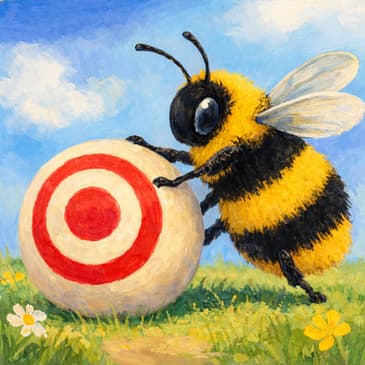
What happens when a scientist hands a bumblebee a wooden ball and a target — and offers a drop of sugar as the prize? She scores a goal. In 2017, researchers at Queen Mary University of London discovered that bumblebees could learn to roll a ball to a target by watching another bee do it first — and then improve on what they saw. With brains smaller than a sesame seed, these tiny athletes showed a level of social learning and cognitive flexibility that stunned the scientific world. But the most surprising discovery? Some bees kept rolling the ball even when no reward was coming. That's where this story gets really interesting. Tune in for Part 1 — and stay for the twist that launched one of the most fascinating bee studies ever published.
Here is the link to the article:
Are these bumble bees playing with toys? | Science | AAAS
#Bumblebee #BumblebeeScience #BeeCognition #BeeFacts #NativeBees #BeeResearch #BeeLovers #SaveTheBees #PollinatorScience #PollinatorProtection #Pollinators #InsectIntelligence #InsectBehavior #AnimalCognition #AnimalBehavior #AnimalPlay #SocialLearning #CognitiveFlexibility #LarsChittka #OlliLoukola #QueenMaryUniversity #QMUL #SecretPollinators #NaturePodcast #SciencePodcast #NatureLovers #EntomologyNerd #Entomology #TinyBrainBigMind #MindBlown #DidYouKnow #ScienceIsAmazing #UnexpectedNature #soccer #cognativeflexibility
About Secret Pollinators
A wonder-first science podcast about native bees, bumblebees, wild bees, and the lesser-known pollinators most of us walk right past every day.
Visit secretpollinators.com
Speaker A: Picture this.
A tiny, fuzzy bumblebee,
you know, about the size of your thumbnail,
is standing in front of a small wooden ball,
and the ball is roughly twice the size of her head.
There's a circular target on the floor that's about 4 inches away.
And somewhere nearby,
a scientist is holding their breath.
The bee looks at the ball and she maneuvers it around.
She pushes,
the ball rolls.
It hits the target,
and she gets a sip of sugar water.
She just scored a goal.
Welcome to Secret Pollinators.
I'm Kelly Parks, and today we're going to talk about the moment scientists discovered that bumblebees with brains smaller than a sesame seed can learn to play a game not by instinct,
not by accident,
but by watching someone else do it first.
So hold on to that, because at the end of this episode,
I promise you, your relationship with every fuzzy bumblebee you ever see will be permanently changed.
Setting the who are these researchers?
Well, let's start with the lab where this story begins.
Queen Mary, University of London Professor Lars Chitka's research group.
If you follow insect cognition research at all, which, I mean,
I don't know who does besides me,
you've probably heard Chitka's name. He's one of the leading figures in the world studying how bees think,
learn, and perceive the world around them.
In 2017,
his team published a study in the journal Science.
The lead author was a Finnish researcher named Ollie Lukula.
And the question they set out to answer honestly sounds almost absurd when you say it out loud.
Can a bumblebee learn a new skill by watching another bumblebee demonstrate it?
Not by trial and error and not by instinct, but by social observation.
And here's why that matters.
We've known for a long time that bumblebees are capable learners.
I mean, they can figure out how to work a flower,
navigate back to the nest,
communicate about food sources.
But those skills are built into them over evolutionary time.
The question Lucola was asking was different.
Could a bee learn something completely outside her normal behavioral toolkit,
something she would never encounter in nature,
just by watching the experiment?
So how do you. Do you teach a bee,
a bumblebee, to score a goal?
Okay,
here's the setup, and I just, I love the elegance of it.
The researchers built a small arena, and in the center, they placed a yellow ball about the size of a large marble.
At the edge of the arena, there was a circular target zone.
If the bee could somehow move that ball to the target,
which is like roll it across that arena floor,
she would receive a reward,
which was a small drop of sugar solution.
Now,
before we go any further,
I need you to understand something. Ball rolling is not in a bumblebee's behavioral repertoire. I mean,
that's not something they normally do. They manipulate flowers. They collect pollen and nectar.
They can even do buzz pollination.
They build waxy cells in their nests, you know,
but they do not, under normal circumstances,
pushed round objects across flat surfaces for fun.
So how do you even get them started?
Well, the team used three different groups of bees to test different ways of learning the task.
The first group,
and we'll call them the observers,
they watched a demonstrator bee, which is, you know, one that had already been trained,
roll the ball to the target and receive the reward.
They watched through a transparent barrier.
The second group found the ball already positioned at the edge of the target when they entered,
which was basically a shortcut that showed them the connection between ball near target and reward.
And the third group were the control bees.
They were put into the arena or soccer or mini soccer field, like I like to think, with no demonstration, no shortcuts,
just to be a ball and a puzzle.
The observers, you know, the ones who watched that demonstrator,
they learned the task significantly faster than the other groups.
They figured out what to do with that ball almost immediately.
The control Bs were. Well, some of them did eventually move the ball,
but it took far longer, and some never managed at all.
And what that tells us is that bumblebees aren't just mechanically copying each other.
They're watching,
processing, and applying what they observed to a novel situation.
And guess what? That's cognitive flexibility,
which is a form of social learning that until very recently,
no one believed insects were capable of.
The twist that changed everything.
Now,
here's where the story takes a turn that nobody expected.
While Lucullo and his team were running the experiments,
while they were carefully tracking which bees learned from demonstration and, you know, which learned from shortcuts and which couldn't figure it out at all,
they noticed something.
Some of the bees were rolling balls when the experiment wasn't running.
No reward,
no researcher watching with a clipboard,
and no sugar solution waiting at the target.
Just a bee rolling a ball for apparently no reason whatsoever.
Now,
as a scientist,
I would think you have two ways to respond to that observation.
You can file it under weird anomaly, move on,
or you can ask,
what if this means something?
And I'm pretty sure you all know which one, I would do.
So one of the people in the lab who could not Let it go was, bless her heart, was a master's student named Samadhi Galpayaj.
I hope I pronounced her name properly.
She's so wonderful.
She would later describe the bee's behavior as mind blowing.
And she said she couldn't help falling in love with them.
She stayed on to do her Ph.D. and that Ph.D. became one of the most fascinating pieces of bee research published in the last decade.
But that is part two,
the next episode of this series.
So what does this tell us about bee cognition?
Before we get there, I want to sit with what the 2017 soccer study actually reveals about the bumblebee mind,
because I think we sometimes skim past the implications too quickly.
Way too quickly.
First,
bumblebees can solve problems they've never encountered before.
The ball rolling task is completely alien to their natural experience.
And yet,
when given the right information,
watching a peer do it, they figure it out.
Second,
they show what researchers call cognitive flexibility.
In the study,
something really remarkable happened when observers watched a demonstrator be rolling a ball from a greater distance than was strictly necessary,
and then were given the chance to do it themselves.
They often found a more efficient route.
Believe it or not,
they moved the ball from closer to the target than the model B had.
And that just. That's incredible.
So they didn't just copy,
they improved.
Third,
and this is the one that keeps me up at night because,
you know, these things do.
The social transmission of this skill happened quickly and reliably.
A native bee watched a trained bee for a few minutes,
and that was enough to unlock a brand new behavior.
I mean, imagine what that means for how behavior spread through a colony and even through a population.
Lars Chitka has spent his career making the case that insect mind is vastly more sophisticated than our assumptions have allowed.
The bumblebee brain has roughly 1 million neurons compared to our 86 billion.
And yet bees navigate, communicate,
learn, remember,
and as we're about to discover, apparently play 1 million neurons doing things we barely understand.
So the bees, the bumblebees in Luculla's study were motivated by sugar.
They learned because there was something in it for them.
I mean,
I could say the same thing about myself because I love chocolate and I'm highly motivated by it.
But what do you need or what do you make of a bee who rolls a ball when there's nothing in it for her?
No sugar,
no target,
no one watching, just rolling?
Well,
that PhD student couldn't let it go.
And what she found is the kind of science that quietly rearranges our worldview.
And, of course, that's part two.
Bumblebee.
Who rolled a ball 117 times for fun,
Just for the pure joy of it.
So until then, go find a bumblebee,
watch her work a flower,
and wonder what's going on behind those compound eyes.
Thank you so much for listening. I'm Kelly Parks, and this has been the Secret Pollinators.
Until next time, part two.