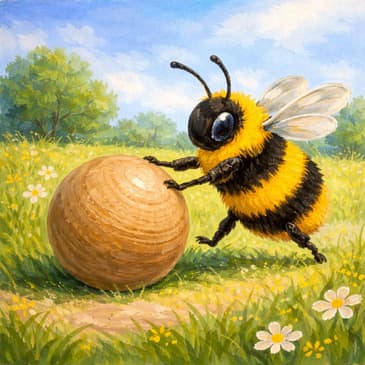
One bumblebee. One wooden ball. One hundred and seventeen times - with no reward, no training, and no reason anyone could explain. In Part 2 of our bumblebee play series, we follow PhD student Samadi Galpayage, who couldn't stop thinking about the bees she'd watched rolling balls for no apparent reason. What she discovered - published in the journal Animal Behaviour in 2022 — became the first scientific proof that insects play. Not for food. Not for survival. Just for the joy of it. We dig into what that means for how we understand bee emotion, insect sentience, and the surprisingly blurry line between creatures that feel and creatures we've always assumed don't. If this episode doesn't change the way you look at the next Bumblebee you see, nothing will.
Galpayage Dona, H.S., Solvi, C., Kowalewska, A., Mäkelä, K., MaBouDi, H., & Chittka, L. (2022). Do bumble bees play? Animal Behaviour, 194, 239–251
#Bumblebee #BumblebeePlay #BumblebeeScience #BeeCognition #BeeFacts #NativeBees #BeeResearch #BeeLovers #SaveTheBees #PollinatorScience #PollinatorProtection #Pollinators #InsectSentience #InsectIntelligence #InsectBehavior #AnimalPlay #AnimalEmotion #AnimalCognition #AnimalBehavior #DoInsectsFeel #SamadiGalpayage #LarsChittka #QueenMaryUniversity #QMUL #AnimalBehaviour #SecretPollinators #NaturePodcast #SciencePodcast #NatureLovers #EntomologyNerd #Entomology #TinyBrainBigMind #117Times #PlayingForJoy #MindBlown #DidYouKnow #ScienceIsAmazing #UnexpectedNature
About Secret Pollinators
A wonder-first science podcast about native bees, bumblebees, wild bees, and the lesser-known pollinators most of us walk right past every day.
Visit secretpollinators.com
Speaker A: The last episode, I left you with a question.
A bumblebee.
A wooden ball,
no sugar, waiting at the target.
No researcher with a clipboard, no reason in the world to do what she was doing.
And yet that bumblebee,
she rolled that ball anyway.
I told you. A master's student named Samadhi Gal Piage couldn't let that go.
And she stayed on to do her PhD because of it.
Well, today we find out what she discovered.
Welcome back to Secret Pollinators. I'm Kelly Parks, your host,
and this is part two.
The bumblebee who rolled a ball 117 times. For fun,
just for the joy of it.
The woman who fell in love with bumblebees.
I want to start with Samadhi because her story matters to this one.
She was a master's student in Lars Chitka's lab at Queen Mary University of London,
the same lab behind the 2017 soccer study we talked about last episode.
She was there to study bee cognition.
She was not there to fall in love.
But she watched a bumblebee roll a ball for no reason.
And she described it later as mind blowing.
She said she couldn't help falling in love with them.
And that's not the language of detached scientific observation, by the way.
That's someone who looked at a tiny insect doing something completely unexpected and thought,
there's more here going on than we understand.
Well, she stayed for her PhD and she built an experiment to find out what she'd seen.
Well, if it was real,
I find that kind of scientific obsession deeply relatable.
20 some years of watching native bees,
particularly native bumblebees, will do the same thing to you.
You stop seeing insects and start seeing individuals.
You notice the ones who take the long way back to the flower,
the ones who seem to linger.
And it really makes you start wondering.
The experiment proving play is real.
So here's what Sam and D designed.
She built what later described as a single story apartment for the bumblebees.
An arena connected to a feeding area with a corridor in between.
And in that corridor, colorful wooden balls, Yellow ones, purple ones, plain ones,
scattered around, twice the size of a bee's head.
Now, the bees didn't have to interact with the balls at all.
There was a clear, unobstructed path to food.
The balls were just there.
Over 18 days,
she watched what happened.
45 bees.
And they went out of their way,
which means they left the direct path,
entered the ball zone, and rolled.
And some of them did it once, some of them did it. A handful of times and one bee,
117 times.
Yes. The same bumblebee,
the same balls. 18 days, 117 times.
That is mind blowing.
Now, you might wonder,
well, maybe they thought the balls were food,
and maybe they were moving them out of the way.
And the researchers had thought of that,
but the balls were inedible.
The path to food was always clear.
Rolling a ball never at any point produced a reward,
and those bumblebees kept doing it anyway.
So that rules out foraging, and that rules out nest clearing behavior.
It rules out mating.
And under the scientific criteria researchers used to define play,
which is, you know, voluntary, spontaneous, repeated,
no immediate function, While those bumblebees checked every box.
The first insects ever documented in object play,
the chamber color experiment,
proving it felt good.
Well, sameity wasn't done,
because showing that bees roll balls for no reason is, well, fascinating,
but showing that they want to is something entirely different.
She ran a second experiment with a group with a different group of bees,
42 of them.
She gave them access to two chambers.
One chamber always had movable balls,
and the other never did.
The bees could go wherever they wanted.
After a while, she tested them.
She presented both chambers again, but this time, neither one had balls in it.
She just painted them different colors so she could track which one each bee chose.
Well, the bumblebees chose the color associated with the balls about a third more often than the other color.
Then she reversed the colors and ran it again.
Same results.
What that means is the bumblebees had formed a positive association with the place where the ball rolling happened.
I think it sounds like soccer fans, don't you?
They even preferred it when there was nothing there.
The behavior itself had been rewarding.
Not the outcome,
not a treat, waiting at the end,
Just simply the act of rolling the ball.
And that is the neuroscience of pleasure expressed in an insect.
Young bees play boar.
So do male bees.
Sound familiar?
Here's where it gets even more interesting.
Younger bees rolled more balls than older bees.
Significantly more.
And male bees rolled them longer than females.
And if you know anything about play behavior in the animal kingdom, those two findings will give you a jolt of recognition.
Young mammals play more than adults.
It's how developing brains build neural connections,
strength and coordination.
Rehearse for the future.
And in many species,
males play more than females, partly because females have more functional demands on their time.
Well, the bumblebee data mirrors that pattern almost exactly.
Now,
the researchers are careful here, and I want to be, too.
Correlation isn't causation.
We don't know yet. Whether young bees roll balls because their brains benefit from it or for some other reason entirely.
But what we do know is the pattern looks remarkably familiar.
And that's the thing about this research that keeps pulling me back.
I mean, it's not just that bees do something unexpected.
It's that the more we look,
the more patterns rhyme with patterns we recognize from our own biology,
from animals we've always assumed were more like us.
And maybe the question was never whether bees or bumblebees are like us, but maybe the question is why we assumed they weren't.
What does this mean?
Well, let's start with a big question for a minute.
If bumblebees play,
which you know is voluntary,
repeatedly,
for the intrinsic reward of it,
what does that imply about what they experience?
And play, by the scientific definition,
requires that the behavior be rewarding in itself.
Not useful or strategic or anything else, but just good.
Which means if bees play, bees experience something we'd have to call positive emotion.
Lars Chicka's lab had actually laid groundwork for this before the place study.
Earlier research showed that bumblebees in a positive emotional state after receiving an unexpected sugary treat,
responded to ambiguous cues more optimistically.
I probably would too, if I was given chocolate.
Anyways, they were more likely to approach uncertain situations,
more likely to bounce back after a scare.
And that's not a reflex, that's a mood.
And Chick has been making this case for years that the insect mind is not a simple input output machine.
That somewhere in that 1 million neuron brain,
something like experience is happening.
And this matters way beyond the science.
And the researchers even said it themselves. If the insects are capable of feeling,
that has ethical implications for how we treat them,
for how we think about pesticides, habitat destruction,
the casual swatting of someone or something we've always assumed didn't mind.
I spent over two decades advocating for native bees and particularly bumblebees. And I'll be honest,
even I had to reckon with this research,
because there's a difference between knowing bumblebees are ecologically essential and knowing that a bumblebee might roll a ball 117 times just because it feels good.
One of those is about what bumblebees do for us,
and the other is about who they are.
A bumblebee with the brain the size of a grain of sand,
rolling a wooden ball across the floor for the hundredth time,
with no reward coming and no instinct driving it, and no survival advantage to speak of, just rolling.
I don't know exactly what that bumblebee was experiencing.
And neither does Samadhi Galpaige.
Neither does Lars Chitka,
and he spent his career on this question.
But I know what the data shows.
Voluntary, spontaneous,
rewarding, repeated.
I mean,
those are the same words that we use for a child with a toy or a dog with a ball or a crow dropping pebbles off a roof just to watch them fall.
We used to draw a bright line between creatures that experience the world and creatures that simply move through it.
And that line has been getting blurry for a while now.
And somewhere in a London lab,
a tiny, fuzzy bumblebee with a wooden ball moved it a little further.
So I implore you, go find a bumblebee and watch her for a few minutes.
And this time, you know,
don't just see the pollination,
see the bumblebee.
Truly,
they are amazing creatures,
and I'm just completely addicted to watching them.
I spend so many hours watching bumblebees on my ranch, and it's just. It's.
It's a little crazy, but they're fascinating,
and they are really kind of like little individuals.
Well,
thank you for listening.
I hope you learned something, and I hope you share it with your friends,
because I think bumblebees are really important, and we're learning a lot about them.
So this has been the Secret Pollinators podcast, and. And I'm your host, Kelly Parks,
and we'll see each other next time.
Have a great day.