🎉 Featured in Ceramics Now Magazine! The article companion to this episode was just published at ceramicsnow.org
The First Ceramicists: When Bees Taught Us About Clay is live now in Ceramics Now Magazine. Read it here: https://www.ceramicsnow.org/articles/the-first-ceramicists-ancient-clay-structures-built-by-bees/
Discover how ground-nesting bees have been master ceramicists for 100 million years—long before humans learned to work with clay. In this episode, Kelly Parks explores recently discovered 20,000-year-old fossilized bee nests found in a Dominican cave, revealing how native bees select materials, manage moisture, and engineer durable clay structures. Learn what Indigenous communities have always known about the bee-clay connection, plus practical tips for supporting ground-nesting pollinators in your garden. Perfect for nature lovers, gardeners, ceramic artists, and anyone curious about biomimicry and sustainable craft practices.
#CeramicsNow #CeramicsNowMagazine #PublishedArtist #CeramicsCommunity #ArtPublication #NativeBees #Pollinators #GroundNestingBees #PollinatorConservation #SaveTheBees #Ceramics #Pottery #ClayArt #Biomimicry #TraditionalEcologicalKnowledge #IndigenousWisdom #SustainableArt #NatureEducation #BeeFacts #Paquime #Ancients #Incas #Aztecs #Secretpollinators
About Secret Pollinators
A wonder-first science podcast about native bees, bumblebees, wild bees, and the lesser-known pollinators most of us walk right past every day.
Visit secretpollinators.com
Speaker A:
Welcome back to Secret Pollinators.
I'm Kelly from Montana and New Mexico, as you learned in the last episode,
and this one is going to be a short episode today because I wanted to tell you about my article that just went live in Ceramics now magazine and I'm so excited about it.
And I hope you go and read it after you listen to this.
It's called the First Ceramicist When Bees Taught Us About Clay.
And it starts with something that stopped me cold.
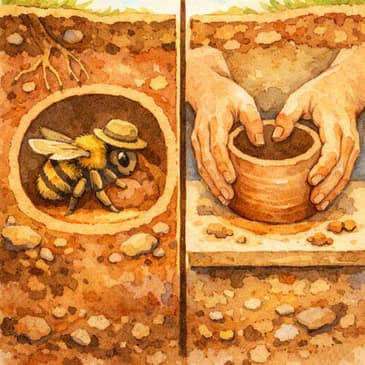
Paleontologists crack open an ancient rodent jawbone in a Dominican cave and find tiny clay nests inside the empty tooth sockets.
If you can believe that.
Well,
those clay nests were built by solitary bees 20,000 years ago.
Smooth walls, multiple layers,
waterproofed with waxy secretions.
And CT scans show six generations of bees returning to the same tooth socket,
rebuilding every time.
And that kind of reminds me of some of these ancient civilizations that we're learning about, like the ones at Pakim in the Chihuahua Desert region. And even the Aztecs and the Incas,
they build upon older sites just like bees.
And that's just the beginning.
The oldest bees nest on record are from Patagonia. Over 100 million years ago,
bees were working clay before flowering plants even looked the way they do now.
We like to think of pottery as a human achievement,
but we're really the newcomers.
Bees,
and native bees in particular had a hundred million year start.
That's crazy.
And as someone who works with clay myself writing this article, it genuinely shifted how I think about the material.
And there's also a section on indigenous knowledge that people that understood the B clay connection long before Western science did.
And that part you need to read yourself. It's really interesting because I can't do it justice in a couple of minutes.
So the link to the article in Ceramics now is in the show notes. So please go click on it and read it and share it with someone who works with their hands.
Until next time,
keep watching the secret pollinators.